By Dunbar and Math Boy
(From Blackjack Forum Vol. XIX #3, Fall 1999)
© 1999 Blackjack Forum
Introduction
In the world of blackjack, the risk of ever going bust when starting with a fixed bankroll and a fixed game is well known. The formulas for predicting fluctuation and the risk of ruin in blackjack can be extended to any game where there is only one payout for winning bets. However, there are a multitude of games for which the risk of ruin (“RoR”) is not well understood. For games like video poker, Caribbean stud with high jackpots, certain advantageous slot machines, state lotteries with large payouts, and similar games little has been written. With this article we hope to remedy this situation.
With video poker and other lottery-type games, the large jackpot creates a substantial skew in the distribution of possible outcomes. This is very different from blackjack, where the payoffs are roughly the same size as the bets, and the possible outcomes from a single event are roughly symmetric. How can we calculate the risk of ruin for these lottery-type games?
The Risk Of Ruin Equation For One Lopsided Game
A few months ago, a Russian mathematician, Evgeny Sorokin, posted a remarkable solution to this problem on the website, bjmath.com. For an example that illustrates Sorokin’s solution., say we are playing this simple game: We bet $1 with the following possible results:
75% of the time we lose $1,
24.99% of the time we win $1,
and 0.01% of the time we win $5101.
Our expectation, or ev is:
75% x (-1) + 24.99% x (+1) + 0.01% x (+5101) = 1%
How much money do you think it would take to play this +1% ev game so that the risk of losing your entire bankroll was just 5%? Would $10,000 be enough? $100,000? Nope, still not enough.
We want to know the risk of ruin for various bankrolls. But what happens if we start with exactly $1? Our risk of ruin will be high, of course, but how high?
If we start with $1, we will be wiped out 75% of the time after the first round. So our risk of ruin is 75% plus the chance that we eventually get wiped out even after we win our first bet. We can write that as follows:
RoR = 75% + 24.99% x (risk of losing $2) + 0.01% x (risk of losing $5102) [1]
But how do we calculate the chance that we get wiped out after winning our first bet? Here’s how: Consider the 24.99% of the time that we win $1 Now our “bankroll” is $2. If we designate the risk of ruin for losing $2 as R(2), and the risk of losing $1 as R(1), then
R(2) = R(1) x R(1). [2]
This is just like saying that the probability of flipping 2 heads is ½ x ½ = ¼ . We want to know the probability of losing a $1 “bankroll” and then losing another $1 “bankroll.” Since the events are independent, we multiply the probabilities, just as with a coin-flip.
And what about the 0.01% of the time that we are lucky enough to win $5101 on the first round? Then our bankroll is $5102, and we need to know the risk of losing $5102. The risk of losing $5102 is the same as the risk of losing a $1 bankroll 5102 times in a row. We just multiply R(1) by itself 5101 times to conclude
R(5102) = R(1).5102 [3]
Let’s rewrite [1] as R(1) = 75% + 24.99% x R(2) + 0.01% x R(5102). Using [2] and [3], this becomes:
R(1) = 75% + 24.99% x R(1)2 + 0.01% x R(1).5102 [4]
Now all we have to do is find the value of R(1), between 0 and 1, which makes the left and right hand sides of [4] equal. That may look difficult, but it is an easy problem for any spreadsheet like Excel. The solution is R(1) = 99.999221%.
Now we can get the RoR for any bankroll. For $10,000,
R(10,000) = R(1)10,000 = 0.9999922110,000 = 92.5%
We can also answer the question we posed earlier: How much bankroll does it take to reduce the risk of ruin for this game to 5%? We’ll use a general expression for [2] and [3] which is good for any game,
R(b) = R(1).b [5]
In our case this becomes 5% = (99.999221%)b, and all we have to do is solve for “b”.
Taking logarithms, ln(5%) = b x ln(99.999221%). Solving this equation for b, we have that b = ln(5%) / ln(99.999221%) = $384,787. This is the answer to our earlier question; it takes $384,787 to play this game with a 5% RoR.
Once you know R(1), you can get the risk associated with any bankroll by using [5]. And you can get the bankroll, b, necessary for a desired risk level from:
b = ln(desired risk level) / ln(R(1)). [6]
The General Risk Of Ruin Equation For Games Like Video Poker
We can generalize [4] to other games. In general, the risk of losing a 1 unit bankroll in a game like video poker is:
R(1) = E [pi x R(zi)] [7].
In [7], R(zi) is the risk of losing a bankroll of size zi. Each zi is the payoff on outcome i which occurs with probability pi. For example, in full pay Deuces Wild video poker, there are 11 types of hands in the payoff schedule ranging from nothing to a royal flush. (see Table 1) Each summed term in [7] would refer to one hand in the Deuces Wild payoff schedule. For example, the 11th type of hand in the Deuces Wild payoff schedule would be a royal flush, and z11 would equal 800. Then p11 would be the probability of getting a royal flush; which will depend on the strategy you use. The value shown in Table 1, 0.0000221, is for perfect play, as listed in Dan Paymar’s Video Poker–Optimum Play (1998).
| Table 1. DEUCES WILD PAYOFF SCHEDULE | |||
| Hand | Payoff | Probability | |
| Zi | Pi | ||
| 1 | Non-winner | 0 | 0.5468 |
| 2 | Trips | 1 | 0.2845 |
| 3 | Straight | 2 | 0.05662 |
| 4 | Flush | 2 | 0.01652 |
| 5 | Full house | 3 | 0.02123 |
| 6 | Four-of-a-kind | 5 | 0.06494 |
| 7 | Straight flush | 9 | 0.004120 |
| 8 | Five-of-a-kind | 15 | 0.003201 |
| 9 | Royal flush (deuces) | 25 | 0.001795 |
| 10 | Four deuces | 200 | 0.0002037 |
| 11 | Royal flush (natural) | 800 | 0.0000221 |
We can use [5] to replace each R(zi) in [7] with R(1)Zi. We conclude
R(1) = E [pi x R(1)Zi]. [8]
This generalized risk equation can be used for any game with a constant set of payouts that occur with a prescribed frequency. If a game does not have a positive expectation, then the smallest positive solution for R(1) is 1, reflecting the fact that ruin is inevitable. Video poker is well suited for the above equations.. In the next section we will show how to use [8] to calculate the risk of ruin for the Deuces Wild version of video poker.
Risk Of Ruin For Deuces Wild Video Poker
Table 1 shows the payout schedule (z1, z2, …z11) for full-pay Deuces Wild. Also shown are the probabilities of achieving each hand (p1,p2,…p11), with perfect play. (Video Poker–Optimum Play, (1998) by Dan Paymar). Thus, for Deuces Wild, [8] looks like
R(1) = 0.5468 x R(1)0 + 0.2845 x R(1)1 +…+ 0.0000221 x R(1).800 [9]
The value of R(1) which “solves” this equation is 0.9993527.
How much money do you need to play Deuces Wild with a 5% RoR? Using [6], we get b=ln(5%)/ln(0.9993527) = 4,626.7 units.
Definition: A unit is the minimum bet on a video poker machine for which the full royal flush odds are paid. (Video poker machines must almost always be played for more than one coin, in order to get the maximum odds on a royal flush.)
Thus, to play with a 5% RoR on a quarter machine which requires 5 coins, we would need $1.25 x 4,626.7 = $5,784. A $1 machine would require $5 x 4,626.7 = $23,134.
Using Excel To Solve The Risk of Ruin Equation
If you are unfamiliar with spreadsheets, you may want to skip this section.
There are a few minor tricks to using Excel to find the correct value for R(1) in Eq 9. First, pick a cell which will end up being your R(1), and place an initial guess of 0.5 in the cell. In a second cell, calculate the right hand side of Eq. 9, using the 1st cell as R(1). Our goal is to find the R(1) which makes these 2 cells equal. So, multiply the difference between the first 2 cells by 1 billion, and place the result in a 3rd cell. (We multiply by 1 billion to force Excel to get a very precise answer.) Now use Excel’s Goal Seek command to force the 3rd cell to zero by adjusting the 1st cell. When Goal Seek is done, the value of R(1) which solves [9] will appear in your 1st cell. In the Deuces Wild example above, this value was 0.9993527.
By making our initial guess for R(1) at 0.5, we have avoided a potential problem. The problem lies in the fact that R(1) = 1 is a solution of [9]. In fact, R(1)=1 is a solution to every such game that has any negative payouts, including both positive and negative expectation games. By making our initial guess at 0.5 in a positive expectation game, we have found that Goal Seek always finds the desired value of R(1) which is between 0 and 1.
What About “Cash Back”?
Many casino slot clubs offer a “cash back”, in which a fixed percent (typically 0.1% to 0.7%) of the total amount bet is calculated and paid to the player after some accumulation. Cash back makes playing video poker more attractive. Even though cash back is paid in increments (after several hours, for example), the effect on RoR can be very closely approximated by assuming the cash back payout is instantaneous. Then we can write [8], the generalized risk equation, as
R(1) = E [pi x R(1)(Zi+C)]. [10]
where C is the percent cash back. Once we solve this equation for R(1), we can easily calculate the RoR for any bankroll, using [5]. This is what we have done in Table 2.
To maintain generality in Table 2, we have related bankroll to the size of the royal flush payoff.
Definition: A 1xRoyal bankroll is the payoff for a royal flush times the unit.
For example, for a $1 machine that requires 5 coins, a 1xRoyal bankroll is 800 x $5 = $4,000.
| Table 2 | RoR FOR DEUCES WILD WITH CASH BACK | |||||||
| B | Cash | Back | ||||||
| A | in Royals | in Units | 0.0% | 0.2% | 0.4% | 0.6% | 0.8% | 1.0% |
| N | 1xRoyal = | 800 | 59.6% | 51.0% | 43.2% | 36.3% | 30.2% | 24.9% |
| K | 2 | 1,600 | 30.4% | 26.0% | 18.7% | 13.2% | 9.1% | 6.2% |
| R | 3 | 2,400 | 21.1% | 13.3% | 8.1% | 4.8% | 2.8% | 1.5% |
| O | 4 | 3,200 | 12.6% | 6.8% | 3.5% | 1.7% | 0.8% | 0.4% |
| L | 5 | 4,000 | 7.5% | 3.4% | 1.5% | 0.6% | 0.3% | 0.1% |
| L | ||||||||
Legend to Table 2: The values in the table give the RoR for various levels of cash back and for various bankrolls. Bankroll is given both as a multiple of the royal flush jackpot and also as the number of units. For Deuces Wild, the royal flush jackpot is 800 units per coin. Thus, “2xRoyal” is 1,600 units. For a $1 game which requires 5 coins, multiply the number of units by $5. For a $0.25 game, multiply by $1.25. So, 2xRoyal on a $1 machine would be 1,600 x $5 = $8,000.
The data in Table 2 are illustrated in Chart 1.
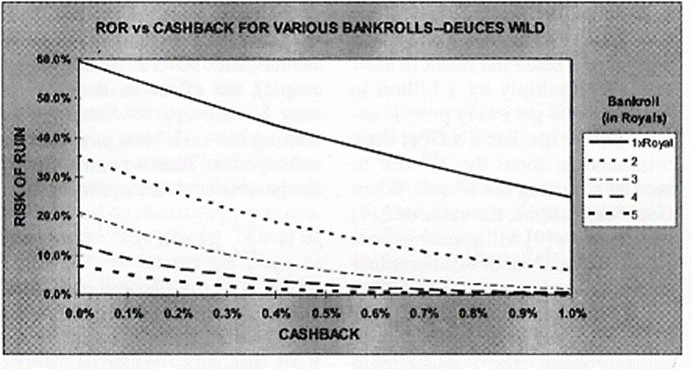
Legend to Chart: This chart shows how cash back affects risk of ruin. Each line represents a different initial bankroll. Bankroll is given as a multiple of the royal flush jackpot. (see, also, Table 2.)
Table 2 and Chart 1 show how valuable cash back is, not just for ev, but also for lowering bankroll requirements. With no cash back on a dollar machine, you need $20,000 (= 5 royals) to have an RoR of 7.5%. But a 0.4% cash back will get you almost the same RoR (8.1%) for only a $12,000 bankroll.
Other Applications
Any positive ev game with a guaranteed set of payoffs with fixed probabilities, including at least one losing outcome, can be analyzed using the generalized risk equation, equation [8]. If a game has a progressive jackpot, such as Caribbean Stud, some “reel” slot machines, and progressive video poker machines, then the generalized risk equation is still useful. If the equation is solved for what one considers the lowest playable jackpot, then the result will be an upper bound on the risk of ruin. If a jackpot almost never rises above a certain level, then solving at that level will give a lower bound on the RoR.
Even a lottery can be analyzed using these methods if one considers the chance the jackpot will be shared by more than one winner.
Comparison To Other Methods
An equation that is often used to accurately calculate the RoR for blackjack was published by George C. in “How To Make $1 Million Playing Casino Blackjack” (1988):
RoR = ((1-ev/sd) / (1+ev/sd)) ^ (b/sd) [11]
where sd is standard deviation and “^” signifies “raised to the power of”. If we apply [11] to the Deuces Wild game with no cash back, we can compare the RoRs to what we get from the generalized risk equation:
| Bankroll (in royals) |
RoR approx by [11] |
RoR exact by [8] and [5] |
| 5 | 9.6% | 7.5% |
| 6 | 6.0% | 4.5% |
| 7 | 3.8% | 2.7% |
| 8 | 2.4% | 1.6% |
So, on a 5-coin dollar machine, the exact RoR for a $32,000 (=8 royals) bankroll is 1.6%, versus the 2.4% we would get from [11]. To get the RoR down to 1%, you actually only need $35,600, instead of the $39,400 predicted by [11].
The differences are caused by the substantial asymmetry of video poker payoffs in comparison to a game like blackjack.
Summary
We have described a method for doing accurate risk of ruin calculations on profitable video poker (and other similar) games. The method involves:
- Solving [8] to get the risk of losing a 1-unit “bankroll”
- Using [5] to calculate the RoR for any bankroll.
- Using [6] to calculate the bankroll required to achieve a chosen level of risk.
In Table 2 and Chart 3 we have presented the results of using this approach to analyze RoR for full-pay Deuces Wild. In a future article, we intend to present similar RoR tables for various other video poker games.
Acknowledgments
We would like to thank Evgeny Sorokin for presenting and explaining the generalized risk equation which is the basis of this article. We are also indebted to MathProf for helpful discussions about the existence and uniqueness of solutions to the generalized risk equation. Thanks also to Arthur Dent, Bootlegger, JD, MathProf and “P” for helpful comments on earlier drafts of this article. ♠


 Never miss another post