Before sitting down at a blackjack table, be sure, as always, to check the table minimum, posted on the small placard somewhere on the layout. You don’t want to sit down at a $100-minimum table (where you’ll often find empty seats when all the other tables are full) if you plan on making $5 or $25 bets.
Up to seven players can sit at a blackjack table. Find an open seat or betting circle and exchange your cash for chips. The dealer counts out and hand over your chips, then deposit the bills in the drop slot using a small plastic plunger.
The dealer deals cards from 1, 2, 4, 6, or 8 decks. Cards from the 1- and 2-deckers are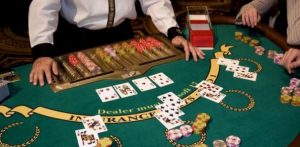 “pitched” from the hand; 4, 6, and 8 decks are dealt from boxes called “shoes.”
Now you can place your wager in the betting circle. You’re dealt two cards, either face down or face up, depending on the custom of the casino. If they’re face up, don’t touch them. If they’re face down, you can pick them up and hold them, but only use one hand. If you forget and handle them with both hands, the dealer will caution you against it (they don’t want players marking or bending the cards). The dealer also gives himself two cards, one face down (the “hole” card) and the other face up (the “up” card).

Check your cards. If you have a natural 21, turn them over and the dealer pays you immediately. Otherwise, everyone plays out their hand one at a time, starting from the dealer’s right side of the table (“first base”) to the left (“third base”).
Rules vary, but these are the common options for playing out a hand of blackjack. You can:
stand, or refuse to take any other cards;
hit, or take as many cards as you need before you stand or bust;
double down, or double your bet and take only one card;
split, if your first two cards are a like pair, such as a pair of aces or a pair of eights; you match your original bet and form two separate hands;
buy insurance, if the dealer is showing an ace. Here, you’re wagering half your initial bet that the dealer does have a natural. If he does, you lose your initial bet, but are paid 2-to-1 on the insurance (in other words, the whole thing is a wash).
If the dealer holds the cards and pitches them to the players face down, you can handle them with one hand. If you want to hit, scratch your cards on the felt layout (if you don’t know how, watch someone else do so or ask). When you’re ready to stand, simply slide your cards under your chips. Don’t pick up the chips to tuck your cards underneath — casino don’t like customers touching unresolved bets. If you bust, turn your cards over immediately.
If you want to double down or split, lay your cards on the table face up and double your bet by placing an equal number of chips next to the original bet. Don’t put the second set of chips on top of the first. Again, you don’t want to touch your original bet.
Many casinos deal the cards face up, usually from a multi-deck “shoe,” or playing-card holder. If so, never touch the cards. Use hand signals to indicate that you want to hit or stand. To double down or split, slide an equal number of chips forward; again, place them next to, not on top of, the original set. You might also have to use verbal commands — for example, if you’re doubling down on a pair of fives. the dealer might ask, “Double or split?” You say, “Double.”
When everyone at the table has played, the dealer turns over his or her hole card and plays out the hand. The dealer has to draw to a total of 17. If his cards total 17 through 21, whoever has a higher total wins. If he goes over 21, everyone who hasn’t busted already wins.
The dealer settles up with all the players according to whether they’ve won, lost, or pushed. Then the whole process starts all over again.

 Never miss another post