A group of soldiers stationed at the U.S. Army’s Aberdeen Proving Ground in Maryland got bored with after-hours poker and started playing blackjack. While they were hashing out the rules, one of the men, who had a Master’s in mathematics from Columbia University, wondered about the probabilities of winning or losing based on the player’s versus the dealer’s hand. He quickly realized he needed an adding machine and enlisted one of the other players, another mathematician who specialized in statistics and had access to a calculator of the day. After one thing led to another, four math heads were doing calculations and two years later, in 1956, they published an 11-page article, “The Optimum Strategy in Blackjack,” in the Journal of the American Statistical Association. It was received with such enthusiasm that barely a year later, the “Four Horsemen of Aberdeen” published Playing Blackjack to Win: A New Strategy for the Game of 21, which sold for $1.75.
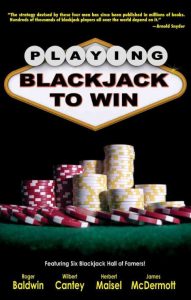
A 2008 reissue of the book first published in 1956, which laid out the blackjack basic strategy and introduced the idea of card counting
In the book, they published the first and only blackjack basic strategy, since their calculations proved to be almost 100% accurate. They also wrote a chapter called “Using the Exposed Cards to Improve Your Chances,” in which they described the technique of “partial casing,” the first time the concept of card counting had ever appeared in print.
According to Arnold Snyder, “Their hit/stand strategies, both hard and soft, are 100% accurate, including the recommendations that hard totals of 12 should be hit against 2 and 3, and that soft totals of 18 should be hit vs. 9 and 10 only.
“The only errors in their hard doubling strategy is that they failed to advise doubling down on 8 vs. 5 and 6 — borderline decisions true for single-deck games only. They missed a few more of the soft doubles, but nothing very serious in terms of dollar value.
“Even on the pair split decisions, they made only three errors in their entire chart — erroneously advising that 2s and 3s be split vs. 2, and that 3s also be split vs. 3. These are also close decisions, and in double-after-splits games, are correct plays.
“Any player who used their basic strategy today wouldn’t not be giving up more than a few
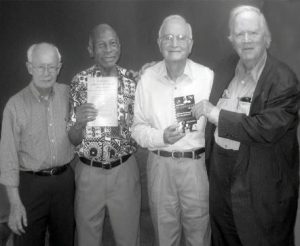
The Four Horsemen of Aberdeen in later years
hundredths of a percent over perfect basic strategy.”
Perhaps the most remarkable outcome of this story is that they spent two years of their free time strictly for the challenge of reaching the end of a mathematical maze. None of them ever used their strategy to make money in a casino.
The four were, in the end, inducted into the Blackjack Hall of Fame in 2007.

 Never miss another post