It’s been an incredible year to be a sports bettor. Much like Oprah, I decided to compile a list of my favorite products and innovations of the year. These are the developments that improved the sports wagering landscape. Obviously, at the top of any bettor’s list would be the Supreme Court ruling that overturned PASPA in May. However, I’d prefer to focus on all the things that came after. Some of it was predictable, some of it was magical. Let’s get started.
Mobile Betting Reimagined
When DraftKings launched its mobile betting app in New Jersey on August 1, it ushered in a new paradigm for mobile betting. Previously, mobile betting in Nevada was basically a way to avoid lines in the sports book. However, to do so, you had to stand in a line fairly frequently to register or transfer money to/from your account. You are essentially tethered to the casino. In New Jersey (and presumably in more states in the future) mobile betting has become autonomous. It’s on a par with the offshore sports books which have dominated the realm for decades. Registration is online; depositing funds can be done via your bank account or even Paypal; withdrawals are simple. With the lower overhead costs to run an online sports book, sports betting is no longer something that’s there only to generate traffic to your casino. It’s now a bona fide income center.
The market domination by DraftKings and FanDuel has also sped up the evolution of the mobile product itself. Previously, mobile betting apps were a bit clunky and hard to use. However, companies with vast experience in mobile platforms are now involved in crafting richer user interfaces.
Revenue Numbers Show the Gap
Most telling, the latest revenue numbers put out by New Jersey for November 2018 show that mobile betting represents 72% of the wagering on sports in the state. While Nevada doesn’t keep statistics relating to the proportion of mobile betting, most bookmakers have stated that it’s roughly 50% of the wagering handle.
Of the states that offer legal sports betting, only three have mobile betting options: Nevada, New Jersey, and just this week, West Virginia. Comparing the November wagering handle of legalized states it’s easy to see the effect mobile betting has.
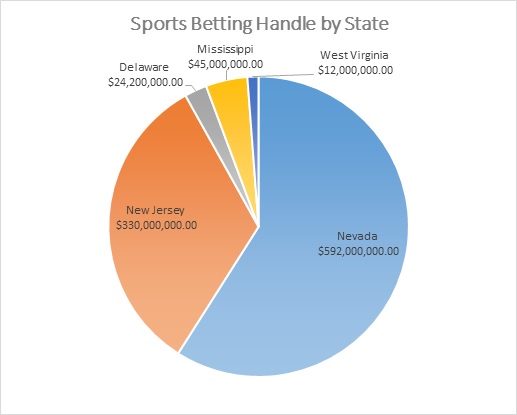
Nevada and New Jersey make up nearly 92% of the market so far. This graph will change greatly in 2019 as new states come online and see the value of mobile betting. Additionally, Nevada is making a push to have the registration and banking portions of its mobile betting available inside the app. That would essentially cut the tether that requires bettors to visit the physical sports book.
The Bonus Bonanza
My next favorite thing of 2018 was the advent of bonuses in the new markets. With sports wagering being a low-margin industry, we’ve come to accept some constants. One is that there is precious little room for give-backs to the players in the form of bonuses and promotions. However, I was pleasantly surprised at the consistent level of promotions and bonuses offered to players in the emerging markets. The new sports books have been so aggressive in their efforts to garner the loyalty of prospective customers to the point that even staunch tight-fisted operations have had to relent and offer incentives.
First came new sign-up promos. In New Jersey, players were offered a matchplay or a loss rebate on their first bet. Competition caused the amount offered to increase and now you can expect $500 in bonus money with your first wager from a handful of New Jersey sports book apps. Next, came odds boosts. It’s now a daily staple of New Jersey’s mobile betting apps to offer increased odds on select events. Sometimes those odds exceed the implied market probability. In other words, they offer a +EV wager. You can also expect loss rebates on high-variance parlay wagers at many books. Moreover, recently William Hill experienced a weekend website outage. Something, that I’m told, is a common occurrence in Nevada. When they came back online, they sent out a site credit to most of their players to apologize for the inconvenience and mine some goodwill.
Can This Bonus Train Roll On?
These promos and bonuses are the result of not only increased competition, but profitable margins for the sports book operators. Low overhead costs and reasonable tax structures foster this environment. It’ll be interesting to see the dichotomy of promotions and bonuses in various states based on each’s competitive environment. Will states like Delaware and Rhode Island decline to offer promotions in their monopolistic setup? Are states like West Virginia inclined to offer more with its business-friendly tax-rate? Will we see Nevada sports books start to feel pressure to match the player-friendly environment of emerging states?
I intend to cover sports book bonuses and promotions in more depth in the next few months. I suspect the target audience for this column will be very interested in finding out more about this facet of sports wagering as more states jump into the pool.
Rivers/Sugarhouse Deal -107 on NFL Game Day
Speaking of the effect of overhead on sports book margins, for months many have predicted doom and gloom for sports betting in Pennsylvania. I’ve definitely joined that choir at times and stated there was no way that a Pennsylvania sports book could offer a competitive product while paying a 36% tax rate. So far the experience has been positive and it makes the list for a favorite thing of mine this year.
In November, sports betting went live at Hollywood Casino in Grantville, just outside Harrisburg. It’s a William Hill-managed book and so far has had standard -110 pricing. Fair enough, that’s a good start. Earlier this month, Rivers Casino in Pittsburgh and Sugarhouse Casino in Philadelphia opened their physical sports books. They’ve been offering -107 on NFL sides and totals on game days. Operating with a 3.3% margin on your biggest bets is a bold move and an impressive one. It’ll remain to be seen how long this low-vig model lasts. Bettors have been waiting in long lines to place their bets with clerks, or at self-directed kiosks.
PointsBet
Back in July, I wrote about PointsBet in New Jersey and its innovative spread-betting concept. You not only bet on who will win, but you get action points on the win or loss. If you wager a team will cover the spread at a $10 stake and your team covers the spread by 10 points, you win 10X your stake ($100). It took them a while to go live in New Jersey, but this month they did; and boy is it fun!
This is probably the most innovative sports betting product that I’ve seen and easily makes my list of favorite things in 2018. If you like math and you like sports, this site is for you. The spread-betting concept even carries over into props. You’re not just betting on how many points LeBron James might score, but how many points he scores squared, or his points multiplied by assists multiplied by rebounds. If 7-team parlays aren’t enough variance for you, there’s always PointsBet. The site also offers traditional betting, but the star of the show is the spread betting. It also offers 0.2% cash-back on traditional bets and an impressive 1% cash-back on all parlay bets and the aforementioned spread betting.
Not for the Faint of Heart
As I mentioned previously, there are limits, so you can’t completely lose your shirt in a black-swan event. However, that said, in the brief time they’ve been open, I’ve won a wager for 771X my stake and I’ve lost a wager for 511X my stake. I’ve also managed to have under 228 on the Phoenix/Washington NBA game on Dec. 22 when the two teams went to triple OT and combined for the most points in an NBA game in the last 10 years (295). I think PointsBet will be a hit with some players, especially the action junkies.
Since it would be a bad business model to allow players to risk more than they have on deposit, sometimes you have to withhold a large portion of your balance to place even a small wager on an event. This will confuse a lot of players and probably turn them off to the product. Recreational bettors want to risk a little to win a lot. This form of betting facilitates that, but also requires that you risk losing a lot if you’re extremely wrong. Education of players will be key to the success of PointsBet. Personally, I hope it catches on with other states. Improbable parlay-ticket wins posted on Twitter by sports books may become pedestrian compared to the crazy results possible on PointsBet.
Palpable Becomes Culpable
My last favorite thing of 2018 isn’t a product or innovation, but rather a decision. You may recall a post I wrote in September. The now infamous mistake line that FanDuel put up near the end of the Oakland/Denver game on September 16. The mistake resulted in a liability that some say cost FanDuel close to $500k. At first, FanDuel refused to pay, citing that a book isn’t responsible for a palpable error.
As I pointed out here, and others echoed, whether or not it was palpable is not their call to make. In regulated environments there’s an ombudsman to make those decisions. I said at the time that it was a watershed moment for legalized sports betting and I still believe that to be the case. No longer was the customer forced to accept a unilateral decision made by a bookmaker. There was now recourse and remediation. In this case, the NJ DGE intervened and encouraged FanDuel to take the high road and pay out the mistake. Three months down the line, it looks like they made the wise choice. FanDuel is leading the New Jersey market and its product is heralded by industry analysts and bettors alike. It’s possible an early public-relations hiccup could have damaged its brand immensely.
Many of my favorite things of 2018 are somewhat centric to the state where I do the majority of my play. Perhaps some of you in other emerging markets have some favorite experiences to pass along. Feel free to comment with your list of 2018 favorite things. In my next column, I’ll share some New Year”s wishes for sports wagering in 2019.


 Never miss another post