In Part 1 of this blog, I discussed the WSOP Main Event (ME) from an observer’s point of view. Now I want to look at the ME, as well as the entire WSOP experience, from my perspective as a player.
As a kid, the anticipation for Christmas started at least a month before. As a grownup poker player in Las Vegas in the ‘80s and ‘90s, I had the same feeling as spring arrived and the WSOP approached; I’m sure most poker players did. Prior to the move to the Rio, the WSOP took place in April and May, the perfect time for weather in Vegas. It was only 3-4 weeks, but we had the time to play a lot of golf, side games, eat well and hang out at the bar at night, with a few tournaments thrown in. Players, dealers, floor people, and cocktail waitresses knew each other; it was like a big family and the Binions were awesome hosts. For everyone involved, it was a truly wonderful time. I feel bad for the players who didn’t get into poker until after the poker explosion of 2003. They’ll never understand how special the WSOP was in the early days.
Outside of the ME, tournaments weren’t the main attraction for a lot of players, as there was too much else going on. The exception was Phil Hellmuth, who had the vision to see the value in excelling in tournaments, collecting bracelets and making a name for himself, which he has parlayed into an amazing life in poker.
I don’t recall when I played my first event, although I’m sure it was in the ‘80s. There were some $500 limit hold ’em and limit Omaha high (a popular game at the time) events, which fit my bankroll, although I didn’t cash in one until 1991, a $1,500 limit hold ’em event. It was harder to cash back then, as they paid only 5% of the field, eventually increasing to 10%, as opposed to 15% today.
I do remember watching for hours part of Archie Karas’ legendary run at the crap table in the early ’90s. I was fascinated with craps, having been both a player and dealer, and seeing Archie covering the layout with $5,000 chips was a trip. At one point he had every Binion’s $5K chip in his box. Jack Binion thought he might be cheating, but he kept dealing to him and eventually it turned and Archie gave it all back. The Archie story is worth googling, or check out Michael Konik’s account in his fascinating book, The Man With the $100,000 Breasts and Other Gambling Stories.
As the WSOP grew in popularity through the ‘80s, it became obvious that the Horseshoe didn’t have the facility to handle the bigger fields. One solution was to make deals with other nearby casinos to set up temporary poker tables. In one low-limit hold ’em event, I played at the Fremont and the Four Queens before being greeted at the Horseshoe by Tournament Director Jack McClelland; “Congratulations, you’ve made the final casino!”
In 1989, Binion’s solved the space issue, at least temporarily, buying the neighboring Mint casino, knocking down the adjoining wall, and moving the base of the WSOP operation to the old Mint side of the expanded Horseshoe. The upstairs bingo room combined with the floor space downstairs was large enough to handle the ever-expanding crowds, at least for a while.
An aging Benny Binion had taken to sitting at the valet desk near the tournament area at the old Mint side, and I made it a point to stop by and talk to him whenever I could. He was happy to talk and tell stories and I was thrilled to listen.
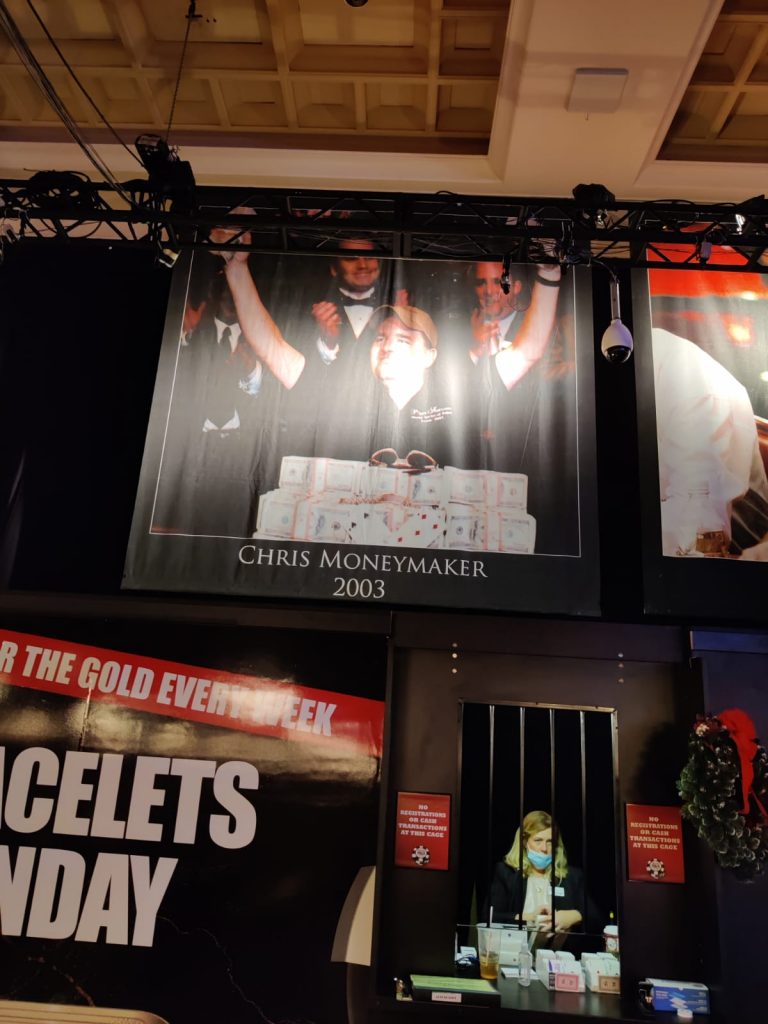
My first nine cashes, all in the ’90s, were in limit events. A lot of players introduced to the game during the poker explosion starting in 2003 don’t realize that prior to 2003, no-limit hold’em (NL) was almost non-existent in cash games in Vegas, and sparse at the WSOP. For example: in the 1998 WSOP there were two NL preliminary events, plus the ME, which was always NL (primarily because it was the staple of the road gamblers who were the original participants) out of 19 events. In 2003, before the “Moneymaker Effect” took hold soon after, there were six NL prelims out of 36 events. Skip ahead to 2006, 24, including the ME, out of 45 events were NL. I hated the transformation, as I was primarily a limit player, but I had no choice but to step up my NL game.
I don’t recall my first ME, but it was likely in the early ‘90s, when success with my sports betting group made the $10K buy-in doable. But I do remember my first bad beat. (We always remember the bad beats!) It was in 1994, when I lost a huge pot with JJ vs the 55 of Tommy Grimes, preventing me from making a real run. I’d traded a small piece with winner Russ Hamilton when we had similar stacks halfway through, so it wasn’t a total loss.
I had a good run of cashing leading up to 2004, which was a banner year, when I had six cashes, with three final tables, including a televised limit hold ’em event, which was really cool. Although the first televised ME was in 1973, it was several years before it was a regular occurrence, the reason being televised poker without viewers being able to see the hole cards is painfully boring. I remember one year CBS employed Dick Van Patten as part of the announcing team and I looked over at the announcing crew and he was fast asleep!
Another year CBS brought in Brent Musberger to do the commentary. He was standing along the wall in the original Horseshoe, and by his demeanor and the suit he was wearing, even though I knew who he was, I thought he looked like an employee. Sure enough, some obviously inebriated girls thought so too, as one staggered up to him and said, “hey mister, where’s the bathroom.” I found it way funnier than did Brent.
The implementation of the hole-card-cam, credited to Transformers toy inventor and poker enthusiast Henry Orenstein, was a key component of the poker explosion. Poker with hole cards exposed to the viewer can be engrossing. In 2004, ESPN experimented with televising non-NL events, which were taped and edited. However, limit poker on TV is a snooze, hole cards or not, so they were soon back to NL exclusively, at least for several years.
The highlight of 2004 for me was my first ME cash. Several memories of that event stand out.
In the small-world category, I was having a great time talking with an Irish player named Patrick O’Connor. I asked what part of Ireland he was from and he told me Sligo. Sligo is a large county but also a small town. I know this because my mother and other relatives are from the town of Sligo. When he told me he was from just outside the town of Sligo I was intrigued. When I got home that night, I called my mom and she said she’d call her cousin who still lived there and see if she knew him. Mom called me back and said yes, Patrick was her cousin’s son’s dentist!
In the WTF? category, I was moved to a table with eventual third-place finisher Josh Arieh seated on my right. He was fairly short-stacked when this hand came up. A player raised pre-flop about half of his relatively small stack with A9, leaving him few chips behind. Josh called with AQ on the button (not sure why he didn’t re-raise the short stack) and I called from the small blind with 44. The flop came A-7-4. I checked to the raiser, who for some unknown reason checked his top pair! WTF? He raised, hit his hand and checked a short stack? Josh bet and I probably made a mistake by raising, but I thought I could maybe break Josh and possibly the original raiser, who somehow folded his top pair and saved his few chips. Josh called my raise but made a great fold to my turn bet, saving a short stack. If the raiser had put in the rest of his chips like almost any other player would, Josh likely would have raised to protect his hand and I’d have busted him. Instead, he soon got moved to another table and in a short time I was listening to announcements of him winning pot after pot and soon was one of the leaders! Good on ya Josh.
Greg Raymer came to my table with a huge stack and proceeded to run over the table, going on to win the championship in impressive fashion. Good on you too Greg!
In the-be-careful-what-you-wish-for category, with six tables left, I was amazed at how eager some players were to overplay AK and get all-in with big stacks pre-flop. I was patiently waiting with a good stack to pick one off and get in really good shape. Sure enough, I raised with KK, a player made a big re-raise and I moved in. He quickly called, with AK and, of course, an ace flopped and I went home in 54th. It was crushing.
When Jack Binion’s sister Becky Behnen took over the Horseshoe, including the WSOP, the old-school feel of the tournament changed. The original WSOP gathering of road gamblers was reminiscent of the Rendezvous of the American Old West, when trappers and mountain men would gather yearly to renew friendships, catch up with the news of the year, play games, and party. Benny and Jack respected the players, enjoyed their company and were awesome hosts. Under Becky and her husband Nick Behnen, players were now viewed as more of a revenue source and less as part of the family.
When Harrah’s Entertainment bought the WSOP in 2004, which they very much wanted (and came with their purchase of the Horseshoe, which they didn’t care about and soon sold off) and announced that the tournament would be moving to the Rio, players were apprehensive. The old WSOP was officially dead and this incarnation raised a lot of questions. If players thought Becky viewed them as merely revenue sources, they hadn’t seen anything yet. Harrah’s was a corporation, as opposed to the family-owned Horseshoe, so their sole purpose, as with all corporations, was to make as much money as possible for their shareholders. While many voices were highly critical of the new stewards of the WSOP, mine among them, it was still the greatest tournament in the world and throngs descended on the Rio. I don’t know anyone who quit playing.
Management decided to move the tournament from the spring to the middle of summer. It was good for them, as summers are a slow time in Vegas, but not good for golfers, as the heat killed much of the golf action that went hand-in-hand with the poker. The meet was expanded to six weeks or so, with a huge schedule of multiple events each day, keeping us busy, so golf wasn’t near the priority that it had been in the old days.
The first year at the Rio they opened a room off the hall as a player’s lounge. It cost $1,000 to join and was soon sold out. There was a small putting green that saw a lot of money change hands, a pool table, closed-circuit TV’s that showed some of the televised tables along with sports, and catered gourmet food weekend evenings. It was an awesome escape on breaks. I won enough from Doyle on the putting green to pay for my membership! Then, the late, legendary Dave “Devilfish” Ulliot saw me messing around on the pool table. He offered to play a game of 8-ball for $20. I said sure, broke and ran the table, something I hadn’t done since I was a good player as a kid! He didn’t miss a beat and offered a 3-out-of-5 match for $500. I should have been wary, but how could I refuse after I’d just run the table? Needless to say, I got slaughtered. The Devil was a man of many talents.
During the first two years at the Rio, the online poker boom was in full swing. Players were offered significant payments for wearing gear representing online poker websites if they were going to be on a TV table. There were awesome free parties leading up to the ME, sponsored by the different sites, and it seemed the sites had hired every hot model west of the Mississippi to wander the Rio and attend the parties. It was a great time to be a poker player! The end of the good times dated to October, 2006, when George W. signed the UIGEA into law, crippling online poker and thereby crashing the party. Although sites like PokerStars and Full Tilt found ways around the law, or so they thought, it was never the same as those two years.
I played a full, exhausting list of events every year, piling up a lot of cashes, but the bracelet eluded me. In 2007 I broke through, winning a $2,000 NL event, beating 2,000-plus players and collecting over $700K. I’d gotten knocked out of a deep run of another event on the morning of Day 3 in horrible fashion and I was so pissed off I jumped right into the NL event the same afternoon. Three long days later I was running on fumes and tons of Red Bull, which almost killed me. When asked how I felt about winning my first bracelet, my honest answer was I was relieved that I didn’t have to kill myself trying to win one anymore. However, soon I was back to playing a full schedule, as I simply loved to play.
The life of a pro playing WSOP events at the Rio consists of playing all day, eating a little, trying to sleep, and coming back to do it again, day after day for six weeks or so before the ME starts. When I was playing seriously, I’d play over 30 events every year. Then the amateurs would hit town for the ME, usually their only event. They’re bouncing off the walls with excitement and adrenalin while exhausted pros try to summon up the energy for the ME marathon.
In 2009 I made a serious run in the ME, finishing 34th out of 6,494. Unlike in 2004, when I thought I should have gone farther, this time I scraped and clawed my way and wasn’t unhappy with my finish, although winning my final race would have propelled me forward and who knows? Joe Cada went on to win the $8.5 million, defeating an out-of-his-element Darvin Moon. (See my LVA blog of 9/28/200 for a great profile of Darvin penned by Nolan Dalla.)
I cashed in the ME twice more, in 2013 and again in 2015, which was likely my ME swansong. The ME structure is incredible, as the longer (two-hour) levels and the slow-moving increases in the blinds and antes give good players plenty of time to ply their trade against an ocean of lesser-skilled amateurs for whom it’s a bucket-list item and are just happy to be there. I’ve always said that any good player who doesn’t enter the ME is making a mistake, as the value is unmatched in tournaments. However, there’s another issue with the extended play. I mentioned in my last blog that I missed several years of the WSOP recently due to health issues, and as I look at the schedule for the ME now, consisting of seven or eight straight long exhausting days starting with Day 3 until a winner is crowned on Day 9, it doesn’t make financial sense for me to enter. If there was still the November Nine format, where final-table players got a four-month break before coming back to play for the big prize, I might take a shot. But, as it is, I feel I could play full-on for three or four days, when the money bubble breaks, but my energy and focus would suffer greatly, as would my edge, as the days ground on. The ME is now as much an endurance contest as it is a showcase of poker skill. It’s a hard realization for me that my love affair with the ME as a player might be over.
Farewell to the Rio
The Rio has been the home of the WSOP since 2005. While there were serious growing pains, after a few years they got the logistics down, Jack Effel really grew into his role as Tournament Director and Caesars (the same Harrah’s group with a new name) has been a good steward for the most part. But now the WSOP is on the move again, with next year’s edition being housed at Bally’s and Paris on the Strip. I always thought the Rio was the perfect venue, with its massive parking lot and huge convention rooms. It was also convenient for locals who didn’t have to navigate Strip traffic. I’m sure there will be growing pains at the new venues, but hopefully it will work out.
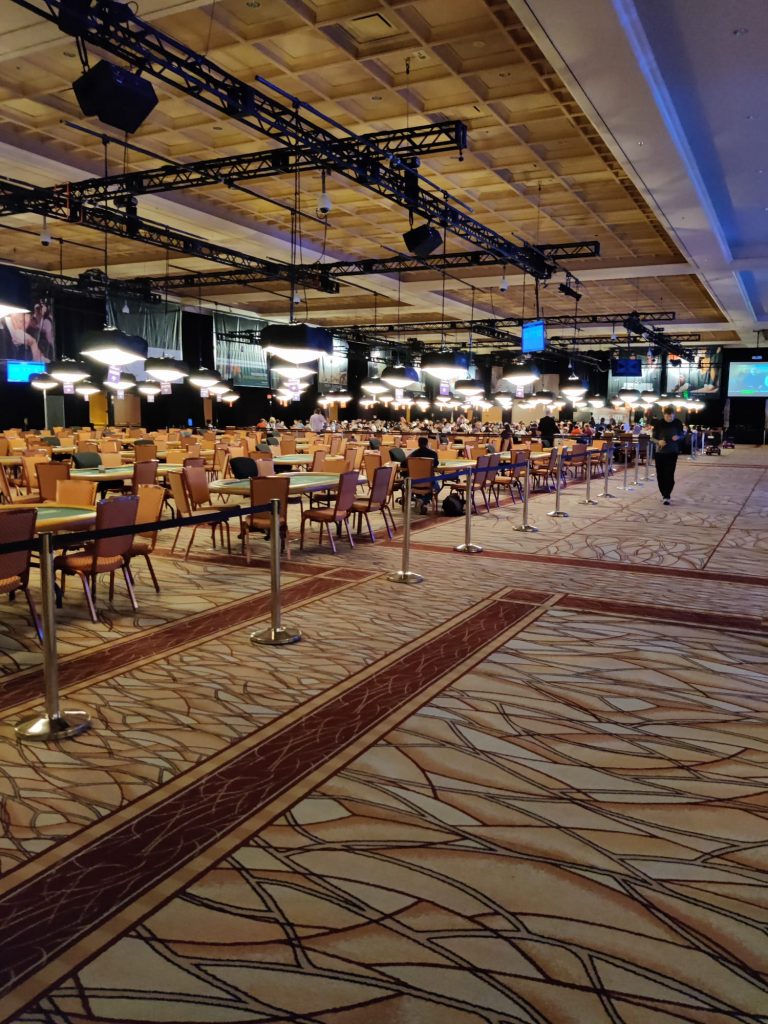
I get nostalgic when chapters in my life come to a close, so I went to the Rio as they were dismantling the poker venues for the last time. I walked the halls and the poker areas, reflected on my countless experiences, and said goodbye. I was seeing the WSOP poker apparatus for the last time at the Rio and it was a sad feeling. I occasionally walk through the Horseshoe and reminisce, but there the memories are happier and the sadness greater, because the WSOP at the Rio was a job. At the Horseshoe it was a joy.



 Never miss another post
I had no idea the WSOP was moving the venue to another location for 2022 but it’s good to know, maybe they’re anticipating a smaller crowd for next year. I didn’t like the changes they announced for 2021 before the event began. Great stories.
Let’s not forget no entry fee was charged for the $10,000 Binion’s Horseshoe World Series of Poker’s Main Event. Players were using real chips before the fake ones were introduced
Great writing, I much appreciate an insider view of the history of one of my two passions in life, I live for poker and golf… The WSOP made poker what it is today, and I am grateful. The Main Event was exactly what killed limit Hpld Em, today it is on life support, only large rooms even offer it, most can not get enough players to fill tables. My local still deals limit games, when I sit down in one I am the young buck at age 61, it’s where old players rule the roost. I finally recently realized that the no limit games are where I can use my experience and intellect much more effectively, machismo flows like Niagara Falls in the no limit games, a savvy patient player can take advantage of newbies that think they are Phil Hellmuth. I think my greatest skill these days is bankroll management, I have become a hit and run player, I can no longer do marathons in my old age anyway. Yes, I can be bought out of winning hands, but since I am so patient, I am dangerous to attempt that on…
Actually, it was the poker explosion of 2003 that killed limit games. I call no limit (NLH) the game that ate poker. Outside of tournaments I find it incredibly boring. But, after Moneymaker, all the new players wanted to play NLH, as seen on TV. Prior to that, in Vegas ,outside of WSOP time, there were lots of limit games and some PLO, but only one NL game, with 5-10 blinds, and it was the tightest game ever. The regs just sat around waiting for a live one to get in the game. And the live ones had no chance. That’s the problem with NL cash games; the good players soon get all the money. When the pool of live ones began to dry up, the migration back to limit games began, although the modern limit games are rarely the old standards, such as 7-stud, stud eight-or-better, Omaha hi-lo and razz. Now it’s common to see a mix of limit games such as badugi, badecy, 2-7 triple draw, razzdugi and a bunch of other games I don’t know or care about.
Blitzkrieg, the new hotels actually have more convention space than the Rio. I doubt they’re anticipating a smaller turnout, unless Covid remains a factor. The turnout this year was a bit down, but that discounts the foreign players who didn’t, or couldn’t make the trip. In past years there was a group of 100-200 Russian players who played as many events as possible, as well as countless players from other countries.
My main concern is the parking situation. The Rio’s huge (and free) parking lot was ideal. Not sure how they’re going to handle it next year.
Thanks Blair. Great article.
Since international travel has become more and more a real impediment, players from Europe have been seeking alternative locations to play. Czech republic is offering plenty of games around the clock, and that’s where professionals are traveling to these days. In addition to that, on the beautiful island of Cyprus, there are a few casinos offering poker and at the same time offering tremendous deals to the casino partrons. As long as this pendemic will last and flight restrictions are so bad, I am not surprised that Vegas has lost visitors. Only if the conditions get easier and covid will be somewhat forgotten, then I think we might see another increase of visitors again.
From Switzerland
Boris
Great piece of writing. As someone who has only played in the super senior event since it started, I enjoy hearing about the main event. Thanks.
Your two posts provide a great historical perspective on the WSOP and the poker scene in general. Thanks for sharing so much of your personal observations and involvement.
Thanks for the trip down memory lane. I first came to Vegas in 1983 to attend the WSOP. $35 a night at the Golden Nugget was a bargain. My first event played was 1989 7 stud. I finished 5th. Mickey Appleman called the WSOP, “A convention of gamblers” Perfect. Presently, we are all a bunch of cattle. They have branded us all suckers. I played the $1500 horse. Even with Matt Savage at the table and several others who knew me from the Sports Betting world, I despised every minute. There was no dinner break, which was good as there was no place to eat. Shit, you could not get a good cup of coffee. The Rio disgusts me. 15% of the field cashing is pure greed as is every other piece of the once great tournament. Good riddance.