

Last Friday, Pinnacle Entertainment tiptoed out with a little bombshell that may have detonated into your e-mail or stock portfolio. In brief: Vietnam‘s planned Ho Tram Strip casino resort is in deep shit. As a 26% owner of the project, Pinnacle is at least knee-high in the manure, too. Pinnacle stock fell 82 cents a share after the news broke.
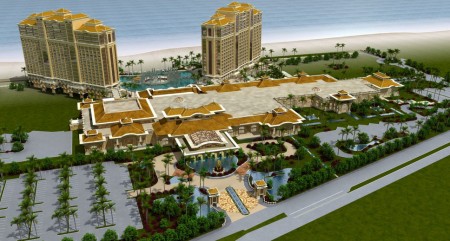
“Broke” would also describe lead investor Asia Coast Development Ltd. Not only can’t ACDL make the deadline for completing $175 million Phase I, project manager MGM Resorts International has advised ACDL that, even were Phase I to be finished, there’s no working capital left to run the place. Consequently, ACDL’s credit facility has been suspended. Also, the resort doesn’t have a gaming license nor are any regulations in place. Deutsche Bank analyst Carlo Santarelli concludes, “the ability of ACDL to open MGM Ho Tram has been placed in serious jeopardy and PNK is at risk of losing its $111 mm investment in ACDL in its entirety,” adding that he expected the news to get worse before it gets better.
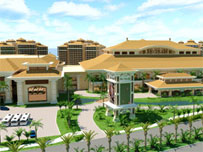 A considerably more sanguine view was taken by Santarelli’s J.P. Morgan counterpart, Joseph Greff, who advised investors that the Vietnamese government was likely to come through with deadline extensions, though he noted that Pinnacle is on the hook to help cover the absent working-capital costs. However, due to Pinnacle’s strength in the St. Louis and Lake Charles markets, Greff concluded that the Ho Tram kerfuffle would be but “a minor drag” on the stock.
Cash is king and nowhere more so than at financially wobbly Caesars Entertainment. The latter just liquidated an ownership stake in Uruguay‘s Conrad Punta del Este Resort & Casino in return for $140 million from Chilean firm Enjoy. It also agreed to purchase a 10% slice of Enjoy, thereby enabling it to mine South America for potential players. The official press release doesn’t explicitly state that Conrad and Enjoy players will be flowed into Total Rewards but strongly implies as much. As for Punta del Este, the Caesars garage sale continues …
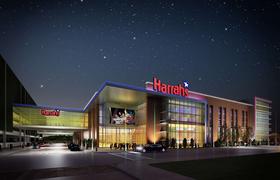 Caesars is spending some of that new “mad money” before it’s even been banked, chipping in $25 million more into what is now Horseshoe Baltimore. The project cost will be upped to $400 million, as many as 110 table games are planned and the 3,750-machine slot floor might be downsized (as happened at Horseshoe Cleveland). Some of the cost overrun — from an initial $300 million — isn’t entirely the fault of Caesars or Rock Gaming. The City of Baltimore balked at the initial project design (left), which looked rather too much like a Target store or something of that ilk. Horseshoe Baltimore has literally gone back to the drawing board.

Bigger issue with Horseshoe née Harrah’s Baltimore was that their parking garage was going to be so huge that you wouldn’t be able to see the stadiums from the freeway.