

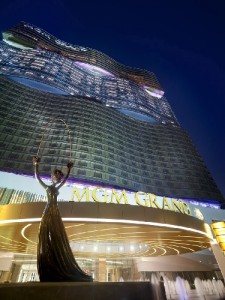
 Although the government of Macao enjoys nothing better than to make casino owners wait and fidget for their land leases to be “gazetted,” today is MGM Resorts International‘s lucky day. MGM China received final approval for its Cotai Strip megaresort. Deutsche Bank analyst Carlo Santarelli calls the timing “ahead of expectations,” which suggests that Macanese bureaucrats were in a generous mood this week. J.P. Morgan analyst Joseph Greff estimates this will add almost $2/share to MGM’s value. Santarelli projects an ROI of 16% from the casino-to-be. Macao is being a “george” landlord, charging only $270,000/year during construction and $700K/year afterward. (For perspective, if MGM sold it to Penn National Gaming‘s overhyped REIT — an absurd hypothetical but bear with me — Jim Murren would be forking over $200 million a year in EBITDA, plus fees, just for starters.) But don’t pop the champagne corks just yet: The $2.5 billion development isn’t expected to be completed until 2016 and reach full potential the year following. When finished, MGM Cotai will incorporate 2,500 slots, 500 tables and 1,600 hotel rooms, spread over 18 acres of — let’s face it — landfill. For a company that was last into the Macanese market and had only property (above), and in a disadvantageous location at that, MGM has hung in there pretty admirably, at least where market share is concerned.
In the near term, multi-property operators Las Vegas Sands, Melco Crown Entertainment and Wynn Resorts are favored  by Greff, with MGM tagging along, in terms of 2013 revenue growth. He sees “earnings momentum in the high-margin mass-market segment,” good news for Stanley Ho, too, “and emerging signs of a recovery in the VIP segment.” Ergo, mass-market-oriented Sands and Melco Crown are favored over “VIP-centric” Wynn and MGM. Melco is tapped for the biggest percentage gain (20%) in share value. Better still, a new rail line to Macao plus connectivity to China‘s high-speed rail network could drive a significant — and this is coming off a 10% rise in business last quarter — upsurge in visitation. Yes, Macanese casinos will have to go to 50% smoke-free this year but most of table game areas will be as hazy as ever. The already ghettoized slot floors, casino cage and low-margin tables will comprise the no-smoking territory.
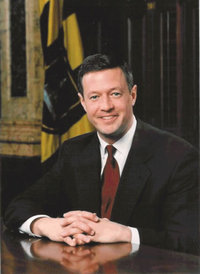 Speaking of Penn … a silly-ass lawsuit that would benefit both casino opponents and the renegade casino operator received the formality of a public hearing yesterday. It seeks to tilt the playing field, arguing that a casino-expansion bill (some of whose provisions have already gone into effect) needed 76% voter approval last November. If you stayed home, casino adversaries argue, it constituted a “no” vote. While this litigation would seem to define “frivolous lawsuit,” the devil’s in the details: If Gov. Martin O’Malley (D, right) the Maryland Lege, in their end-of-summer, special-session scramble to get this done, worded the initiative sloppily, we could be back at Square One. As Geena Davis sagely observed in Thelma & Louise, “The law is some tricky shit.”
Take a victory lap, you folks at Station Casinos. Fertitta-helmed development of $800 million Graton Resort & Casino, a tribally owned property in California, was topped off yesterday after seven months of construction. Joe Hasson, late of Harrah’s New Orleans and Green Valley Ranch, is Station’s point man at Graton. On the home front, Station’s multi-generational “We Love Locals” still rolls on with prominent ad buys. Boyd Gaming‘s zombified, gerontic, Cheers-themed campaign, however, seems to have done a speedy vanishing act — or been banished to low-visibility time slots.
