

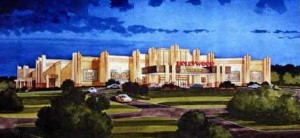
 Penn National Gaming trimmed its 2013 revenue projections today by 3% — not surprising, given the “headwinds” represented by recent tax changes that will eat into Americans’ discretionary income. Sluggish early slot performance in the Columbus and Toledo markets was blamed on a lack of marketing and comping “into underpenetrated submarkets,” as Joseph Greff of J.P. Morgan put it (sounding just a wee bit pornographic). Table games, investors were assured, were doing “just fine.” Revenue generally met expectations but cash flow and profitability were disappointing, with Ohio taking some of the blame, as did Penn’s expensive electoral bust in Maryland, which cut into the bottom line.
If Wall Street seemed blasé towards Penn it was practically ecstatic about Las Vegas Sands, with both Greff and Deutsche Bank‘s Carlo Santarelli calling the results better than expected. In particular, both focused on rebounding 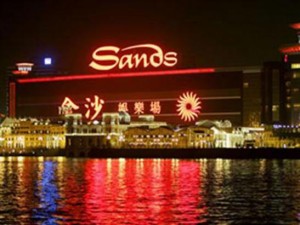 numbers at Marina Bay Sands — a cause of “significant investor consternation in recent months,” as Santarelli put it. Greff described the numbers as “better than expected mass [market] revenues … and meaningfully stronger than expected VIP volumes.” He projects over $2.6 billion in cash flow from Sands’ Macao casinos and $1.6 billion from Marina Bay Sands this year (a 21% return on investment). Sands Cotai Central is underperforming its neighbors, casualty of another Sheldon Adelson “soft opening,” but is expected to improve as another 1,800 hotel rooms hit the market in “Phase 2B.” (Adelson’s opening are so soft that their phases now have sub-phases.) Although Sands didn’t hit or exceed every one of the myriad metrics the Street was monitoring, its level of marksmanship was impressively high, as revenues and cash flow from overseas continue to dwarf what Adelson rakes in domestically. Analysts, however, disagreed on the potential cost of Sands’ Parisian megaresort in Macao, putting it anywhere from $1.5 billion to $2.7 billion. (I’m taking the “over” on that one.)
 Disappointment came from the home front, where Sands missed forecasts by a country mile. Venelazzo‘s $308 million in revenue, while nothing to sneeze at, represented a 9% falloff from 4Q11 and room revenues (up 2%) were the lone bright spot. If it weren’t for low table hold, management argued, $53 million in cash flow would have been $88 million … but it wasn’t. Except for baccarat play, Sands execs were said to be down in the mouth about near-term prospects in Las Vegas, which would explain why they’re trying to gauge interest in a possible sale, if industry rumors are correct. Ditto red-headed stepchild Sands Bethlehem (above), whose $118 million in revenues and $27.5 million in cash flow weren’t good enough to keep a “For Sale” sign off the front lawn. It’ll be tough to move, though: Sands is asking roughly 9X EBITDA ($1 billion) against a prospective ROI of, oh, maybe 12% for the buyer. But if Sands were to have to sell at an industry standard of 7X or 7.5X, it’d probably lose money on the place, whose cost has been shrouded in mystery since it passed the $800 million mark.

It seems as if Venelazzo doesn’t know what it wants to be when it grows up. With “Rock of Ages” and “RockHouse” moving in, it kind of brings a different clientele than Carnevino and Delmonico. Trying to ape Caesars strategy of hitting all market sectors, but doing it all in one building?