

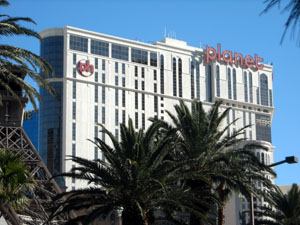
 It may have taken time for Gary Loveman‘s chickens to come home to roost but they’re doing it by the flockful. To raise cash, pronto, Caesars Entertainment — which hasn’t turned a profit in over three years — has piled several random assets into wishfully named entity Caesars Growth Venture Partners, in which it would continue to maintain “a significant portion,” probably a majority, a phrase which should strike terror into the hearts of potential investors. It’s a grab bag that includes Planet Hollywood (left), Caesars Interactive, theoretical ownership of Caesars’ as-yet-unbuilt Baltimore casino and as-yet-to-be-determined “other holdings“ … along with a $1.1 billion I.O.U. Buyers would also find Dan Gilbert waiting for them in bed, since he holds an $80 million stake in Caesars Interactive, for which he paid nearly $5K a share. I’ve long thought the Gilbert deal was either an under-the-table loan or a means of shielding Caesars Interactive from creditors. Whatever the case, that question may be moot. (Although, on paper, Caesars owns 20% of the Baltimore project, it will have to accept an even smaller position if this puny demi-IPO goes through: Gilbert controls the other four-fifths.) Anyway, offering to ‘flip’ part of a casino that’s literally on the drawing board lends this exercise a touch of surrealism. Loveman can’t unload any of the physical assets he has, so now he’s trying sell ones that don’t yet exist. That’s certainly creative thinking.
Given how long online gambling has been touted as Caesars’ salvation, it’s a fair index of Loveman’s desperation  that he’s willing to cut Wall Street in on the action. According to Bloomberg News, Caesars’ debt load has risen to $23 billion. Considering the return Apollo Management and Texas Pacific Group are getting on their $30.7 million investment of five years ago, they’d have done better by simply leaving their money in the bank. Instead they’re trying to borrow an additional $1.5 billion (at 9% interest) so they can sprinkle some moolah on the banks — a sum hopefully large enough to purchase a five-year forbearance on their debt load, meaning that Leon Black and David Bonderman wouldn’t have to start paying down their principal in earnest until 2020 … by which time the loan will almost be old enough to take driving lessons.
Right now, investors must brace themselves for a 4Q12 loss that may be merely [sic] $452 million or as much as $556  million — as much as a 225% increase from 4Q11. Caesars tried to soften the blow by reporting higher revenues from its Las Vegas Strip properties. That rings a bit hollow when Planet Ho is on the block and Caesars will have to replicate that better-than-expected performance without Bill’s Gamblin’ Hall & Saloon, which was put to death last weekend. (After a stomach-churning elevator ride a few weekends back, I can’t say the closing comes a day too soon.) The nightclup/party pool/hotel that will replace it is now Brand X, a proposed “Caesars Drai’s” moniker having landed with a dull thud. Yet, despite the evidence of desperation all about, Caesars continues to brandish invisible money at Toronto and Boston alike. If the Massachusetts Gaming Commission hasn’t already grown queasy from looking at Caesars’ balance sheet, the fourth-quarter numbers ought to make it lose its lunch.
Robert Earl “spotted.” Whatever happened to Robert Earl? He sold Planet Ho to Caesars, amid promises of an ongoing role, and has hardly been seen in Vegas since. When he is, it’s at someplace like Excalibur. Another rare sighting of the pint-sized mogul occurred on Jan. 23, when he dined at Carla Pellegrino‘s new Meatball Spot in Town Square. At least now that Two Way Hard Three has gone on permanent hiatus, Earl need no longer fear that Hunter Hillegas is persecuting him.
 What we like to call the “Penn National effect” — habitual overestimation of potential casino revenues — may have to be ratcheted up to a top rate of 50%. Having led themselves to believe casinos would bring in $1.9 billion/year before taxes, Ohio state officials have lowered their expectations to $958 million. And when you’re taxing casinos at 33%, that’s quite some shortfall, most of which will impact school budgets. Caesars’ financial problems play a role, since revenue projections were predicated on more casino product than was delivered by Horseshoe Cleveland (whose second phase is in abeyance). Penn National Gaming, meanwhile, is shocked — shocked! — to learn that some 821 Internet cafes in the state are serving as de facto rivals. Perhaps Penn should have tried to scotch that problem, via ballot initiative, before going on all in on on the
  Buckeye State market. Now, uncorking blasts of hot air from Eric Schippers (left) looks hypocritical and lame. It also doesn’t explain or excuse when Penn’s Hollywood Columbus‘ slots (even after their holds were tightened) are getting clobbered by Scioto Downs‘ VLTs. Penn President/COO Timothy Wilmott used to be a Harrah’s man. He’s supposed to know how to fix these things! So Penn is swallowing its pride and loosening up on the free-play and buffet coupons. If you’re sweating comps, how much of surprise can it be that you’re getting your butt handed to you?
So Ameristar Casinos blew $16 million for land on a casino it decided not to attempt to build in Massachusetts. Now it wants a markdown on its tax bill. Too bad. Having made two rash decisions in a row, Ameristar should just pay The Man and wait for Pinnacle Entertainment to sort out this mess.

Hmmm, I wonder if we could swap Caesar’s for Pinnacle or Ameristar in Baltimore? Even with Dan Gilbert being the real money, having a leaky ship like Caesar’s on top doesn’t give me much confidence in the project.