

Editor’s note: On June 20, J.P. Morgan lowered its price-per-share target for Penn National Gaming, citing “the sluggish Ohio ramp,” along with cannibalization of business in neighboring states.
On May 22, legislators in Ohio voted to limit payouts from “sweepstakes machines” in Internet cafes, thereby crimping — without outlawing — this gray-market industry. Observed Deutsche Bank‘s Carlo Santarelli at the time, “while the existence of internet cafes in Ohio was known prior to the start-up of casino gaming in Ohio many thought the impact from the cafes would be minimal. However, the slow out of the gate results, relative to the demographics in Ohio, caused many to reevaluate the impact the cafes were having on the casinos.”
 In other words, it’s a governmental effort to forcibly steer customers from one segment of the industry to another, more politically palatable one. Since Gov. John Kasich (R) had already diluted the earning power of the four Buckeye State casinos approved by voters, by allowing seven racinos as well, it’s an after-the-fact form of protectionism. Given the inelastic nature of the Ohio market to date, it’s questionable whether cracking down on Internet cafes will drive massive amounts of slot play to the casinos and racinos. But, after the number of times the gaming industry has been shaken down by Kasich and his legislative cronies, it’s awfully sweet of them to try and manipulate the market back into mainstream gambling’s favor.
 Horseshoe Cincinnati was pulling in an impressive $235 per slot per day last month, which puts it within shouting distance of the state’s desired $243/slot/day. Caesars executives, though, have a long way to go to reach their hoped-for $305 slot/day. Being on the doorstep of Kentucky hasn’t delivered the expected windfall.
There, in a microcosm, you have the ‘reality gap’ between the state and the industry, what’s known on S&G as the Penn National Effect (due to Penn’s propensity for financial hyperbole).
Perhaps the avarice of the Kasich administration may be chastened somewhat by the $20.5 million gap between what it expected to wrest from Scioto Downs,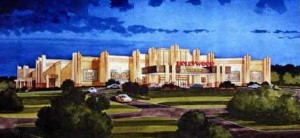 Hollywood Toledo (left) and Horseshoe Cleveland. As Thistledown Racino and other tracks come online, expect those shortfalls to lengthen. Track owners have already been cutting back on VLT orders. Gaming positions were expected to eventually 29,120. Now it looks as though they will only reach two-thirds that number.
There’s your Penn National Effect: The disappointment which follows rose-colored financial projections … a bad habit the industry manifests when wooing new jurisdictions. Disappointment is all but certain to follow (Cincinnati has halved its tax expectations from Horseshoe), but nobody ever seems to learn.
 One such professional optimist is Gaming Marketing Advisors‘ Steve Gallaway, who — according to Cincinnati.com — says gambling companies “don’t think the market can absorb all the slot machines allowed.” No, Mr. Gallaway, they don’t ‘think it’: The market isn’t absorbing them. It’s quantifiably and painfully obvious. We’re assured that there will be more demand in three or four years. Why then, I wonder. Wasn’t gambling-deprived Ohio expected to be a hotbed of “pent-up demand” already?
Penn and Caesars (especially the former) have been hoist on their own  petard. They sold casino legalization on the basis of ludicrously optimistic numbers, courtesy of Spectrum Gaming Group, ones that Penn subsequently had to walk back. They’re making their nut but Ohio is going to be a grind, not a bonanza (unlike Pennsylvania).
There’s plenty of blame to go around. Lawmakers put racinos on the table back during the Ted Strickland administration. When Kasich displaced 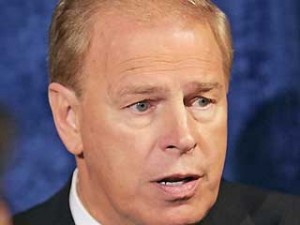 Strickland (left), he kept that ball in play. The new governor’s revenue expectations turned out to be slightly less bogus as those of Caesars or Penn, but he misread the market, too. People in Ohio weren’t as anti-gambling as previously thought but it’s a market that only has so much money in it and is stubbornly inelastic. If people don’t want to — or can’t — spend, you’re up against it. (Several other states are discovering this.) At least Caesars is doing a better job of it. Its two casinos gained traction last month, while Penn’s continue to falter.
Thistledown is retarding Horseshoe Cleveland’s growth, however. The latter improved 1% from April to May, while the racino’s VLTs grossed $11 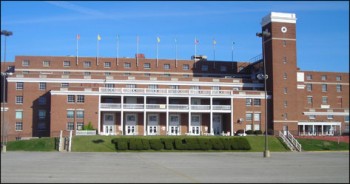 million, against the downtown casino’s $20 million. Thistledown (right) scooped up $322/slot/day (best in the state by far), compared to a borderline-anemic $202/slot/day at Horseshoe. Caesars tried to put a good face on it but it looks like they’ve robbed Peter to pay Paul. (In a sign of muted desperation, evening parking is now free downtown — most nights.) Thistledown is already a home run but if Horseshoe Cleveland keeps hitting ground balls how can Dan Gilbert financially justify the expansion that is expected from him? He’d get a bigger bang for his buck by further upgrading Thistledown.
 Besides, there’s a Hard Rock International racino headed for the area, one that could be open within the year. When that oncoming train hits, expect Rock Gaming Caesars to pull the emergency switch that allows them to relocate Thistledown to Akron or Canton. (To put it another way, Caesars would have to remove the competition posed by … Caesars.) With the exception of MTR Gaming, everybody who’s a player in the Ohio market had oversized dollar signs dancing in their heads and now has received a stiff dose of reality. It really makes you wonder how well they can read the economy there … or anywhere else.
Being proactive. With casinos in Massachusetts creeping closer and 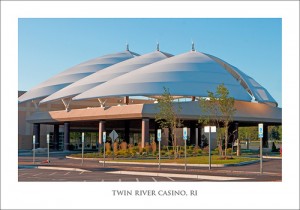 closer to reality, Rhode Island is buying time — three years, according to Gov. Lincoln Chafee‘s administration — by adding table games to its repertory of gambling. Boston has been a huge growth market for play at Twin River Casino and the latter hopes to milk that trend as long as it can, especially since Rhode Island players are pretty much seen as a given and Foxwoods Resort Casino and Mohegan Sun — despite their recent struggles — have Connecticut darn well sewn up. Unlike the blinkered fools in the New Hampshire Legislature who keep killing casino legalization, people in the Ocean State know what time it is — and that it’s fleeting.
