

Soon, the North Fork Rancheria Band of Mono Indians is expected to  become not only California‘s 63rd gaming-enabled tribe but the first with an off-reservation casino. The medium-sized (2,000 slots, 200 hotel rooms) facility would be 36 miles off the rez, near Madera. The Rancheria Band may soon be followed off-rez by the Estom Yumeka Maidu Tribe of the Enterprise Rancheria.
After a laborious, nine-year process, the Mono Indians’ land grant squeaked through the California Assembly and is expected to pass the Senate. (The quid pro quo is an increase in the profit percentage that the tribe pays to the state; a precedent that is understandably worrisome to the other 62 tribes.)  If it does, expect a sigh of relief to waft through the corridors of Station Casinos, which has been shepherding the project in hopes of eventually being the operator of an actual Mono Indian casino. Meanwhile, the nearby Wiyot Tribe will be paid millions per year not to build a casino. The debt-strapped Picayune Rancheria of Chukchansi Indians is predicting doom for its own, existing casino — so the Mono Indians’ probable victory looks to spell the beginning of a casino arms race, one in which more and more tribes plead “exceptional circumstances.”
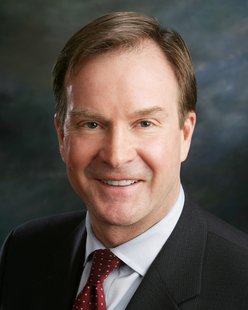 The U.S. Supreme Court will get to weigh in on another case of what opponents call reservation shopping: A tribe on Michigan‘s Upper Peninsula wants to build a casino roughly 100 miles south, in Vanderbilt. Michigan Attorney General Bill Schuette (right) has been trying to shut the project down but the Sixth Circuit Court of Appeals sided with the Bay Mills Indian Community. Should SCOTUS side with the latter, Vanderbilt will be the leading edge of further Bay Mills expansion, into Port Huron and Flint. If the Bay Mills tribe wins, expect elastic, new definitions of what constitutes “land taken into trust” for tribal gaming.
Still further east, in Massachusetts, the Mohegan Sun project in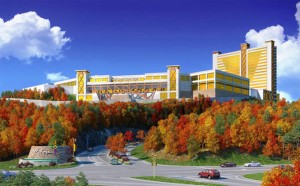 Palmer keeps upping the ante — this time literally. It wants the non-hotel parts of the project rezoned for at least 150 feet in height: a threefold increase. Sitting on a hilltop next to a highway, the casino-hotel would not exactly be inconspicuous — even less so now that it’s talking about stringing the place with ziplines. But, so far, city officials appear to be supportive. Considering that one local politico’s suggested method of measuring whether or not the approve the change — releasing a helium balloon — is downright whimsical, one suggests city councilors use their noggins, visualize what a higher-profile Mohegan Sun would look like, and decide based on that. Nearby, in Springfield,
 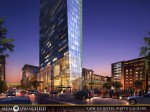 MGM Resorts International is promising to brings its diversity program and LEED-certification emphasis to Springfield, along with 50% of its purchasing. With MGM doing everything but wave money at the electorate — even bringing in staffers from Las Vegas to help with the campaign — the Palmer effort appears to be falling farther and farther behind its rivals, the casino-resort proposal mutating amorphously on an almost-daily basis, like The Blob.
If ever there were a no-brainer, it’s whether the selectmen of Salisbury should enter talks with Cordish Gaming on whether to accept the company’s proposal to build a slot parlor. While the casino (1,250 slots) would be small by Cordish standards, the company’s recent history in Maryland speaks powerfully for itself. Time is of the essence (Oct. 4 is the drop-dead date for slot-house proposals) but Salisbury shouldn’t repeat Boxborough‘s mistake of turning Cordish away. It would be a shame if Massachusetts were deprived of a name-brand operator because a board of selectmen couldn’t get its act together. (A lack of urgency is becoming a recurring motif in casino/city negotiations in the Bay State.)
