

A produce warehouse and a fistful intangibles. That’s what Joseph “Tomato King” Procacci says will enable him to get his casino proposal up and running 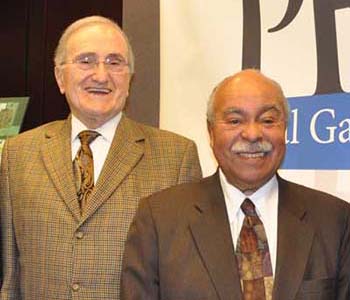 six months ahead of any rival bidder. Touting his ‘juice’ in the community, the Tomato King laid out a two-stage proposal, starting with a quick-and-dirty, 1,500-slot casino. In another year, 900 more slots would be added and, eight months later still, a hotel would follow. (The role model is a seven-stage tribal casino, Silver Reef, in Washington State.) Pennsylvania Gaming Control Board members treated this with warranted skepticism, although PHL Local Gaming countered that only it had the space to expand to 5,000 slots. It also played up its 24-acre, family oriented entertainment annex, with zip lines and driving ranges.
Casino Revolution also has proximity to two interstates working in its favor. However, when faced with the question of cannibalization, executives rather illogically contended that they’d grow the market, that it needs more casinos, not fewer. They even dug up an analyst to make the argument. (Ah, the old “pent-up demand” shibboleth.) If the PGCB falls for this snowjob I’ll be gobsmacked.
On the other hand, we have Market8, which is proposing a ‘stacked casino,’ 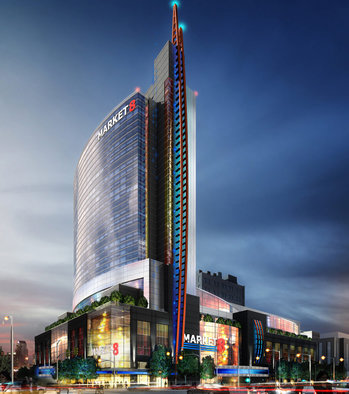 much like The Cosmopolitan of Las Vegas. Uh-oh. The casino wouldn’t even be on the ground floor. The hotel would be an offshoot of the Marriott Autograph Collection. Market8 boasts it can generate $518 million a year, based on the extremely aggressive projection of $382/slot/day ($117 higher than the state average). Citation of operator Mohegan Sun as the generator of these numbers does not augur additional confidence either. (Market8 would, I see, be run in “silo” fashion. Not good.) Market8 is banking heavily on walk-in business, Casino Revolution on drive-by customers.
Stack Market8’s Ken Goldenberg against Tomato King and Bart Blatstein, and you have a cage match of local tycoons. (Omnipresent investor Ira Lubert, who must own a piece of every casino in Pennsylvania, turns up in the Goldenberg camp.) However, the city has still to hear from the partnership of Cordish Cos. and Greenwood Racing. Can it match the flash of the Goldenberg and Blatstein projects? What the City of Philadelphia manifestly doesn’t want is a barn full of slots, the norm for regional casinos.
On speed dial. Selection of Massachusetts‘ slot parlor is scheduled for Feb. 28, after three days of deliberations. Has the Massachusetts Gaming Commission been stung by accusations of too glacial a selection process? Who knows but it’s nice to know the suspense will soon be at an end.
Deadwood, South Dakota, could become a wide-open gambling destination if the Lege puts an expansion bill on the November ballot. Deadwood casinos would gain roulette, craps and keno (what, no baccarat?) in a proposed constitutional amendment that passed the State Affairs Committee by a 10-1 vote.

One minor correction – according to that Inquirer article Market8 will have restaurants at street level, casino on 2 & 3 and the theater on 4.
The location is actually very good. In addition to the tourists, conventioneers, and downtown residents mentioned in the article that location is also a short walk from the central regional rail hub Market East – 120,000+ people pass through daily.