


Update: Rotate Black failed to make the cutoff date for Hemingway Casino (below), meaning the property will go back on the market, Rotate Black never having paid for its option. It is still contemplated as a future casino site.
D’Ibreville, Mississippi has been waiting two decades for a casino and it’s going to have to wait a spell longer. The men behind the Scarlet Pearl Casino project missed their deadline to close a deal and there’s no hope of an extension. Instead, they have to start over from Day One. Regulations for developing an onshore casino have changed and Scarlet Pearl has to meet a newer, higher set of criteria, as would Hemingway Casino, (below) in Gulfport, which was in peril of missing its deadline today.
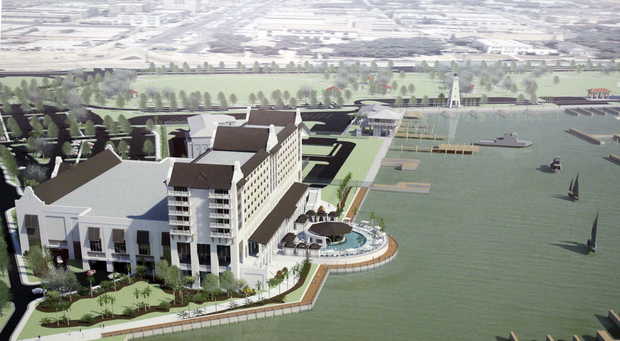 At least Scarlet Pearl doesn’t have to upsize its project. It has the mandated 300 hotel rooms and necessary square footage. Hemingway Casino could be going back to the drawing board, as it has only 205 hotel rooms and 35,000 square feet of gaming space, not the newly required 40,000. In Scarlet Pearl’s case, developer Rotate Black had missed several previous deadlines, causing the Mississippi Gaming Commission to run out of patience and extensions. Sounding vexed, MGC Executive Director Allen Godfrey said, “This was their fifth time before us. They assured us they would have everything in order.”
 New York State has unveiled its criteria for casino applications and they carry certain necessary safeguards. Local lawmakers and their constituencies will have to demonstrate support, ensuring the state doesn’t impose a casino on an unwilling town. The local business community has to sign off as well. Unlike Massachusetts, however, there is no “home rule” provision. License fees will be on a sliding scale, starting at $20 for a second Southern Tier casino, $50 million for the capitol region and going up to $70 million for Orange County and Dutchess County. (If one of those counties gets a casino, a Catskills license will be discounted to $35 million.) Applications will have to include extensive quantification of the economic impact, which is weighted as far and away the predominant consideration. (“Wow factors” need not apply.) “Regulators said they will seek exhaustive information from applicants on their finances, background, ownership and legal history. They must share details of their resort plans down to parking infrastructure.”
One not-so-minor detail is still missing from the criteria: How much will developers be expected to invest? They probably won’t know until roughly May 10. Reactions by developers to the reams of paperwork dropped on them ranged from “excited” (David Flaum) to “privately stewed.” At least the $1 million application fee is refundable if wannabe developers get sticker shock from the licensing fee and want out. With luck, construction will begin this autumn.
