

Observing stability in regional gaming markets, Deutsche Bank‘s Carlo Santarelli is out with a bullish investor note on Penn National Gaming today, declaring “the  worst appears over.” He sets a $17 target price for the stock (currently trading just below $14), ascribing $4 of that value to Penn’s Plainridge project alone. “As such, with competitive headwinds largely behind them, for the first time in a long time, we see PENN as a compelling GARP [growth at a reasonable price] idea.”
Dismissing the REITmania surrounding Boyd Gaming and Pinnacle Entertainment, Santarelli forecasts that Penn will increase cash flow at a compound annual growth rate over the next two years of 11%, compared to 2% at Boyd and a slight contraction at Pinnacle. He predicts “the discount closes as investors get more comfortable with the … growth story.” He also noted “solid aggregate October results and continued strength at the recently opened Ohio tracks [and] a reasonable, though outside, shot at the soon-to-be-decided-upon [New York] license.”
* In the wake of this month’s election, expect to see a lot more stories like one I read yesterday in which Sheldon Adelson took a victory lap — the first of many, I’m sure — for a perceived victory over online gambling. Never mind that Internet gambling wasn’t on the ballot anywhere 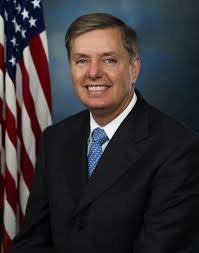 and people would probably find it less off-putting than they would Adelson. The question is, What happens next? Some think Sheldon will get an anti-gambling hearing or two on Capitol Hill, strictly out of gratitude and for show.
However, Sen. Lindsey Graham (R, right) has never been so close to victory in his attempts to re-rewrite the Federal Wire Act to reinstate his aversion to online play. I don’t think he’ll be satisfied with cosmetic congressional hearings and Kabuki theatre. Getting trampled in this jostling for position is a little thing called the 10th Amendment. It specifies that “The powers not delegated to the United States by the Constitution, nor prohibited by it to the states, are reserved to states respectively, or to the people.” That would seem to make intrastate Internet gambling firmly a states’ rights issue but never underestimate the capacity for congressional overreach.
