

 Caesars Entertainment‘s last hopes for a Massachusetts casino are slipping through its fingers. A federal appeals court ruled in favor of the Massachusetts Gaming Commission and cleared Chairman Stephen Crosby of any charges of untoward conduct. Judge David Souter ruled that the MGC had “highly discretionary” powers, particularly when the license carried “substantial risks of commercial and social harm.” Citing recent Supreme Court precedent, it also answered Caesars’ claim of deprivation of property rights through an “arbitrary exercise of government power” by ruling that submission of a casino bid does not a property right create. To quote the legalese, would “Massachusetts law recognize in the request for action by the commission a source of expectable value sufficiently reliable to be protected as property”? “The licensing cases point to a negative answer, and the casino licensing law does the same with unmistakable emphasis.”
On another front, Caesars is teaming up with another industry giant (and sometime rival), PokerStars, to push back against Sheldon Adelson‘s campaign to outlaw Internet wagering. “The alliance between PokerStars and Caesars … is a clear 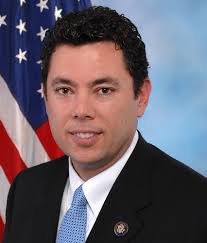 indication that they are taking Sheldon Adelson’s lobbying efforts seriously,” writes Steve Ruddock. “And well they should.” The “Restoration of America’s Wire Act” bill, believed to have been written by Adelson’s lackeys, has been reintroduced in the House of Representatives by Rep. Jason Chaffetz (R, right). Hey Jason, we know you Utahns frown upon gambling, but do you have to lay your negative trip on the whole country?
As Caesars’ Jan Jones Blackhurst said, online-gambling companies have enemies and “clearly it’s not Amaya and PokerStars. They are a strong ally in the space.” Amaya spokesman Eric Hollreiser echoed Blackhurst’s comments, saying, “intends to work closely with Caesars and others to promote the U.S. online gaming industry and support responsible regulation at the state and federal levels.”
Meanwhile, back in Washington, D.C., Sen. Lindsey Graham (R, below) was trying to back Attorney General Designate Loretta Lynch into a corner on the Justice Department’s 2011 reinterpretation of the Wire Act, the one which opened the door to Internet gambling. Lynch offered to examine the ruling but noted that a reversal would be an extraordinary act, 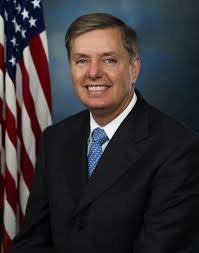 caused only if the 2011 decision were found to be “unreasonable.” Prior to the 2011 reconsideration, the Wire Act had a carve-out for parimutuel wagering. Sen. Dianne Feinstein (D) offered that the case could be made that the original Wire Act could be interpreted to ban all forms of gambling. (At present, only sports betting is nixed.) That would certainly be unpopular in the 12-plus states which have taken their lotteries online.
“Because OLC helps the president fulfill his constitutional obligation to take care that the law be faithfully executed, it is my understanding that the Office strives to provide an objective assessment of the law using traditional tools of statutory interpretation,” stated Lynch, which certainly doesn’t make it sound like a re-reinterpretation of the Wire Act is in the offing. She suggested that Graham take the matter into his hands, saying, “I would, of course, welcome the opportunity to work with you and other members of Congress to address concerns about online gambling through legislation.”
* In California, the Rincon Band of Luiseño Indians, the United Auburn Indian Community, the Pala Band of Mission Indians and 20 card rooms renounced their support for a “bad actor” clause (in a nuanced sort of way) in Internet-gaming legislation , “recognizing that control of an entity may change over time in a way that resolves regulatory concerns.” That’d be a big boost for PokerStars, as it acknowledged in a statement. However, as long as the Pechanga and Agua Caliente bands remain opposed to PokerStars, its Golden State aspirations are seen as an uphill climb.
