

When the Great Recession struck, no company was more ill-positioned to weather it than Station Casinos. A few tribal contracts aside, all of Station’s eggs were in the Las Vegas 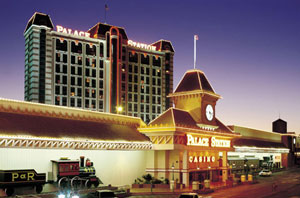 basket. To put it another way, Vegas may have gotten the flu but Station contracted tuberculosis. The company went south so fast that its bankruptcy is now a distant memory.
All of which is preamble to the disclosure that Station’s 4Q14 numbers were the best since the halcyon days of 2008, when company execs were dreaming big and Station was living large. As CFO Marc Falcone put it, “It may finally appear we have reached that inflection point we have been discussing for several years.” In 2014, Station grew revenue 3% (to $1.3 billion) and cash flow 9%. Vegas business completely drove the comeback, with 4Q14 hotel revenue up 13% (the biggest bump since 2007) and only $47 million coming in from California and Michigan tribal operations all year.
Quarterly gaming revenue was up 5%, the best since early 2012, with Station riding a six-month crescendo in slot revenue. Falcone credited higher consumer confidence and local wages — plus lower fuel costs — with helping drive Station’s gains: “The majority of key economic indicators have shown signs of improvement for several years and we expect these improvements to continue in 2015.”
Oh, and the lines for the oyster bar at Palace Station are as long as I’ve ever seen.
* MGM Resorts International‘s fourth-quarter numbers drew a rave review from J.P. Morgan analyst Joseph Greff. Not even a $20 million miss on estimates for Macao could dampen his enthusiasm. “[We] importantly project ~10% LV Strip EBITDA growth on very 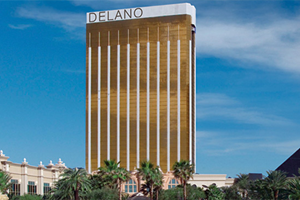 reasonable 4% net revenue growth and flow-though [sic] assumptions in 2015,” he wrote. He predicted “a steadily improving balance sheet/leverage position” through 2017, as various MGM projects begin to be monetized. “We continue to view MGM as having a favorable risk-reward given its positive operating momentum in Las Vegas and its less than severe sensitivity (relative to peers) to Macau swings,” he added.
Among the factors encouraging Greff were “sustainable … operating trends” on the Strip, where MGM is rolling out a series of new projects — the Delano, The Park, the AEG Arena and the expansion of Mandalay Bay‘s convention center — in staggered fashion. MGM’s loyalty-marketing program was described as “effective.”
Speaking of marketing, Greff felt MGM had positioned itself well in Macao by targeting the mass-market player. However, VIP play is still so preponderant that mass-market growth of 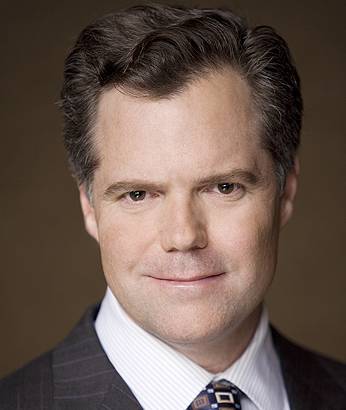 19% couldn’t begin to offset a 39% plunge in high-roller action. Closer to home, despite widespread saturation, MGM’s Mississippi and Detroit casinos outperformed estimates. “January has started off strong … with LV Strip baccarat up double digits and overall table games up high-single digits over 1Q14,” Greff added.
In a very un-Murren-like swipe at the competition, CEO Jim Murren (right) kicked the corpse of the Riviera. “The days of [the Riviera’s] benefit to Las Vegas are long gone, and to have the quality construction, quality infrastructure, entertainment-oriented activity that the convention center would produce would be very beneficial to the neighborhood,” he told the Las Vegas Sun.
* Wisconsin Gov. Scott Walker (R) has found a part of “casino” he likes: the last two letters. In an ill-timed and tasteless political stunt, he went to Kenosha to celebrate 50 new jobs at Toolamation Services … having just killed hundreds (if not thousands) of potential new jobs at nixed Hard Rock Kenosha. It’s as though Walker were dancing a jig on the grave of Kenosha’s hopes.
