

Gaming & Leisure Properties‘ track record to date has been unimpressive, its big acquisition play being underperforming Casino Queen in East St. Louis. Contrast that  with GLPI’s boastful talk that the phone would be ringing off the hook with purchase opportunities the moment its REIT separation from Penn National Gaming cleared. Well, it looks like GLPI has stopped waiting and decided to stir up some action on its own. It has offered to buy the physical assets of Pinnacle Entertainment in an all-stock transaction. (REITs are all the rage; even MGM Resorts International is toying with one.) Pinnacle shareholders would get 0.55 shares of GLPI stock for every Pinnacle share they own, along with one share in a spun-off Pinnacle operating company. This represents approximately $36 a share and a 30% premium to last week’s closing price. (When negotiations with Pinnacle began on Jan. 16, it was a 59% premium.)
As envisioned by GLPI, Pinnacle CEO Anthony Sanfilippo wouldn’t be out of a job but would preside over a publicly traded operating company. “However, four months after announcing its separation plan, Pinnacle has still not provided any specificity regarding its plans, including when, and even whether, it will be able to close, how much equity dilution shareholders will suffer, the financial leverage of each company and the terms of the lease between OpCo and PropCo,” GLPI huffed.
Resorting to negotiation through the media, GLPI outlined a five-point program, making such points as “GLPI will have more than twice the assets and cash flows compared to the  standalone real estate company proposed by Pinnacle” and “Pinnacle has yet to identify a senior leadership team to operate the real estate company.”
Frustration boiling over, GLPI CEO Peter Carlino (left) stated, “We have repeatedly tried to engage Pinnacle in a constructive manner regarding our value-creating proposal, and we are disappointed that they have refused to explore our proposal in any meaningful way,” adding that a recent offer talk came with an “inappropriate non-disclosure agreement.” As a consequence, Carlino is trying to rile the Pinnacle shareholders, to get them to put pressure on management. However, the tactic may have backfired, as Pinnacle shares immediately jumped 20%. Still, Credit Suisse analyst Joel Simkins said, “Given that Pinnacle has a fairly diverse investor base and no dominant insider shareholders, we believe the board and management will have to seriously consider this offer.”
Other analysts speak …
Joseph Greff, J.P. Morgan: “PNK gets value up front without going through a lengthy and potentially uncertain process and the risks associated with its PropCo/OpCo separation plan. For GLPI, it would receive acquisition-related growth (a heretofore investor concern) and reduce its largely single tenant risk exposure (ditto) through creating and spinning out another OpCo. Ultimately, we see scale and geographic diversification benefits that should/could result in a higher valuation multiple for GLPI. Lastly, we don’t think GLPI’s first offer is its only, best, or last offer—only because in most cases, it’s not—despite management’s history of being a value disciplined buyer of assets and companies.”
Carlo Santarelli, Deutsche Bank: “While the deal is clearly a positive for PNK holders, whom we believe will be largely supportive of this structure, we see significant benefit for GLPI as well. Subsequently, given the proposed PNK holder ownership in GLPI, the likely deal price for a PNK holder, assuming GLPI shares move higher, as we anticipate them to, would be north of the $36 valuation. We are buyers of GLPI on this news.”
* Confronted with a defunct Harrah’s Tunica, bankrupt Caesars Entertainment has requested permission to “dismantle and liquidate” its former flagship in the Tunica market. 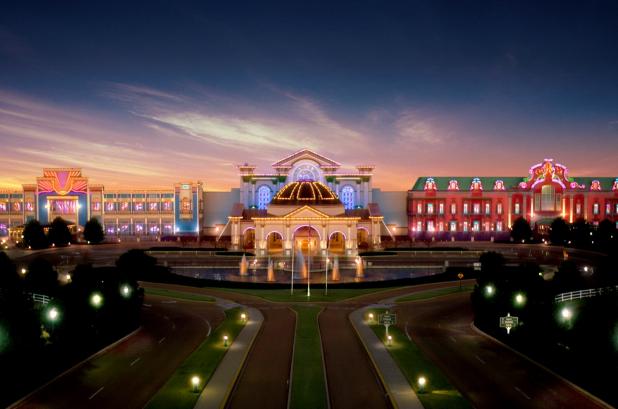 It would remove the five barges upon which the casino proper sits in Buck Lake. Caesars has earmarked the money, it says, for repayment of debt. It will also be spared the cost of maintaining the “riverboat.” Or, as a court filing stated, “All current estimates for the liquidation project indicate that the debtors will generate significant revenues from liquidating the obsolete property.” It would also, the company says, help position the Harrah’s Tunica hotels for resale.
County officials, though, would like it if Caesars reopened the rest of the complex, which includes a shooting range and golf course. Tunica Convention & Visitors Bureau CEO Webster Franklin said, “All of that stuff is what is needed. It’s not the casino, per se.” Two attempted sales fell, through, the filing reveals. It also discloses that revenue has increased 13% at Horseshoe Tunica and Tunica Roadhouse Hotel & Casino since the Harrah’s Tunica closure. So that’s one dark cloud that had a silver lining.

The dangers of becoming a REIT = you can lose control of your assets!
This is going to be very interesting!