

Shares of MGM Resorts International could trade at $55. So thinks hedge-fund boss Jonathan Litt, who has proposed converting MGM into a REIT, a move he says could 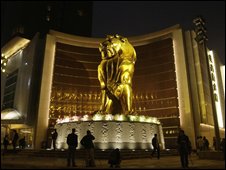 halve the company’s massive debt. (Asset sales are part of Litt’s plan.) The casino company’s stock rose 9% in reaction to Litt’s proposition. He plans to nominate four candidates to the MGM board to help make his idea a reality. We’ll be getting more detail from Litt’s Land & Buildings fund later today. Pundit Joel Elconin thinks the MGM board may be behind this, trying to extract more value from its real estate holdings. The stock, he observes, “has been dead money over the past year, stuck in the $17.25 to $28.75 range.” For his part, Litt says “We strongly believe the U.S. real estate of MGM is worth $25 per share alone, more than the entire MGM share price today.”
MGM China would be spun off and a third entity would be formed to manage MGM’s domestic holdings. “REIT investors would welcome a high-quality, Las Vegas-focused  lodging REIT,” spake Land & Buildings, although that field is already going to be crowded if Caesars Entertainment pulls off its REIT conversion of most of its properties. Prior to the Litt proposal CEO Jim Murren had exuded ambivalence, telling investors “We’re pitched by every bank that is out there in terms of whether or not we should do that. And there’s some merit to it. I’d have to say, there’s nothing definitive. There’s nothing to report.”
Evaluating the Litt putsch, Deutsche Bank‘s Carlo Santarelli wrote that “we struggle with some of the assumptions of the current proposal.” Predicating the success of the REIT on a heavy concentration on Las Vegas is “aggressive,” he opined. Noting that Land & Buildings had pitched the same idea to Las Vegas Sands, Santarelli pointed out several disincentives, including “asset sale requirements … annual capex requirements … assumptions for how to handle the gaming piece of the business … we see the consummation of a transaction of this nature as a low probability.”
* If Gov. Chris Christie (R) has been looking for political cover to keep PokerStars out of New Jersey, he just got it. Ditto California tribal casinos who want the company excluded from the Golden State as a ‘bad actor’ on the Internet-gambling stage. The company’s Italian subsidiary has been accused of tax evasion involving some $318 million. The Guardia di Finanza charges that PokerStars Italy has been offloading revenue to tax havens on Malta and the Isle of Man, then importing costs from those jurisdictions onto its Italian balance sheet to lower its liability still further.
(According to Poker Industry PRO, the Guardia’s bark is worse than its bite: What PokerStars did is “transfer pricing” and “entirely legal … The practice becomes a legal gray area partly because of disparities between the tax treatment of financial items between different national tax jurisdictions—what is a cost in one country can easily be defined as revenue in another.”
Without admitting culpability, PokerStars acknowledged cognizance of the investigation: “PokerStars has been working with Italian tax authorities since they launched an audit several years ago. We have operated in compliance with the applicable local tax regulations and have paid €120 million over the period covered by the audit.” If this weren’t enough of an embarrassment, PokerStars parent Amaya Gaming is being probed in Quebec for insider trading. The news that Amazon.com and Google are also being scrutinized by Italian authorities hardly makes this less of a blow to PokerStars’ domestic aspirations.
