

“FanDuel and DraftKings are optimized for power players to rape and pillage regular players over and over again.” So says daily fantasy sports podcaster Gabriel Harber, in the course of a lengthy New York Times  expose of the DFS industry. It shows a business desperately in need of regulation, playing its games on a tilted field that favors the high rollers in the sport. According to reporter Jay Caspian Kang, the fact that a small number of players rake in most of the winnings does not prove that DFS is a game of skill and “only the sites with the biggest prize pools could survive.”
Rather, it’s “a rapacious ecosystem in which high-volume gamblers, often aided by computer scripts and optimization software that allow players to
submit hundreds or even thousands of lineups at a time, repeatedly take advantage of new players, who, after watching an ad, deposit some money on DraftKings and FanDuel and start betting.” What’s more, he accuses DraftKings and FanDuel of changing the rules to favor the whales even further, and the industry in general of not having a full understanding of what it’s doing.
A key component of DFS, whose executive ranks are heavily populated with refugees from online poker, is “bumhunting.” What this translates to is “sharks are free to flood the marketplace with thousands of entries every day, luring inexperienced, bad players into games in which they are at a sizable disadvantage.” Given the absence of regulation for DFS, Caspian King describes a situation of borderline anarchy, one in which — because those bumhunters are needed to generate the bigger prize pools — the top players get chummy with the DFS bosses and are able to have the rules bent in their favor.
One can see from the NYT story why consumer protections, like those being  implemented in Massachusetts, are needed … and also why Nevada casinos, despite being allowed to add DFS to their sports-betting repertory have not moved to do so. (The Massachusetts Gaming Commission is expected to recommend taxes and licensing fees on DFS companies, even though MGC Chairman Stephen Crosby asks, “How do you add a tax rate for an industry that’s so young it’s still losing money?”) It’s an industry that’s hard to understand even for its practitioners and even harder to police. In any event, the need to install rules that make DFS genuinely fair to the player seems self-evident.
* Iowans were playing a bit less last month, with a flat December achieved only by the addition of Wild Rose Jefferson. Otherwise, revenues would have declined 1%, as a 3% gain at the riverboats was offset by 4% less in
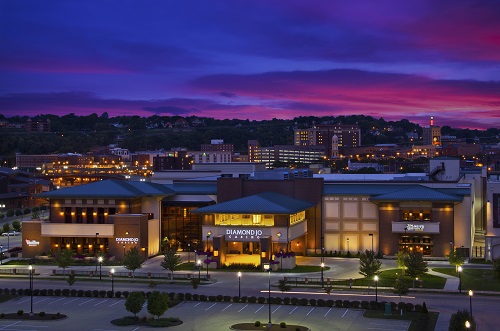 racino play. Boyd Gaming had a fairly dramatic month, with Diamond Jo (right) up 10% and its sister property in Worth climbing 4%. By contrast, post-bankruptcy blahs continued at the Caesars Entertainment properties, with Harrah’s Council Bluffs declining 6% and Horseshoe Casino off 2% (but posting the second-highest gross, $14 million). Isle of Capri Casinos got walloped at Miss Marquette, down 11%. Ameristar Council Bluffs wasn’t exactly raking it in for Pinnacle Entertainment either, down 1%. Tops in the state was Prairie Meadows Racetrack, with $16 million (-3%).
The one other significant gainer was Hard Rock Casino in Sioux City, up 8%. Two other casinos experiencing a cold winter at the cashier’s case were Wild Rose Emmetsburg, plunging 16%, and Riverside Casino Resort, down 7%. There’s always pressure to add more gaming capacity to the Hawkeye State but residents seem to have all the casino options they need.
