

Although state Attorney General Maura Healey continues to draw a road map for daily fantasy sports in Massachusetts, the state’s gambling regulatory body has stepped forward to volunteer its services as an  enforcement agent. Yes, DFS would be classified as gambling in the Bay State, at least if Massachusetts Gaming Commission Chairman Stephen Crosby gets his wish. “One approach for the Legislature to consider is to recognize that because Internet gaming activity is unique, quickly deployed and highly malleable, regulation ought to be vested in a single, nimble Internet gaming regulatory body,” wrote the MGC. (That’s right, DFS would be codified as Internet gambling.) It added, “This approach would require new legislation, but the regulatory body could be one that currently exists or one that the Legislature creates” (emphasis added).
Down in New York City, state Attorney General Eric Schneiderman‘s attempts to pull the plug on DFS were stayed by an appeals court, meaning that DraftKings and FanDuel can continue operations at least until the issue has been adjudicated at trial. Schneiderman — known to some as “Inspector Gotcha” — is pushing back with a demand for $200 million in fines and $3 billion in refunds, a tab that would surely be impossible for FanDuel and DraftKings to pay. Having been temporarily unable to thwart them in court, Schneiderman (below) seems determined to bankrupt the DFS giants instead.
For this, Schneiderman has been accused of practicing “armchair sociology” 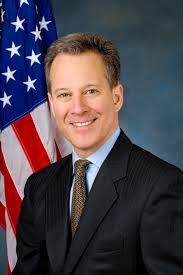 and drew a skeptical response from New York Law School professor Robert Blecker. He said, “Fantasy sport is a derivative on sport itself. As a derivative, it heightens interest and creates secondary markets. The Great Recession should have taught us how important it is to regulate derivatives without destroying them or allowing them to distort the primary activity from which they derive.” Admittedly, DraftKings and FanDuel are like two fist-pumping douchebags disrupting your concentration at the blackjack table. However, bad taste doesn’t translate into illegality — and the New York State Legislature, egged on by the lure of taxable revenue, will surely have baptized DFS by the time Schneiderman’s case reaches fruition in court.
* Now we know why Penn National Gaming‘s Argosy Alton had such a disastrous December (-23%). In a word: floods. Unlike all other ‘riverboat’ casinos in the area, Argosy is directly on the river, making it vulnerable to Mother Nature’s whims. At the same time, Tropicana Entertainment was finally seeing a return on its Lumiere Place investment, thanks to a 45% increase in table game winnings. Who says luck plays no role in this business?
* Faced with curbed designs, budget increases and construction delays in its Springfield project, MGM Resorts International is taking its case to the court of public opinion. In a series of billboards on I-91, it will assure  Massachusetts residents that it is “working hard [and] moving forward.” “We are going nowhere,” said MGM Springfield President Michael Mathis, meaning that the resort remains on track, not that he’s running in place (though there’s been a bit of that too). Although it’s been accused of downsizing the project out of fear of new competition from Connecticut, MGM has upped the budget to $950 million, hardly the sign of a casino company on the ropes.
Far to the east, the Aquinnah Wampanoag tribe managed to double down on last year’s court defeat of their attempt to convert a Martha’s Vineyard hall into a Class II casino. On Jan. 5, Judge Dennis Saylor IV not only reaffirmed his previous ruling, he imposed a permanent injunction on the tribe. The conflict now moves to the First District Court of Appeals. The Aquinnah tribe struck a Faustian pact when it signed away its gaming rights in the Settlement Act of 1983, a decision they now have ample cause to regret.
* How bad is casino business in Macao? Stanley Ho‘s Jimei Casino is helping organize a junket to bring in high-value slot players. As Union Gaming Securities analyst Grant Govertsen wrote, it’s “an idea that in a different era would likely not have even been considered.” Unfortunately, Jimei is so low on the casino food chain that, Govertsen adds, “it could be a tough sell to attract and retain players based solely on having VIP slots on offer.”
