

While DraftKings CEO Jason Robins and FanDuel CEO Nigel Eccles insist that their companies are just too special to apply for a Nevada gaming license, entrepreneurs Vic Salerno and Michael Knapp are effectively calling their bluff. They’re seeking a license for their newly formed US Fantasy. Rather than being run as a sports pool, as  most DFS sites are, US Fantasy would offer parimutuel-style wagering. “What we did is kind of work within the framework of the existing rules and regulations that were on the books either in Nevada or in California,” remarked Knapp, whose experience spans Internet gambling to California horse tracks. He characterized his product as “a lot easier, more fun, fairer” than conventional DFS … if we can characterize such a novel product as “conventional.” Knapp himself feels that it is in a natal state and will evolve considerably over the next few years.
US Fantasy’s product is designed to be compatible with both casino and online play, and comes with geofencing capabilities that would contain its action within Nevada. However, Knapp also sees clouds on the horizon in the form of state taxation of DFS. “It is going to be very tough for them to be profitable; they are going to have to raise the takeout. That is the same sort of thing that happened to racing, and in my opinion the reason why it declined like it did,” he told LegalSportsReport.com.
DraftKings CEO Jason Robins‘ performance before the Nevada Gaming Policy Committee is getting roundly panned in some quarters. Robins got rather shirty with the idea that his product is gambling (Who is he kidding?) as well as the idea that Nevada laws were appropriate to regulate it. “We don’t feel that the type of regulation that we’re being asked to administer is appropriate for our industry. But the exact form of regulation that has been proposed, we don’t think is appropriate for the fantasy sports industry, given that it is a new technology, and something different than what was contemplated when those laws and regulations were written,” he blustered.
Nevada Gaming Commission Chairman Tony Alamo was enthusiastic about DFS, at least in principle: “I do want to set a tone here, that daily fantasy sports is good. It’s a fabulous thing. It creates excitement for a sport. It puts people in the stands …. it creates increased viewership. It excites the sports, so people walk into our sports and race books and, directly or indirectly, will put money down. It creates handle, increases profits, increases gross gaming revenue for the state, and taxes.” That being said, he wasn’t a pushover for Robins and Eccles.
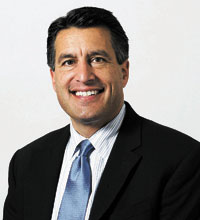 Alamo wasn’t buying the latter’s contention that “heavy-handed” Nevada regulation would reduce the playing field to two companies. (Guess who?) “There are a lot of people, smaller than you, with less money and less financial means, that go through the process of licensure,” Alamo replied. And when Robins claimed Nevada’s licensing procedure was “onerous,” Alamo called his bluff and asked whether DraftKings had started applying. Robins admitted it hadn’t. Silver State Gov. Brian Sandoval (R, left) basically told DFS operators they’d have to live with the current regulatory framework for at least another year, until the Lege can vote on adjustments to current laws. In other words, get cracking on those applications, boys.
* Although legalized Internet gambling has failed to be a windfall for tax coffers in the United States, lawmakers in Brazil believe they can reap as much as $4 billion a year if they legitimize it. While the legislation is far from being finalized, it appears that Internet casinos can look forward to a much higher tax rate than terrestrial ones: 20%. After all, you don’t have to build a big building with lots of bells and whistles to run an Internet casino.
* Las Vegans don’t get up in arms much about the constant change of Sin City. However, when Vickie’s Diner (in the former White Cross Drugs, near the Stratosphere) removed a particularly kitschy painting of Clint Eastwood as The Outlaw Josey Wales as part of a reality-show makeover … well, that was one change too many. It’s a cause celebre that would be surprising in any city but this one.
