
Writes Deutsche Bank analyst Carlo Santarelli, “according to people familiar with the matter, Penn National has conducted on again off again discussions to acquire Pinnacle Entertainment.” He warns that “a long list of questions, which  may or may not make a deal difficult/hamper value creation, exist.” He calls the deal “sensible” in theory and the potential synergies “considerable,” identifying $28/share as a target price for the deal. Pinnacle shares, at the moment, are trending downward ($23.82 at last check). There will be a certain amount of addition by subtraction, with Penn likely to have to divest itself of least one casino in Pennsylvania, another in Missouri, while “Mississippi could be reviewed with scrutiny.”
Continues Santarelli, “A combination of PENN and PNK would create the largest domestic regional gaming asset collection … While PNK extracted healthy synergies from Ameristar (targeted $40 mm, achieved ~$60 mm), it did so on a smaller operating expense base.” He predicts $75 million in synergies from the mooted takeover. Over at JP Morgan, Joseph Greff waited until the Penn/Pinnacle talks were verified by the Wall Street Journal. He sees nothing imminent, as Pinnaclc CEO Anthony Sanfilippo is buying up stock, something he couldn’t do if a merger were in the offing.
Greff put the purchase price at $30/share — a 35% premium. In addition to Kansas City and St. Louis, he identified Ohio as a market where Penn would have to sell assets to placate the Federal Trade Commission. (Acquisition-minded Boyd Gaming, take note.) Unanswered questions Greff has are to  what extent would Penn landlord Gaming & Leisure Properties approve the deal without requiring higher rent and which members of the combined management team remain? Any takeover that doesn’t leave Sanfilippo in a leadership role would be a mistake, in our opinion. Greff predicts Penn/Pinnacle would jettison the Meadows racino in Pennsylvania (of which Pinnacle has only recently taken charge), Belterra Park in Ohio (good idea), Hollywood St. Louis and Argosy Riverside, and Boomtown Biloxi. That’s $800 million in gaming revenue a year. Can Penn afford such a sacrifice?
* Gross gaming receipts at MGM National Harbor, initially split 50/50 between table games and slots, are tilting toward the one-armed bandits — $300/win/slot/day — $28 million to $21.5 million. (The tax collector will be happy.) Despite garnering $49 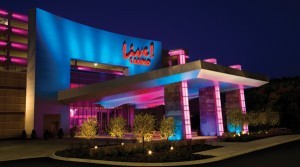 million of Maryland‘s $153 million, National Harbor saw an incremental decrease in its market share, some of which was recaptured by Maryland Live but not by Horseshoe Baltimore. Year over year, Maryland Live was down 13%, Horseshoe fell 22% and Hollywood Perryville was flat. (Always a victory of sorts when talking about that snake-bitten property.) Rocky Gap Casino inched up 6% and Ocean Downs jumped 12%.
National Harbor’s effect continues to reach into West Virginia, where Penn’s Hollywood Casino at Charles Town Races has been down 9% since the MGM property opened. Last month it saw declines of 9% at slots and 22% at tables. Overall, West Virginia was down 8%, with the splits pretty closely tracking with those at Hollywood, despite the hidden benefit of an extra weekend day. Maryland, by contrast, was up 38.5% for September.

[…] has a pretty good write up on the Wall Street rumor that Pinnacle and PENN gaming might merge, read here. If I remember the REIT that holds the physical properties already owns both Pinnacle and PENN […]
[…] open up Las Vegas to new casino visitors around the country. You can read about the possibility here. I’ll explore this deeply if it becomes a […]