
Penn National Gaming‘s quarterly report was about what you’d expect: strength in Ohio, weakness in West Virginia, and negative impacts from Hurricane Nate and the Mandalay Bay massacre. 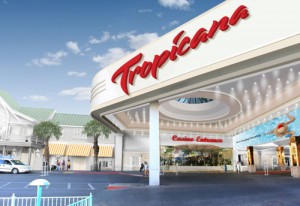 Also, Penn is looking toward the Canada market for expansion. As Deutsche Bank analyst Carlo Santarelli headlined his investor note, “We’ve seen this movie before.” The main item of interest on the conference call was the Tropicana Las Vegas, which has seen a revenue increase of 14% in 3Q17. Cash flow was said to be “more than doubling” given the reopening of a critical pedestrian bridge and of Robert Irvine‘s restaurant. Cancellations jumped 35% in the Oct. 1-15 period but “business volumes are slowly recovering.” Worst of all, future capex investments have been pooch-kicked until a year from now or thereabouts. Poor Trop. It never gets the love it deserves.
Over at Caesars Entertainment, management was providing some — but not very much — color about its plans for its acreage (including 89 off-Strip acres) for Las Vegas. The one specific it would divulge was that former slum land behind Harrah’s Las Vegas and the Flamingo would give way to a 300,000-square-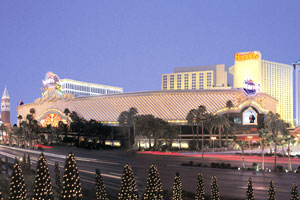 foot convention center. The project will cost $350 million, tops, and be open in 2019. Also, CEO Mark Frissora plans to franchise the Caesars brand and others like it (the most valuable one in gaming) to firms overseas, mostly north of the Equator. This is quite a turnaround from Gary Loveman, who valued the Caesars brand so highly he parked his ass on it and never deployed it except in Windsor, Ontario. Good move, Gary. Said Frissora pointedly, “Our brands are powerful and wanted by developers all around the world. We’ve never done this before.”
As for the aftermath of October 1, Frissora said “every day seems to change and improve. The meeting business is solid. There have been no cancellations for the year. The biggest impact has been 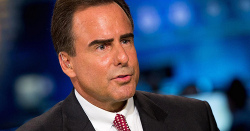 in Asian play. It has been less because people in Asia are very respectful of the deaths that have occurred and believe there should be a period of mourning.” There were vague noises about Japan and Brazil, where Jan Jones Blackhurst has been racking up the frequent-flier miles. Caesars was more definite about its South Korea casino project, which will move forward despite Lippo Group‘s defection.
Over at Planet Hollywood, Caesars was taking the next step forward with skill-based-slots, installing a pair of TriStation modules from Gamblit Gaming. Each is loaded with six games, 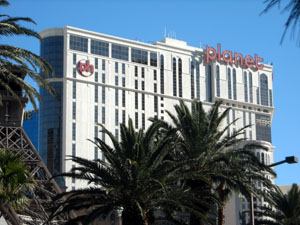 including popular Smoothie Blast. The Las Vegas Sun has the details. There’s also a first-person-shooter game. Couldn’t we have a moratorium on these for a decent interval after the Mandalay Bay shootings? Also, the time it takes to play the game, as opposed to the fast pace of traditional slots, has some doubting the new business model (“The math of all casino games is in favor of the house. As such the more wagers made the more money the casino will make”), as well as wondering if its complexity will be counterproductive.
* Saipan‘s eminence as a tower of strength in the gaming world is safe: Guam has decided to forswear casinos. Whew! They had me worried for a minute. Blame it on those darn Japanese tourists, who don’t like casinos.
* Speaking of Japan, its government is being advised that the free market should determine the size of casino floors, not some predetermined limitation. As Global Market Advisors put it, “Japan should allow the operator to work in partnership with the regulatory board to allow for a gaming floor that meets demand, thereby allowing enough profit to warrant the large levels of investment necessary to appropriately construct the other non-gaming amenities that will help spur incremental tourism and economic benefits.”
Meanwhile, Fitch Ratings poured cool water on some of the more exuberant revenue estimates coming out of Nippon, estimating the size of the market between $6 billion and $9 billion, not the $25 billion so often bruited about. Fitch also questioned whether some of the big-budget promises — $10 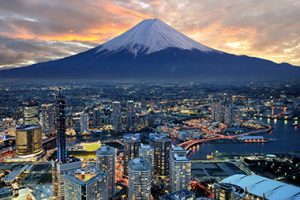 billion and higher — might hamper the obtaining of financing. Fitch’s Alex Bumazhny wrote, “For gaming operators, Japan provides an opportunity to diversify their holdings and capitalise on the market’s solid supply-demand dynamics. Those benefits come at a cost – any Japanese project would likely be expensive and may pressure credit metrics.” More optimistic was Morningstar Inc., which forecast 17% ROI in Osaka (on a $10 billion investment) and a 20% return from $11 billion spent in Yokohama, pending upcoming regulations. Those are the kind of numbers Wall Street likes to hear.
* Congratulations to Mohegan Sun, named Casino of the Year by the National Entertainment Buyers Association. Although this is the second time Mohegan Sun has received the accolade, it is not resting on its laurels but is putting $80 million into its Exposition Center which, when finished, will encompass a staggering array of event-friendly spaces. Your turn, Foxwoods.
