
MGM National Harbor dominated Maryland yet again, garnering 39% of market share and grossing $50.5 million. The balance of revenue continues to creep toward the (punitively taxed) slot side of the casino, so MGM won’t be completely thrilled with  November’s otherwise-impressive numbers. Gambling revenue in the state rose 42% but was down 13% on a same-store basis, as National Harbor continues to suck the wind out of the competition’s sails. Commanding 33% of market share, Maryland Live ($43.5 million) was down 13.5% while a 20% drop-off at Horseshoe Baltimore ($23 million) did little to remediate that casino’s 17.5% market share. An unlikely beneficiary of this competition was Penn National Gaming‘s Hollywood Perryville, up 2.5% to $6 million. Ocean Downs ($4 million) was up 3% and Rocky Gap Resort gained 8.5% to close at the month at $4 million.
Across the border, in West Virginia, slot winnings were down 4% and tables declined 15%. Penn suffered a 9% dip at its Charles Town racino (whose name is so preposterously long we refuse to reprint it).
* Last week’s brazen robbery of a Bellagio casino cage is throwing light on casino surveillance measures. The “eye in the sky” had a spectacular view of the extravagantly disguised robber and yet no attempt was made to interdict him. It could be that there was  no one watching: Strange as it may seem, casinos are allowed to leave surveillance rooms (which are skimpily staffed) unattended up to an hour while employees take their lunch breaks. According to surveillance consultant Willy Allison, this facet of casino security “runs very lean” in Las Vegas. Great. The world’s number-two casino destination and it decides to skimp on protection.
“Considering the volume of people and money in Vegas casinos, their staffing levels are surprising to me and way below worldwide standards,” Allison told the Las Vegas Review-Journal. As for hardware, Las Vegas evidently hasn’t heard the word “digital,” relying on VCRs and analog tape. (Except for newly introduced ‘nightclub cams,’ which must be digital.) It would appear that there’s work to be done.
* Could Del Lago Resort & Casino be turning things around? Its $3,532,995 Thanksgiving-week haul was its second-best ever. That would seem to indicate that Del 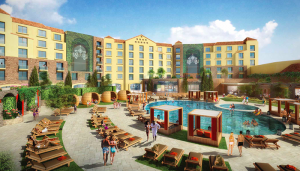 Lago is luring back some of the lookie-lous who turned out for the opening month, back in February. $4,540,83 was wagered at the casino’s 85 tables, while slots had an average daily win of $170/slot/day. A local paper reported that “average monthly traffic at the Waterloo exit increased by 43 percent since the casino opened in February.” Meanwhile, Tioga Downs finally qualified for “resort” status when it opened a 161-room hotel. A new golf course was also rolled out (odd timing for that amenity). On the question of underperformance, owner Jeff Gural riposted that the reinvented Tioga Downs makes more now than it did when it was just a racino.
* While on the subject of golf courses, the closing of Wynn Golf Club is being blamed on financial reasons, the implication being that the high-priced links weren’t paying their way. So it’s “Auld Lang Syne” time for a course that was played by the likes of Donald Trump, Bill Clinton and George W. Bush. Oh, if those sand traps could be talk! You still have until Dec. 17 to play the course … if you can afford the whopping greens fee (the highest in the U.S.), a cost that surely hastened the golf club’s end.
* Lawrence Ho is thinking well ahead of the competition when it comes to a Japan casino megaresort. Not only his architectural plans exciting, he’s planning a high-tech approach to screening out problem gamblers. Now if we could get him even half as interested in Las Vegas as he is in Nippon …
