
Kentucky is resuming its off-again/on-again flirtation with casino gambling. The reasoning was predictable. “The reason this idea has been on the radar for years is that we  know we’ve been headed towards very bleak budgets. Well, we’re there now,” said state Sen. Morgan McGarvey (D). Added state Rep. Jerry Miller (R), “It’s much more palatable than a tax increase.” True that, but this idea has come up in Lege after Lege and always fallen short. “This would free up tax dollars now going to pensions to be spent on other things in the budget,” Miller said and he’s proposed a bill that would dedicate all “casino gaming” revenues to the state’s sagging pension fund. Would casino companies cotton to something so confiscatory?
Gov. Matt Bevin isn’t on board with the idea, offering unspecified but ‘comprehensive’ tax reform in its place. The Kentucky Baptist Convention has his back. “I expect most legislators still agree that this is a terrible way to implement public policy and a favor to multi-national gambling interests. … There are other revenue alternatives without the social costs.” said lobbyist Tom Troth. Since the bill would have to pass both houses of the Lege by supermajorities its chances are long, even though Miller and McGarvey have cleared some of the underbrush by postponing detail-rich implementation legislation until when/if the overall enabling bill has passed. Despite having several co-sponsors from the GOP side of the aisle, McGarvey already seems willing to fold his hand, telling reporters, “We’re not asking people whether they want casinos, we’re asking people if they want to turn around the carloads of cash that are leaving our state on a daily basis. If the voters say no, we’ll stop talking about it in Frankfort and look for other ways to raise revenue.”
* What do you do if your revenues are so low that Moody’s Investor Service is warning that you won’t be able to pay off your debts? If you’re Del Lago Resort & Casino, you throw a big-ass party, complete with showgirls. General Manager Jeff Babinski, in a now-familiar refrain, dismissed Moody’s as “just a report. It’s analysis. At the end of the day, with what I know about what we’ve done here, what we are doing, I’m not worried.” 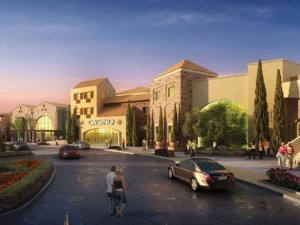 Perhaps he should be. Moody’s gives Del Lago a year to turn things around: “Given del Lago’s current performance, Moody’s is of the view that without a substantial improvement in revenue, del Lago will not be able to achieve a level of performance that can support its existing debt capital structure,” wrote Moody’s Senior Vice President Keith Foley. Instead of cannibalizing other upstate casinos, as Moody’s originally expected, it is Del Lago that is being devoured.
Not only is Del Lago’s debt level above the Moody’s “downgrade trigger,” the casino is falling short of Moody’s optimistic $250 million revenue projection for Year One, on track for $150 million instead. Over a Tioga Downs, owner Jeff Gural is engaging in some revisionist history, saying he knew all along the market was “saturated.” Of course Gural sang quite a different tune when putting on a full-court press for a gaming license. And at least he’s in relatively good shape, being only $30 million off his projections.
Babinski washed his hands of Del Lago’s exaggerated revenue forecast, saying, “That’s four years ago. I wasn’t here then. I’m here now and I know the impact we’re having.” The  casino-resort is definitely providing a windfall for some local businesses, Glenora Wine Cellars, awash in sales, and the town of Tyre, which gets a cut of the casino’s 37% tax rate. That means an $800,000 will grow exponentially, augmented by as much as $2.4 million in casino lucre. However, Tyre Town Supervisor Ron McGreevy has been circumspect in his plans, even with property-tax rates falling through the floor thanks to Del Lago’s revenue stream. “We’re frugal. We didn’t budget for money we don’t have. We like to operate on a ‘pay as you go’ basis,” he told a reporter. Would that Del Lago had been similarly restrained.
University of Texas Rio Grande Valley gaming analyst Clyde Barrow, who had projected Del Lago’s Year One revenue at $158 million, was not in the least surprised by 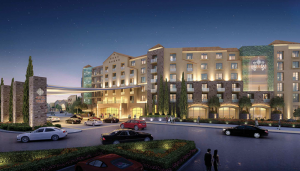 the casino’s struggle. “The state’s facilities siting committee really took the (casino) vendors forecasts at face value. They discounted the effects of cannibalization … They implememented a model that didn’t take into account the existing facilities,” he told a reporter. “They put casinos in places that were already saturated, or even oversaturated, and put a moratorium in New York City, which is where they should have put them … New York [State] did it backwards.” It will be several years before the Empire State has a chance to rectify that mistake.
* Mercer County may be three or four rounds away from consideration for a Pennsylvania mini-casino but, based on what they’ve seen so far, county boosters like their prospects. (So do we.) Who knew that when Keystone State legislators priced the  licenses at $7.5 million they gave the casino industry a belated Christmas present. The licenses have gone for $40 million, $50 million — money is no object when one of these licenses is in play. Mercer County has two potential sites: Grove City Premium Outlets and at the Shenango Valley Mall. No casino company has overtly expressed interest but the first two bidding rounds have producing some surprising developments, so Mercer is right to hope.
* South Dakota is looking at the Nebraska border and asking, “Why don’t we have a casino there?” The answer may be that it would take a constitutional amendment to accomplish it but they’re not wrong to ask. Nebraska has whiffed on the casino issue for years, leaving its gamblers free to be poached by South Dakota. The proposal before lawmakers calls for a casino to be operated by a non-profit group. (Somebody’s obviously been studying how things are done in Iowa.) Year One revenues are projected at $35 million. Per the amendment, on offer would be roulette, keno, craps, limited card games and slot machines. The bill is already generating from tribal casinos in the Yankton area, of which there are 11 and who would be understandably unenthusiastic about the state horning in on their oligopoly.
