
Even as it’s using MGM Springfield as a catspaw to potentially land Wynn Boston Harbor, that didn’t prevent MGM Resorts International from announcing a date certain for the Springfield opening. Mark August 24 on  your calendars, for that is the day the doors are supposed to swing wide and a new era in Massachusetts begins with its firs casino megaresort. If there’s going to be any special entertainment, MGM has yet to announce it. However, it does promise “eclectic guest rooms inspired by the historic significance, iconic architecture and literary legacy of its urban surroundings. Each space is punctuated by details such as quotations from the works of Emily Dickinson and whimsical Merriam-Webster-inspired works of art.” Recreation includes as TopGolf “swing suite,” where you can play a simulated game, an eight-screen cineplex and a bowling alley.
The dining array is headlined by Michael Mina‘s Cal Mare, as MGM continues its profitable association with the celebrity chef. Public art will consist “of commissioned and hand-selected pieces by international and local artists from Springfield, the greater Berkshires, New England and beyond,” while Springfield Museums is loaning out antiquarian technology that 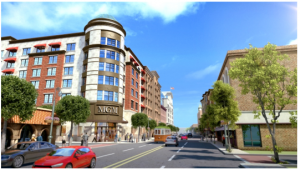 includes a Western Union telegraph machine from 1925 as well as something called a Telegraphone (I’d go just to see that). By opening in late summer, MGM Springfield gives locals several months to enjoy the open-air plaza that “will feature live events, local artisans, farmers markets and seasonal programming including an outdoor ice rink.” Gambling is way down the page of the press release and in very small print, although it mentions 2,250 slots, 120 tables and a poker room. Having gone into such exhaustive detail to capture the New England market, it’s a little hard to imagine MGM throwing it away for a grab at Wynn Boston Harbor but if it does, Boyd Gaming or someone like that will inherit a very nice casino indeed.
MGM announced 1Q18 results yesterday and JP Morgan analyst Joseph Greff pronounced them “better than expected.” However, conversion of Monte Carlo to Park MGM must not be going as well as planned, as 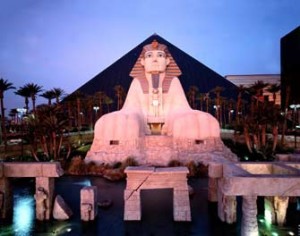 continued disruption at that property clouds MGM’s immediate future on the Las Vegas Strip, as does the cancellation of a Canelo Alvarez fight (count on Canelo to let you down in the clutch) and continued customer aversion to Mandalay Bay — I can’t imagine why. Still, MGM’s Strip cash flow ($449 million) was $27 million better than Greff’s estimate, even though MGM’s regional casinos underperformed JP Morgan projections. Mandalay Bay and Luxor were a drag on the Strip portfolio, with room revenues down 12%. Slot revenue was a bit off (2%) but table winnings were up 8%.
Deutsche Bank analyst Carlo Santarelli wrote that curtailing room-revenue expectations “speaks to our view of continued softness in 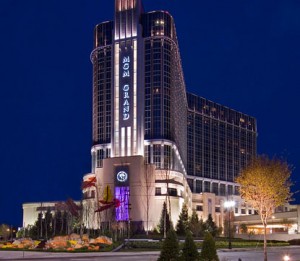 demand and an ambiguous outlook, with convention attendance having plateaued.” Santarelli took a more-favorable view of the regional revenues, although Borgata missed its target by $8 million. (MGM National Harbor and MGM Grand Detroit remain towers of strength.) MGM Cotai came in far below Wall Street consensus for cash flow ($6 million vs. $16.5 million), but MGM Macau made up for that with $146 million, $9 million above consensus.We look forward to additional color from the formal conference call.
* MGM’s primary Macanese rival, Las Vegas Sands, also announced results and Santarelli pronounced that Sheldon Adelson “delivers against high expectations … we believe the strength in Macau is and clearly will be the story for the stock moving forward.” The house(s) played lucky in Macao, reporting 21% higher VIP revenue on 14% greater volume of wagers. Intriguingly, “management discussed its strong position in Japan, expressing optimism around the timing of the implementation of the gaming bill, while also noting further optimism around a potential opportunity in South Korea.” The latter is most  intriguing, as Adelson has ruled out any resort development that doesn’t admit locals. Does he sense new flexibility in the Korean government? As ever, Sands was upbeat about selling the Marina Bay Sands retail mall but we’ve heard that golden oldie many times now. “Stronger high end table play drove stronger than expected table drop and, combined with better than expected slot handle, drove upside to our gross casino revenue forecasts” on the Strip, where room revenues were up 1%.
Speaking of Marina Bay Sands, which we do insufficiently, its $430 million (!) cash flow easily beat JP Morgan’s estimate ($401 million), “reflecting solid VIP, retail/mall, slots, and overall margin performance,” according to Greff. He projects Marina Bay Sands to do just shy of $1.8 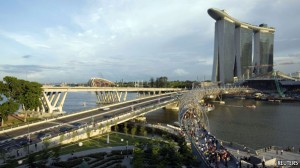 billion in cash flow this year. Its $352 million gross gaming revenue far exceeded his $259 million forecast. Non-gaming revenues, by contrast, were only (?) $220 million. Pretty impressive for a single casino and explanatory of Adelson’s optimism toward Japan. Macao gaming revenues were a hard-to-imagine $2.1 billion for the quarter, helped by 22% growth from that staple of Adelson’s business, the mass-market player. Not resting on its laurels, Sands has redone two of its Parisian VIP rooms, one at Four Seasons, and is preparing to open the Four Seasons and St. Regis Suites Towers, bringing 650 more high-end suites into the market. Las Vegas was almost an afterthought but net revenues in Sin City were 7% higher and cash flow comfortably exceeded expectations.
* Churchill Downs beat Wall Street expectations on the strength of 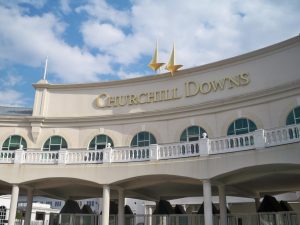 its casino portfolio (which stretches from New Orleans to Oxford, Maine). Casinos brought in $98 million, while racing pulled up lame, far below Street estimates. Not even the first-quarter scheduling of the Louisiana Derby helped. Neither did what should have been an easy comparison for Fair Grounds in New Orleans, which had been adversely impacted by a contagious-disease outbreak in 2017. Were it not for slot machines at tracks, we’d see horse racing go the way of the dodo.
* Penn National Gaming put out a “messy but clean” (Santarelli) earnings alert, “and while there are a number of moving parts stemming from accounting and reporting changes, the net result is soundly above estimates and guidance.” Excluding some Casino Rama accounting minutia, there wasn’t much to chew on in the report, certainly nothing indicative of Penn’s future plans.
* Our “Stiff of the Week” goes to the Trump administration for granting 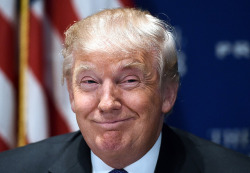 recognition to six Virginia tribes — on the condition that they forswear casinos. What Donald Trump giveth with one hand he taketh with another. Stay poor and on the rez is the message from the White House. It will be intriguing to see what happens if Virginia legalizes casinos, in which case the Indian Gaming Regulatory Act could empower the tribes — or at least make for one helluva court battle.
