
While Las Vegas, as mentioned earlier, is slogging through a 10-month visitation slump, you wouldn’t know it from March’s gaming-revenue numbers, which were 9% higher on the Las Vegas Strip ($574 million), although 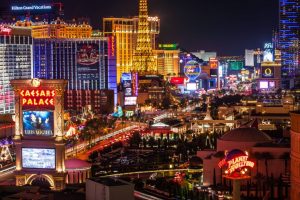 locals casinos took a 5% hit. Deutsche Bank‘s Carlo Santarelli suggested that the Strip result was a bit of smoke and mirrors. The increase was “due entirely to stronger than expected baccarat drop/hold … given the majority of the Strip operators already reported, the result is largely inconsequential.” Slot revenue was flat at $278.5 million on slightly lower coin-in and tighter holds, while tables ($179 million) were down 8% on the Strip. The star performer was baccarat, up 115% on 52% higher volume and also enjoying a favorable calendar — one more weekend day.
Downtown ($54 million) got hit hard, off 14%, while North Las Vegas ($24 million) was down 9% and the Boulder Strip ($64.5 million) slipped 6%. Laughlin ($52 million) was up 2%, though, while uncategorized Clark County ($107 million) was 3% off. Given the frequently invoked strength of the Las Vegas economy, Wall Street boffins were at a loss to explain these numbers. Reno ($51 million) was flat while South Lake Tahoe fell 13% to $14.5 million. Out in the boonies, Elko (up 5%) was strong at $27 million and Carson Valley ($9.5 million), even stronger at almost 13% higher.
Perhaps Nevada would be doing better if weren’t only the third-most “fun” state in America, according to WalletHub. Sure, we’re tops in casinos per capita but only 25th in access to national parks and 30th in  amusement parks. California and New York State best us overall but we edge out Florida while Illinois comes in a surprising fifth. West Virginia is the least-fun state in America, down there with Mississippi (#49), Delaware (#48) and Rhode Island (#47), which shows that slot machines can’t cure everything. Nevada does come in #1 in “nightlife,” a category in which it squeaks past — believe it or not — Wisconsin. States without casinos tended to inhabit the lower half of the list, although New Jersey‘s 27th-place ranking hints that Atlantic City can’t do it alone.
* Boyd Gaming can’t get into the Illinois slot-route market fast enough. The latest casino revenues from the Land of Lincoln were not impressive: 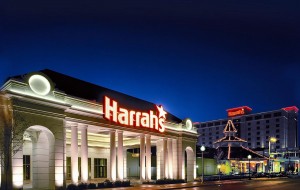 down over 5%, with foot traffic 6.5% lower than last year. Ironically, Boyd’s Par-A-Dice, which was incrementally better this year, was one of the few casinos to improve its performance, grossing $7 million. Between Harrah’s Joliet and Harrah’s Metropolis, the Caesars Entertainment riverboats grossed $21.5 million, a 7.5% slippage. Penn National Gaming was mostly down — 7.5% off at Argosy Belle ($4 million), 2% down at Hollywood Joliet ($10 million) but 2.5% higher at Hollywood Aurora ($10.5 million). The soon-to-be Eldorado Resorts boat, Grand Victoria, swooned 8%, for a $13.5 million finish.
Speaking of Eldorado, it blamed “adverse weather” for missing Wall Street earnings estimates. “We believe ERI has positioned itself for multiple years of significant EBITDA growth,” wrote JP Morgan‘s Daniel Politzer, citing a slew of positive factors including growth markets in Reno, Black Hawk, Columbus and southern Florida. Politzer blamed snow in Reno for the 1Q18 shortfall.
* Santarelli called Macao gaming-revenue growth of 27.5% in April a “big positive surprise,” especially when the Street’s estimate was for 20%. “We believe the VIP segment led the growth in the month of April, as hold was broadly normal, and mass growth again eclipsed 20% … We expect May 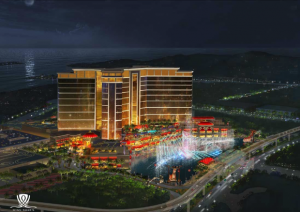 to maintain this momentum.” Wynn Resorts gained a smidgen of mass-market play, at the expense of Sands China and Galaxy Entertainment, but it gave it right back in the VIP tranche, where Sands and Melco Resorts & Entertainment excelled. Sands continues to be the mass-market leader, with a 30% share, followed by a scrum of Galaxy (18%), Sociedade de Jogos de Macau (17%), Melco (14%) and Wynn (13%), with MGM Resorts International way back at 7%. Where VIP play is concerned, Galaxy is tops with 28%, comfortably ahead of Wynn (19%), Melco (15%), Sands (15%), SJM (14%) and MGM (8%). The latter is flat on a sequential basis, strongly implying the MGM Cotai isn’t giving it any traction,

With the recent Garces (restaurant) Group bankruptcy, what will the soon to open Ocean Casino in Atlantic City do with its four Garces restaurant’s spaces? Also the Tropicana has two of his restaurants.