
They came, they saw, they bought. Yes, Vici Properties has struck again, inking a bargain-price deal to acquire the Octavius Tower of Caesars 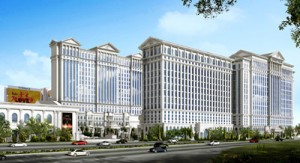 Palace and Harrah’s Philadelphia. On paper, Vici is paying $507.5 million and $241.5, respectively, for the two assets. However, thanks to lease-modification hocus-pocus, the purchase price has been discounted $159 million. “Harrah’s Philadelphia will bolster our presence on the East Coast [I thought it already had] by establishing a foothold in a top gaming market [I thought it had done that too],” said Vici CEO Edward Pitoniak. What I want to know is, how are these cut-price deals maximizing shareholder value?
* Mohegan Sun has thrown its hat in the ring for a Japanese casino. “We see many similarities between Mohegan Sun and the Japanese regional resort concept,” said CEO Mario Kontomerkos. “Like Connecticut, the regional markets of Japan are four-season markets, meaning that a special kind of expertise is required to drive visitation both in the winter snows, and the summer heat.” Compared to the $10 billion megaresorts envisioned for Japan, Kontomerkos’ $1.6 billion Project Inspire in South Korea is just a 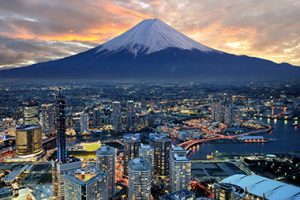 little shack. However, it gives Japanese politicians a view-in-progress of what Mohegan Sun could do for the Land of the Rising Sun. Kontomerkos promises to cross-market the prospective pair of super-resorts. “We will tie our Japanese venture into this connectivity … to create ‘tourism synergy’ between the two resorts – and the two nations – that will be unmatched in all of Asia,” the CEO said. “In other words, this is a US$5 billion dollar investment not in just Korea, but into all of northern Asia, including Japan.”
Kontomerkos also made a more-bang-for-your-buck argument, saying, “Mohegan Sun is located in a very remote and rural area in southeast Connecticut, and has little – in the way of local population – 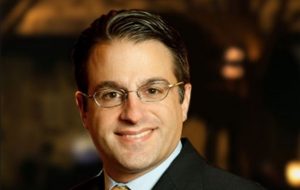 to draw from. Yet it is the highest-grossing casino resort in the Western Hemisphere, currently attracting around 11 million visitors per year. This one property creates one-third of the annual visitation of the entire Macao market.” That’s data that will be music to Japanese ears.
So will Société des Bains de Mer CEO Jean-Luc Biamonti‘s promise to exceed the Japanese government’s expectations for responsible-gaming practices. “In addition to government rules, we will add to these rules to ensure there is no problem – we will be very protective of the people,” said Biamonti, whose company is teaming with Galaxy Entertainment, the 800-lb. gorilla of the partnership. 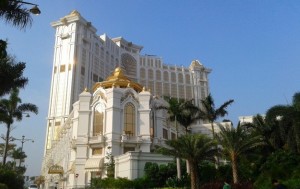 Said Biamonti’s, citing SBM’s 63% governmentally owned stake, “We can exclude anyone from the casino and we don’t have to give a reason. If we see a problem we take action.” His message that bread-and-butter players were the worst addicts seems to play right into Japanese fears of gambling addictions — but did you know that the Monaco Formula 1 Grand Prix loses money every year, too?
* At least one good thing has come out of Steve Wynn‘s misconduct. In what appears to be an effort to improve its image, Wynn Macau properties are improving their maternity and paternity benefits. Good on Wynn — the company, that is.
While on the subject of Macao, there’s already talk emanating from MGM Cotai about adding a second tower with 900 hotel rooms. The property already has quite a room repertory: 1,248 so-called resort 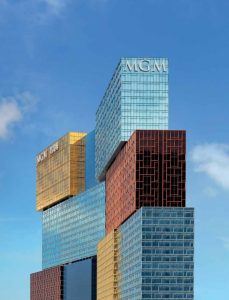 rooms, 99 suites, 16 skylofts and 27 high-roller villas. This latest announcement looks like a play for the premium-mass market, although the addition of 100 suites is a pure high-end move. There’s no timeline for these expansions, even though MGM China has $325 million budgeted for capex investments this year. CEO Grant Bowie‘s explanation was an oracular, “We need to respond to the market conditions to make sure that we can meet the expectations.”
* Florida lawmakers are justthatcloser to being dealt out of casino policy in the Sunshine State. (Visited it last week; loved it.) A February poll of unknown provenance shows 76% percent approval of likely  voters of a constitutional amendment under which casino approval would revert to local control only. Tallahassee would be out of the discussion. The plebiscite needs only 60% to pass. Despite 1.1 million petition signatures and 23K Facebook “likes,” the campaign has the feel of astroturf. Of the $10 million that came into its war chest, the entirety of it came from the Seminole Tribe and casinophobic Disney World, two diametrically opposed interest groups who have decided that the enemy of my enemy is my friend.
* Gov. Mary F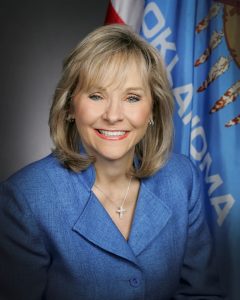 allin having appended her signature, Oklahoma tribal games will soon be eligible for craps and roulette. The Sooner State gets gaming money and tribes get badly coveted games. “It’s something the customers are demanding, it will obviously provide some incremental revenue back to the tribes via their casino operations, and then the state and teachers are getting additional funding, as well. I think it’s one of those opportunities that came to fruition where all parties actually, truly benefit from it,” said Cherokee Nation Entertainment COO Mark Fulton. Last year, tribes paid $137 million in exclusivity fees, which went to a variety of good causes, including mental health.
“What are currently in operation are games that perform like a craps game or roulette game, but they’re card-based. In other words, they don’t have a roulette wheel with a ball spinning around it, and you don’t have live dice playing the games, but you have all the possible outcomes on those games,” Fulton said of the outgoing status quo. Hard Rock in Tulsa, West Siloam Springs, and Roland will be the first beneficiaries. Fulton is particularly looking forward to the incoming games because they will give CNE additional bullets in its bandolier with which to compete with the Shreveport/Bossier City market.
What do with this potential largesse? Sheila Morago, executive director of the Oklahoma Indian Gaming Association lays it out:  “There are literally only five areas that the tribes can spend their gaming money on, and that’s in the Indian Gaming Regulatory Act. Technically, all of the money the casinos make is 100 percent taxed by the tribal government to government services, like any city would with taxes, so – infrastructure, running the government, education.” Sounds fair to us.
* April gambling revenue at Penn National Gaming‘s Plainridge  Park racino nudged up 2%, as looser hold negated 5% higher coin-in. Slot grosses were $183, or $389/win/slot/day, well above the historical average of $357/slot/day. Plainridge Park insists upon thriving despite the Boston Globe‘s repeated efforts to pillory it as a failure.
