
Yesterday, we spotlit the Debbie Downer view of Las Vegas of one online columnist. And while a lengthy slide in visitation numbers remains a concern, dark and anecdotal snapshots of Sin City are  contradicted by the numbers. The latter are across-the-board better, in cases significantly so, than a year ago. (To be honest, these numbers also reflect Macao‘s recovery, particularly in the case of Las Vegas Sands.) Richard Velottta has a lengthy laundry list of the reasons why Vegas companies are doing better. As Wynn Resorts CEO Matt Maddox told investors, “The future is better than the past, no matter what the media likes to say.”
Companies not doing better are few but Boyd Gaming is one of them. It blames I-15 construction for poorer business in Downtown and bad weather for weakness at its regional casinos in the first quarter. Station Casinos is coming off a $620 million revamp of the Palms but doesn’t expect it to hit its stride until year’s end. As for casino companies with an outlying presence, Union Gaming Group‘s John DeCree offers some comfort: “In our view, the regional consumer is very healthy, and  we expect better trends are ahead as winter concludes. The first quarter is always choppy as the unfavorable weather moves around, ultimately impacting one or two markets; this year for Boyd, it was the Midwest, which was also impacted by a new competitor” in the form of Four Winds, in Indiana. Still, there’s no denying that two of the top three casinos (Sands, MGM) are heavily reliant upon good times in Macao. As for the third, Caesars Entertainment, we haven’t a quick theory but it definitely has a not-so-secret weapon in the form of Total Rewards.
Meanwhile, Eldorado Resorts doesn’t have a Vegas presence, but it’s hovering on the edges with the impending acquisition of Tropicana Laughlin. Eldorado’s tale is the feel-good story of a family company and a home-grown casino enterprise that grew from one property (the titular Eldorado in Reno) to a big-leaguer with 27 casinos in 12 states,  assuming that all regulatory approvals go through — and there’s no reason to think they won’t. “Las Vegas is a great market, and maybe someday we’ll have the opportunity to have a casino here, but nothing’s eminent [sic],” says COO Anthony Carano, who adds that acquisitions aren’t geographically planned but depends “whether we can provide a great return to our shareholders, and it kind of falls where it may on a map.” Maybe that lack of geographic strategy explains the buyer’s remorse Eldorado experienced in Erie and Vicksburg. Still, Eldorado’s runaway growth has to be one of the headline stories of 2018.
As for Station, we were wondering if its “From Dust to Gold” ad campaign for the Palms would stick in any craws and sure enough it did. With the Mandalay Bay Massacre fresh in his mind, Cornell University School of Hotel Administration‘s Dr. Chekitan Dev confesses to a “mixed feeling … It appears to be about revitalizing the brand. On the one hand, glorifying violence and destroying property to make a point seems gratuitous at best and irresponsible and crass at worst.” Boston University School of Hospitality Administration professor Makarand Mody agrees: “I think some of the images they used in the video were a little insensitive … from the perspective of particularly what happened in Las Vegas last year. It could have been more subtly executed.” Well, the Fertitta Brothers were never known for subtlety.
One defender of the ads likens them to the current fad for “Anger Rooms.” Creative consultant Faris Yakob says, “The Dust to Gold commercial is dramatically expressing the idea of creative destruction and evokes the emotional release that has made Anger Rooms popular once again … it works well, but there are a couple of elements that I think will jar.” This may be reflective of Station’s decision to go to market with the ads without pre-testing them on consumers, a gut-level decision that resulted in “people wielding gilded baseball bats and crowbars, Molotov cocktails, and chainsaws, all while carnivorous Doberman Pinschers run down hallways and explosions erupt throughout the property.”
Palms General Manager Jon Gray would take issue probably with the ‘Anger Room’ comparison, saying, “The couple [in the ad] is enjoying themselves. We really wanted to make sure there was no sense of anger in that.” He added, We really wanted to highlight the beauty of the destruction process to create the new, and we were sensitive to that in how we approached it.” Gray knows whereof he speaks, throwing in a Pablo Picasso quote (not used in the ads): “Every act of creation is first an act of destruction.”
Gray didn’t address the spot’s obvious derivation from The Cosmopolitan of Las Vegas‘ “Right Amount of Wrong” positioning but 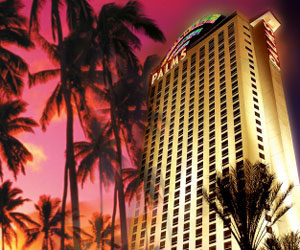 said, “The campaign has to do a lot of heavy lifting. It had to articulate the story of how The Palms, the entire property, has undergone this massive construction and redevelopment project and tell people there’s a lot of new stuff, but also more to come.” (Remember, the new renovation is only the first of three phases.) Dev would agree at least to the extent that “shock and awe” are needed in the Vegas market to differentiate between different casino brands. No question that “From Dust to Gold” has plenty of awe and a certain amount of shock.
Dev thinks the campaign might resonate with the Palms’ core constituency but it’s a question of ‘which one’? Locals who associate the Palms with good paytables and excellent marketing offers might be put off by the high-end skew of “From Dust to Gold.” As for the monied Californians who flood the property on weekends, it could be right up their alley. (You don’t check into the Palms expecting to get a good night’s sleep.)
Dev’s main beef with the spot actually isn’t all the carnage. “From my understanding of the Las Vegas market, where I have done multiple projects, The Palms has always positioned itself with a unique attitude that was bold, brash, sexy, and over the top. That doesn’t come through for me in this campaign.”
We disagree, as does Gray. “It evokes an emotional reaction right away. It’s really refreshing. I’ve only gotten positive feedback and it nods to the guests we used to have.” If he means the big spenders, then the campaign has done its job. As for increased locals play, that’s probably lagniappe. The Fertittas bought the Palms because it was as close to being on the Las Vegas Strip at an affordable price as one could manage (and not in an antiquated property). Besides, it’s nowhere near as crass as George Maloof‘s rollout of the Fantasy Suites, which looked like a recruiting brochure for Al-Qaeda. It’s an interesting experiment in marketing and we can’t wait to see how it pays off.
* As though the Illinois gaming market were not sufficiently diluted, lawmaking pest Rep. Bob Rita (D) is back with a gambling-expansion  bill that keeps returning from the grave, hoping to rush it to a floor vote before adjournment. In addition to making slot routes yet more attractive by lifting the cap on winnings, Rita would add six casinos (one of them in Chicago), more riverboats, plus racinos. If this monstrous afterbirth of the illicit coupling of Rita and racetrack owners is allowed to come to term we’re likely to see some casino closures in the Land of Lincoln.
There’s no question that the tracks are the prime movers behind this. Arlington International Racecourse General Manager Tony Petrillo said that existing tracks were “on the verge of extinction from fierce competition.” Petrillo’s estimate of $100 million in additional tax revenue is one of the more extreme versions of wishful thinking we’ve  encountered but legislators are rarely able to resist that kind of talk. Taking a stick-it-to-the-casinos stance, state Sen. Terry Link (D) said spitefully, “You have to remember one thing, of those of us who have gray hair in this room, all of this was illegal at one time in the state of Illinois. No one anticipated the casinos making the kind of money that they made from the beginning.”
The only person talking sense is Illinois Casino Gaming Association Executive Director Tom Swoik, who noted that the industry has already lost 28% of its customer base to slot routes and that the expansion would translate into 27 new casinos, an exponential increase. As for the current state of affairs, “These gamers didn’t disappear. They went to the 6,500 neighborhood locations with slots,” Swoik said. The question is whether anyone in Springfield is listening to Swoik and willing to smother this homonculus in its crib.

Mr. McKee..Do you have any factual numbers or even personal speculations regarding how much the recent ongoing and escalating charges for resort and parking fees have added to the revenue streams for CET and MGM Resorts?
Casino companies haven’t been breaking out those numbers, with the exception of the last MGM conference call, in which the company attributed a $2.80/room/day increase in revenue entirely to higher resort fees. It appears that it is no longer necessary to increase business, merely to create the *illusion* of increased business.