

We’ve warned against turning the tribal-recognition process over to Congress and a bill singling out a California tribe for special treatment would seem to be an object lesson in the “Why.” Rep. Doug LaMalfa (R) wants to reinstate Ruffey Rancheria, formerly 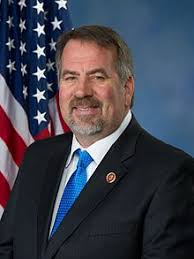 the reservation of the Siskiyou County American Indians, created in 1907, taken away from the landless tribe in 1957. Since LaMalfa’s bill would constitute an end run around the land-into-trust process used by the Bureau of Indian Affairs, especially with regard to approval of gaming, it’s stirring some ire in the Etna area, along with criticism of setting a precedent that would turn the Indian Gaming Regulatory Act on its ear. LaMalfa has already smuggled a land-into-trust bill for the Chumash Indians through the House and into the Senate. (LaMalfa, pictured, bears an unfortunate resemblance to the proverbial used-car salesman.)
Ruffey Rancheria attorney Tahj Gomes tried to strike a bipartisan note before Congress. “For us, restoration is not a political issue. It is not a partisan issue, it is a question of justice.” That may well be, but if so what is it doing in the most politicized forum in America? Justice or not, the rancheria is not playing by the rules abided by every other casino-aspiring tribe in America. LaMalfa’s argument is that only  Congress can undo what Congress did to the Ruffey Rancheria. Again, we disagree. One hates to go along with tiresome anti-gambling groups like Stand Up for California but such is our position. SUC is contending that the rancheria was terminated because, at the time, the land was abandoned.
Even other tribes are lining up against LaMalfa. Seventy of them have done so, and counting. “Why the rush, and why so much secrecy?” asked Karuk Tribe Chairman Russell “Buster” Attebery. As to LaMalfa’s motives, follow the money: 28 of his top donors are either gambling interests and Native American tribes, two groups that intersect to form a powerful set.
* Casinos could be coming to India in earnest. That country’s Law Commission has concluded that the only way to combat problem gambling in the subcontinent would be to legalize casinos, sports betting and Internet gambling. “Many countries that prohibit  gambling have not been successful, particularly with regard to online gambling,” the commission argued in a hefty report. The commission was basically holding its nose with one hand and issuing the report with the other, saying that gambling was “not desirable.”
However. “Incapability to enforce a complete ban has resulted in rampant increase in illegal gambling, resulting in a boom in black-money generation and circulation. Since it is not possible to prevent these activities completely, effectively regulating them remains the only viable option.” The commission’s work was prompted, in part, by a recent match-fixing scandal that rocked the cricket world. “Match-fixing and sports fraud should be specifically made criminal offences with severe punishments,” sternly noted the commissioners, making it clear that point shaving was, well, just not cricket.
But before U.S. gaming companies begin to salivate at the prospect of Indian gaming of an entirely different sort, note this: “Gambling and betting, if any, should be offered only by Indian licensed operators … possessing valid licences granted by the game licensing authority. For participants, there must be a cap on the number of transactions an individual can indulge in these activities in a specific period, i.e., monthly, half-yearly or yearly.” Investors will have to weigh those downsides against an unknown upside, although Global Market Advisors pegs at $10 billion, peanuts compared to what Japan is expected to generate.
* Speaking of Internet gambling, the Supreme Court may have cleared the way for interstate sports betting, via its interpretation of the federal Wire Act. Read the fascinating details here.
