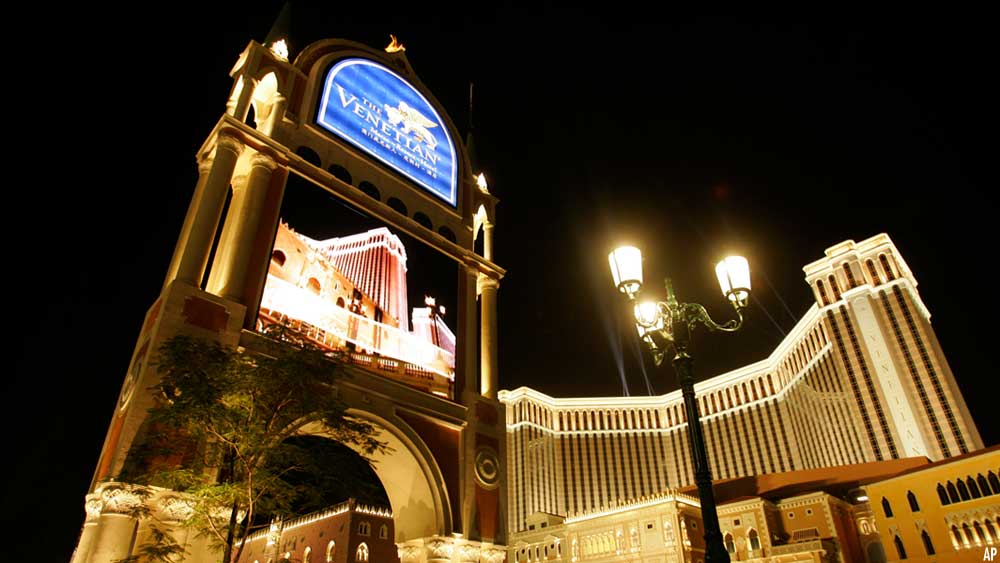

In his latest column, gaming-law expert I. Nelson Rose contends that U.S.-owned casinos in Macao are on dangerous ground, caught in the cross-hairs of the U.S./China trade war. He begins  by recapitulating China’s highly targeted retaliations, which make red states like Iowa their Ground Zero. He points out the vulnerability of Las Vegas casinos to curtailment of exit visas from China: In 2013, the Chinese government launched its now-infamous crackdown on corruption. In Las Vegas, “Just a slowdown in visitors from China cost Nevada casinos more than $400 million a year on this one card game,” baccarat, lifeblood of the Strip.
Beijing could also throttle visitor traffic to Macao, as it has done in the past. “One of my students was in charge of the frequent visitors program for an American-owned casino. When visa restrictions were imposed from Beijing, she lost her job, because there were no more frequent visitors.” Finally, we get to the most sensitive issue of all — concession renewals. While the chief executive of Macao has the prerogative to extend concessions as much as five years, after that they must explicitly be rebid. For Rose, this raises the specter of  Genting Group and Caesars Entertainment (which notoriously passed on Macao the first time around) coveting the hard-won assets of MGM Resorts International, Wynn Resorts and Las Vegas Sands. Besides, “there will also be a lot of giant Chinese companies, some having nothing to do with gaming, which would like to take over these enormously successful casinos.”
Also the subconcessions enjoyed by MGM and Sands are nowhere codified in law. As Rose notes, this can be fixed in China with a stroke of a pen, but things can be undone just as easily. Rose enumerates Donald Trump‘s litany of blunders in the Pacific Rim and his insular, impervious attitude toward unwelcome information, to say nothing of his disinterest in other cultures. “Trump seems not to know how serious his insults to China are. Worse, he does not even know what it means in China to save face. Making someone lose face can create an enemy for life. At the very least, it requires revenge; Chinese soap operas often involve avenging face-losing situations.” (Rose teaches at the University of Macao and has probably watched a Chinese soap or two.) “The danger to legal gaming is that Trump never backs down. He openly and consistently revels in revenge.”
Between Trump’s appetite for seeking conflict and the Chinese imperative to save face, Rose sees a dangerous nexus for American-owned casinos. (Macanese officials have flexed their muscles several times already, first taking a casino site away from Sheldon Adelson, then capping the number of table games allotted to new resorts.) Rose wittily adds, alluding to Steve Wynn‘s political loyalties, “When it comes to saving face, the [People’s Republic of China] probably won’t buy the argument that the ‘Wynn’ on the side of casinos may now refer to Elaine rather than Steve.”
If goaded into revenge, Rose postulates, Chinese leadership won’t repatriate concessions outright: “No Western company would ever spend another cent in China if these investments are lost through government action.” However, open bidding is not out of the question. Or maybe it will settle for curtail visitation to Nevada. One way or another, China is not finished getting back at Trump. And in this game of political football casinos find themselves at the unenviable position of the 50-yard line.
