

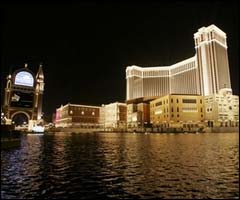
 If the Chinese government isn’t handing free money to casino operators in Macao, they’re getting the next best thing: free land. Due to the exceptionally slow-moving nature of Macanese governmental paperwork, casino developers have been able to build on their sites for years, rent-free. Las Vegas Sands was able to save at least $3 million on Venetian Macao (left) because it took bureaucrats nearly three years to finalize the lease. Galaxy Entertainment and Melco Crown Entertainment are named as other beneficiaries of governmental sloth.
My favorite part of the exposé is when it refers to Sands’ stalled Cotai Strip™ sites, “where it pretends [sic] to build a total of three hotel and mixed use towers in Cotai.” No, but it must sometimes feel like a pretense to the long-suffering Macanese.
Here’s one way to keep the federal government out of the casino-taxing business, regulate and tax Internet gambling at the state level. The California proposal is more elaborate than the Review-Journal lets on and may prove too cumbersome to implement, but given Golden State lawmakers credit for taking a forward-thinking approach. This is a trend worth encouraging.
We’ve been taking a wait-and-see attitude on New Jersey Gov. Chris Christie, vis-a-vis gaming issues, and so far it’s been a mixed bag but mostly positive. His reversal of a Jon Corzine policy to have casinos police themselves in the event of another government shutdown was a sensible move. S&G also took heart from his declaration that the state’s horse tracks would have to be self-sufficient, as that implicitly meant the horsey set would have to been itself from the $30 million/year teat supplied by Atlantic City‘s casinos.
However, Christie — if not exactly flip-flopping — is starting to waffle a bit where once he was flatly opposed to VLTs at tracks. Way to push Atlantic City under the bus, guv! Then again, if it’s going to require massive tax incentives to get Revel finished on the Boardwalk (as appears to be the case), slots at tracks may be the bitter pill Atlantic City has to swallow in order to sweet-talk additional development dollars out of Trenton‘s grip.
Whoever takes the reins at Pinnacle Entertainment is going find themselves a lame duck. Supposedly interim CEO John Giovenco continues to preempt major decisions that ought to be the prerogative of his successor. There’s no dearth of available executive talent, so Pinnacle’s stalling tactics are a head-scratcher … unless Chairman Richard Goeglein‘s endgame is land an obliging patsy who will carry out his (Goeglein’s) vision for the company.
Trouble in Rivers Casino. If business doesn’t continue to pick up at Pittsburgh‘s downtown slot parlor, it’ll have to raid the casino cage to meet its commitments to the city and county. The book on Rivers Casino is getting perilously close to Chapter 11.

Ain’t likely to happen here in CA.
Some casino Indian tribes oppose it because of potential competition & threaten to stop paying their contracted $millions to the State, saying it would void state/tribes compacts.
Other tribes support internet gambling, figuring they can get into the action.
The tribes will probably fight each other in court, and in the $egis$ature.
If the Legislature does manage to pass something (which is doubtful, given its doleful track record) the law would immediately be tied up in lawsuits by tribes and special-interest groups.
And it’s probable that the Repubs would refuse to vote for any such plan, claiming it (1) would amount to a tax increase; (2) would create another evil government bureaucracy; (3) is against Christian morality.
If anything happens at all, the legislature would probably write up some slap-dash measure and kick it out as a referendum for the voters to fight over – as usual.
[…] the original post: Macao even more profitable than previously thought « Stiffs and … Share and […]
[…] post: Macao even more profitable than previously thought « Stiffs and … Share and […]
Hmmm…..The Chinese Government is NOT collecting rents during casino/hotel construction….Hmmm…in the future, could this be the basis for the Chinese goverments to evict the casino operators and then take control of the casinos?…Hmmm….Lots of money being gambled in Macao….Hmm…..?