

Hard Rock International exited the Ohio market by one door, then reentered it by another. The tribal giant bought Dan Gilbert out of Jack Cincinnati and Turfway Park. REIT Vici Propreties will own the real estate of the casino and racetrack, while Hard Rock gets the management contracts, part of an increasing trend in the casino  world. The deal leaves Gilbert still in control of Jack Cleveland, racino Jack Thistledown and with a minority stake in Jack Baltimore. If Gilbert is playing one side off the other to get the best deal a la carte I’d saying it’s a winning strategy. It also explains why Hard Rock was not only so tractable to selling Northfield Park but were quick to take their name off the racino. The deal is valued at $780 million. Now let’s rid of that ridiculous “Jack” brand, which reeks of douchebaggery.
* It’s Masters Week in Augusta and online sports-betting shops are having a field day, especially on anything involving Tiger Woods, even though he has ceased to be a significant force on the 18s. Punters can wager if Tiger will make the cut, go bogey free in any round, make an eagle, and much more. (Does that include when he will bang his first waitress?) If the odds hold, Rory McIlroy will lead the final foursome (+775), followed by Dustin Johnson (+825), Justin Rose (+1227) and Woods (+1775). Considering that over a third of the props bets involve Woods doing something or other (like finding water on the 12th fairway) you have to say that he’s done good things for broadening golf’s image from that of a bunch of stodgy old white guys in hideous pants.
* Donald Trump likes to brag that “I played Steve Wynn at golf twice and beat him badly both times.” Here’s how.
* Regulators in Singapore have it in for that country’s problem gamblers. They’ve raised the locals-only entry fee by 50%, so that the entrance fee that once cost you $74 will now set you back $111. The is 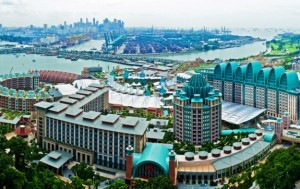 despite the administration’s insistence that the problem-gambling numbers are moving in the right direction and that the real threat comes from online casinos, which are subject to no such constraints. Government officials said local patronage of Marina Bay Sands and Resorts World had “declined significantly” and disordered gambling was “under control.”
“Although problem gambling has not worsened since the introduction of the IRs, we are nevertheless wary of the dangers posed by gambling, in particular online gambling, which has become an increasingly serious threat,” said Minister for Trade & Industry Chan Chun Sing, oblivious to the apparent contradiction. As for casino owners who dawdle on their megaresort upgrades, City Hall is putting a bit of stick about, threatening to raise their tax rates to 22% on mass-market play and 12% on VIP action. That should get some attention.
* United Kingdom watchdogs are growling at some of the nation’s leading gambling advertisers for violating a newly in place code on ‘kiddie advertising.’ Avatars programmed to simulate the net-surfer of  minors were tasked with vetting the ‘Net and the Advertising Standards Authority did not like what it found out: “Over a two-week monitoring period the regulator identified ads by 43 gambling operators appearing on freely accessible online outlets, including 20 YouTube channels and two dozen children’s websites.” Unibet was identified as the primary offender but it was quick to push a third-party service provider under the bus. Watch out, liquor and junk-food purveyors: You’re next under the ASA’s microscope.
* Iowa‘s senate Ways & Means Committee has voted sports-betting legalization through to the full senate, bringing it closer to an encounter with Gov. Kim Reynolds (R). The latter ran for governor last  year with a hands-off attitude toward sports betting and is expected to sign the bill if clears the remaining hurdles (which include the oversight of setting a tax rate). Owners of casinos and riverboats will get first dibs on sports betting (which will also be mobile), followed by third-party vendors. Iowa solons have clearly seen the writing on the wall, as surrounding states move to take sports bets, and want to cash in on the phenomenon. Not too fast … some sources say going live could wait until July, while some put the inception date into 2020.
Alabama joined the party last week, introducing a bill for seven licensees to participate at $100K a dance. Taxed at 10%, the gambling would be restricted to licensed parimutuels and its proceeds would go toward the founding of an Alabama Gaming Commission. Mobile wagering, where the real money, would also be permitted. Since the Cotton State only has one race track and three OTBs, it’s somewhat curious why the law specifies seven, especially as the state’s Native American tribes are cut out of the action. Considering that Alabama has voted down a state lottery—not to mention DFS—in the recent past, the chances for the new bill look bleak but we’re glad to see our neighbors making a step in the right direction.
