

Debate over sports betting in Massachusetts has brought out a ruction between Boston-based DraftKings, representing the forces of online gambling,  and brick-and-mortar casinos, which want to be the sole purveyors of Internet sports bets, with maybe five to seven ‘skins’ permitted in the Bay State. For its part, DraftKings warns that taxes and revenue projections are too high, pointing to shortfalls in other states. Representing the opposition, MGM Springfield President Michael Mathis said his company doesn’t oppose direct operation by the likes of DraftKings but that things would be better if the betting were routed through a casino company: “You can do it directly, but you’d be better protected doing it as sublicenses.”
Meanwhile, the major leagues are whining for—you guessed it—”integrity fees,” better known as ‘a piece of the action.’ Their pound of flesh is set at 0.25% of revenue. They also oppose prop bets, which they believe are a corrupting influence. (Would Chris Sale throw a first pitch out of the strike zone if money were riding on it?) Gov. Charlie Baker (R) is already on board with sports betting, which is the subject of no 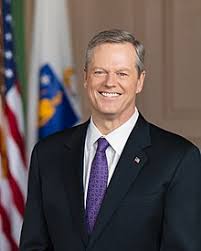 fewer than nine (!) bills in the Massachusetts Lege. The casino companies want to offer wagers on collegiate sports events, which Baker opposes. The governor favors a staggered tax rate of 10% on brick-and-mortar bets and 12.5% on online ones. Baker’s obviously been doing his homework, given the dominance shown by mobile sports wagering where enacted. That would also apply to daily fantasy sports, that well-known gray area. The guv would also like to see licensed fees set at $100,000 apiece, good for five years.
Across the border in Rhode Island, sports bettors put down $17 million in wagers last month. Casinos kept $2 million—at least until the state took its 51% cut. Casinos in the tiny state have racked up nearly $4 million in profits since sports betting went live in November, counting the $2 million bath they took on the Super Bowl. Despite having been advised to expect something closer to $15 million in tax revenue for the next fiscal year, the state is still pinning its hopes on a $23 million haul. The gubernatorial budget is still more optimistic, projecting $30 million from sports betting (the September launch of mobile wagering is fueling these upbeat numbers).
* Las Vegas casino revenues are stagnant at the moment but don’t tell the Los Angeles Times, which is peddling a comeback narrative heavily premised on the Resorts World Las Vegas opening, which is still a year and a half away. Still, kudos to Treasure Island for snagging a Marvel-themed exhibition. Maverick casino operator Phil Ruffin continues to put his establishment competitors to shame.
* Casino operators in Macao are on their best civic behavior, pledging a total of $2 million-plus to promote the fine arts in the enclave. That’s even more than City Hall is ponying up. The move comes in response to a government 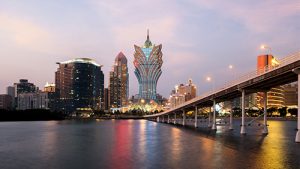 directive that the casinos do more to promote culture in Macao. And the casinos, with concession renewal staring them in the face, have been quick to comply. As GGR Asia puts it, the 2002 renewal “has created an environment where the operators seem to be keener than ever to prove their value to the local community.” The casino subsidy will go toward funding an arts initiative comprised of 40 large-scale events. All six concessionaires will be sponsoring art exhibits, with Sociedade de Jogos de Macau leading the way with seven. Sands China‘s contribution will be a ceramics display called All That’s Gold Does Glitter – An Exhibition of Glamorous Ceramics, with 90 pieces spread across four Sands properties. Well done, gentlemen.
In other Macanese news, law enforcement wants to go biometric in casinos to help it catch crooks. The casinos have managed to keep an in-casino fatal stabbing quiet, while Plaza Macao suffered the theft of $382K in casino chips, making Sheldon Adelson a bit lighter in the wallet. Melco Resorts & Entertainment has already promised cooperation.
* As might be expected, Harrah’s New Orleans got a 30-year license extension from the Louisiana Lege, which has sent the bill to Gov. John Bel Edwards (D) for his promised signature. After getting turned down last year, Harrah’s has  received permission this time to build more restaurants plus a second, $325 million hotel. The key to the reversal was an about-face by state Senate President John Alario (R). He engineered a $130 million tax increase from Harrah’s that won over his allies. “Alario also told Harrah’s chief lobbyist, Randy Haynie, not to hire two football teams worth of lobbyists as the company had done in 2018,” reports The Advocate. Two lobbyists did the job this year. The only thing Harrah’s didn’t get was an expansion of its casino proper.
The extra money includes a three-year block grant to New Orleans, increased funding for problem-gambling treatment, for rural water projects and for other infrastructural improvements. Churchill Downs‘ Fair Grounds racino was not a happy camper, wanting to be granted sports betting in return for all the concession made to Harrah’s. Still at issue is the occupancy tax that the state wants to collect on rooms that Harrah’s comps or discounts. That could be worth as much as $50 million. At attempt to codify that by statute was quashed by Alario. Self-confess gambling addict Sen. Karen Carter Peterson (D), who knows whereof she speaks, wanted $1 million for problem gambling but Alario held the line at $500,000. Gambling addicts might not appreciate that.
