

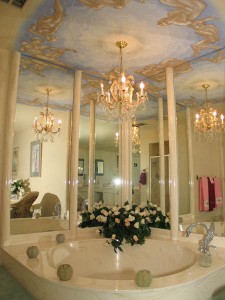
 Well, not literally in it but damn close. From our rear windows we can see the former Liberace mansion that now goes by the name of Las Vegas Villa. It’s a large but otherwise unobtrusive neighbor in a very quiet Las Vegas neighborhood … quiet, that is, except with the northeast runway and the heliport at McCarran International Airport are in heavy employment, much to the fascination of our cats.
Anyway, while I was minding God knows what business, Steve Friess beat me to a story taking place right under my nose. It seems that the King of Bling’s former abode is in foreclosure, which could mean dire things for one of the relatively few historic sites Las Vegas possesses. That’d be a shame, because it brings a lot of cachet to what’s otherwise an area of tract homes developed by another Vegas eminence, the late Wilbur Clark. Judging by their similar fencing and mansard roof, the Liberace estate wrapped around the south side of the block to encompass a third house, on Wilbur Street, perhaps as a servants’ quarters or what have you.
Whatever the case, Las Vegas Villa has been so tacked onto and modified over the years that its historical-preservation status is doubtful. We’d hate to see it bulldozed or turned into an apartment building but somehow it feels symbolic of the larger condition of Nevada itself: a race between preservation and catastrophe in which catastrophe has opened a seemingly insuperable lead.

Are there any places in Las Vegas where preservation pays? By that, are there any places where preservation has been shown to attract crowds who, it stands to reason, spend money? In many, many places preservation does pay.
I’m convinced that, for example, the Flamingo really missed the preservation boat by not preserving just a bit of the Ben Siegel era property. After they knocked down the last bit of the old Flamingo I think the place lost a lot of cachet but I’m just an occasional customer, not a casino executive.