

After the Supreme Court threw out the Bradley Act, there were a few grumbles on Capitol Hill about federal regulation of sports  betting. However, American Gaming Association President Bill Miller, in his capacity as gaming’s premier lobbyist, took the temperature of the corridors of power and discovered no fever for sports-betting regulation. Besides, as he reminded us, there had been federal regulation—the Bradley Act—and it had failed miserably. Now the NCAA is back, making noises about federal oversight, even an outright ban on collegiate sports betting (talk about bolting the barn after the horse has fled). The NCAA’s chief supporter is that bottomless well of bad ideas, Sen. Chuck Schumer (D). For a bit of bipartisan oomph, Sen. Mitt Romney (R) has climbed aboard, too.
A bill nixing collegiate sports betting would seem like a replay of Christie v. NCAA, the case that upended the Bradley Act, reviving the issue of “commandeering” the prerogatives of the states.  However, don’t bother the NCAA or Schumer with logic. NCAA Vice President of Hearing Operations Naima Stevenson Starks cloaked the madness in faux solicitude: “It’s fairly daunting to think that every state would have a different set of regulations. Having some minimum standards, we are very supportive of and have been an active proponent of.” While the simplicity of overreaching federal regulation has its merits in other industries, in gaming it is an idea that has been tried and found badly wanting.
* Slot play could be diplomatically be called “soft” at Encore Boston Harbor. Not even a Game of Thrones slot could generate much action when the Boston Globe came calling. 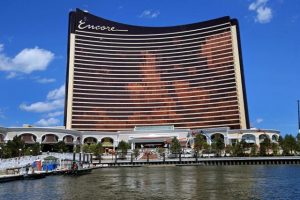 What to do? Encore has already shed 100 one-armed bandits, filling their place with table games, which have proven more popular. MGM Springfield has been even stricter, subtracting 300 slots in favor of more tables. (It also got good results by moving video poker machines into a bar. As any Las Vegan could tell you, video poker + booze = $$.)
At least Encore has loose slots on its side, holding 5.6% compared to Plainridge Park‘s 7.6% hold and MGM’s 8.6% (trying to fleece the yokels, mayhap?). “If a machine is hitting, I  guarantee you that within a few months it will be gone,” grouses one Plainview customer. UNLV‘s gaming supremo, David G. Schwartz thinks it’s “a generational thing: Younger players don’t want to sit in front of a machine pressing a button for hours on end.” (Neither do I.) As for video-game-derived slots, “If you want to play a video game, you’d probably stay home and do that . . . rather than going to a casino and paying a couple dollars a minute to do it.”
Even once-ballyhooed skill-based slots are bogging down. MGM Springfield Vice President for Casino Operations Robert Westerfield confesses he doesn’t see how the machines can be monetized nor made appealing to guests. Even electronic table games aren’t gaining traction. Penn National Gaming is putting its hopes in superior customer service. But study the slot situation for a minute or two and it becomes clear why Penn is clamoring for table games at its racing.
* Phil Ruffin is tipped as the mystery buyer of Circus Circus.  I guess he got tired of waiting for South Strip assets to hit the sale block. Ruffin thinks outside the box, so he’d be just the man to reinvent the Circus Circus acreage, currently a collection of outdated/underused parcels. Ruffin wasn’t shy about wanting a second Strip resort and probably sees that revenue has been growing most for the bargain-hunter properties.
* Casino executives hoping for new casino licenses in Macao can pretty much abandon hope. Incoming Chief Exective Ho Iat-Seng has voiced strong discomfort with the present concession/subconcession system and wants a hard cap on casino licenses. If that becomes policy, the only way to get into Macao would be to get another operator kicked out.
* Kudos to the American Gaming Association for ponying up $100,000 to the National Center for Responsible Gaming. The AGA’s largesse will go toward the study of sports wagering on American gamblers. “Research supported by NCRG’s fund will equip operators, policymakers and the more  than 4,000 regulators across the U.S. with science-based evidence to assess and design gaming provisions and policies that protect consumers and prioritize responsible gaming above all else,” says the AGA. If you want to know who the good guys are, MGM Resorts International was a founding donor, followed aboard by American William Hill, GVC Holdings, IGT, Hard Rock International and NASCAR. Thanks, guys. Let’s hope other major leagues see the wisdom in following NASCAR’s example.
