

Resort fees, the bane of customers to Las Vegas, are inspiring some congressional action. Lawmakers Rep. Eddie Bernice Johnson (D) and Rep. Jeff Fortenberry (R) are collaborating on  a bill that would outlaw resort fees (it’s the Hotel Advertising Transparency Act of 2019). The bill states that “advertising that does not reflect the true mandatory cost of a stay at a place of short term lodging is deceptive.” It would forbid “a rate for a place of short-term lodging that does not include all required fees, excluding taxes and fees imposed by a government.” The bill would be enforced by the FTC, while state attorneys general would be empowered to crack down on resort fee-ing hotels.
“Not only will this bill require upfront disclosure of all fees in the advertised price of a hotel room, but it will require the same for short-term rentals. Congress has a real opportunity here to pass a bipartisan, common-sense bill on behalf of American consumers,” said Lauren Wolfe of Travelers United. Mind you, the bill has to get out of  committee, pass the House of Representatives and somehow get into the Senate, where self-styled “Grim Reaper” Mitch McConnell (R) has killed bills by the bushel. Also, don’t expect the private sector to take this lying down. We can hear the squeals of outrage from Venelazzo to MGM Grand already.
Why not? Resort fees are big business. “It is projected that in 2019, over three billion dollars in revenue alone will be collected from consumers due to these hidden fees,” says Rep. Johnson (pictured). If, by some miracle, the Fortenberry/Johnson bill becomes law, look for hotel companies to ratchet up their resort fees as the moment of truth draws near. They’re shameless like that.
* $850 million is supposedly the magic number that will give Phil Ruffin the keys to Circus Circus. That implies annual cash flow of $106 million (using Wall Street‘s 8X EBITDA valuation), impressive when you consider that Ruffin paid $775 million for Treasure Island, a much more state-of-the-art resort.
* Casino proposals for Rockford have been revealed. Rock River West wants 1,000 slots and 200 table game position, with the option to upsize the latter to 2,000. Hard Rock 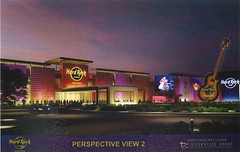 Live! would have five restaurants but is somewhat vague about the gaming component. (All three proposals can be seen at full length here.) At least Hard Rock is promising funding to local problem-gambling treatment up front. Forest City Casino is problem the fuzziest proposal of all, although its backers have a plan for capturing the older casino demographic: They’d build a senior center as part of the hotel-casino complex. For shame.
* Good news for Century Casinos. Its purchase of Mountaineer Casino, Racetrack & Resort has been approved by the West Virginia Lottery Commission. Century is getting Mountaineer  from Eldorado Resorts for peanuts—$107 million. Century co-CEO Erwin Haitzmann predicted Mountaineer would be a good fit, since the company already owns two other racinos. Century got a rave notice from Lottery Director John Meyers. “They don’t try to take on too big of a property, they take on the size they are used to managing and they can apply the same principles across all those properties,” he said.
Haitzmann extended an olive branch to Mountaineer employees, saying, “My impression is that it’s a great staff and we want to keep everyone from the general manager down to the lowest level. We have no intention of making any changes. We think it’s a wonderful group of people.” Glad to hear it.
* Chill out, American casino companies. Mexican President Andrés Manuel López Obrador (how long before he’s dubbed Am-Lo?) has declared a moratorium on new casino licenses for as long as he’s in office—until 2024, that is.
