
Steven Witkoff buried the lead when announcing that Bobby Baldwin had been called out of retirement to become CEO of The Drew. Witkoff’s PR peeps said that the project was in “final preparations 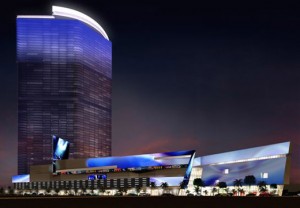 for construction,” which is the first movement on the megaresort that we’ve seen in a long, long time. Completion is estimated to happen sometime in the second quarter of 2022. Baldwin, having overseen the development of CityCenter (and later, the Vdara Death Ray) is no stranger to inheriting other people’s problems. He’ll have his work cut out for him at The Drew, formerly the hopelessly dysfunctional Fontainebleau. No cost estimate for completion was given but it will run into the billions, one of the reasons F-blew was abandoned back during the Great Recession.
The Baldwin announcement didn’t stint on self-congratulation. We were promised that The Drew will “set the standard … truly unique … state-of-the-art … innovative … vibrant … and groundbreaking.” That’s setting a pretty high bar to clear. More substantively, the 3,800 rooms will be subdivided into three hotels: The Reserve by Drew (inauspicious choice of name: The Reserve was the name of Ameristar Casinos‘ worst flop, now Fiesta Henderson), Edition by Marriott International and a JW Marriott. Judging by the preponderance of Marriott, The Drew should be very popular with Mormons. As for Baldwin, he’s got some heavy lifting ahead of him, so we wish him good luck.
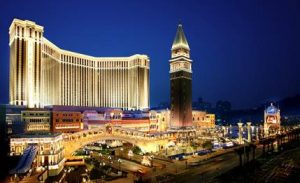 * Congratulations to Venetian Macao, winner of the “Property of the Year” award at Global Gaming Expo. We’re surprised (in a good way) that a more recent casino wasn’t chosen but the selection of the mammoth Sands China trophy resort speaks well to Sheldon Adelson‘s standards of excellence. And here’s an esoteric accolade: Venetian Macao hosts the only Michelin-starred Indian restaurant in Macao, Golden Peacock. (Now closed, evidently.)
* Gaming & Leisure Properties released 3Q19 results and they were surprising, in that GLPI’s embattled Perryville and Baton Rouge casinos were in line with prior estimates. Revenues were on the money at $288  million (mostly rentals) while cash flow beat expectations. Wrote J.P. Morgan analyst Joseph Greff, “Management remains disciplined and continues to look at a number of M&A opportunities. GLPI noted that while some operators feel the US economy is relatively late in the cycle and may prefer to hold onto their real estate, there are still a lot of investors/entrepreneurs that are looking to monetize their real estate.” He added that the company is looking for a return by private equity to the gaming sector (Oh no!) and the the sale of Bellagio to Blackstone Group is likely the beginning of many similar transactions.
* An October 30 day off for employees of Harrah’s Resort Southern California was more trick than treat. Not only did wildfires force the
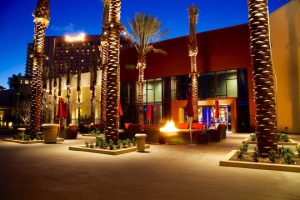
Harrah’s Resort Southern California
closure but so did the power outages that have been rolling through the Golden State. “The safety and security of our guests and teammates is our highest priority … We are waiving cancellation and change fees for stays with arrivals from Oct. 30 until power is restored. In the meantime, there will be a mandatory precautionary closure of the property and current guests will be offered a refund,” Harrah’s announced. It also helped displaced guests find other accommodations. I’d say that’s pretty darn george of them.
* Sports betting and Internet gambling are one step closer to reality in Michigan, thanks to bills passed out of the House on a mostly bipartisan basis (Democrats were the largest naysayers). The legislation would tax sports betting at 8.75%, with a possible 3.25% surcharge for Detroit 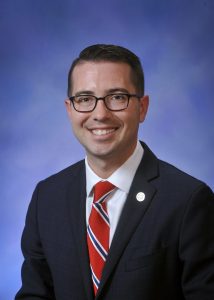 casinos, which are currently taxed at 19%. Internet win would be taxed at a formula so convoluted as to be impossible to explain, topping out at 23%. Gov. Gretchen Widmer (D) voiced some concern that new iterations of gambling would sap the state lottery, which helps fund schools. Legislation sponsor Rep. Brandt Iden (R) shot back that bills vetoed by Widmer’s predecessor, Rick Snyder, wouldn’t have taxed gambling nearly as much. “The tax rate went north. We got her more than half of what she asked for on both,” Iden said. “The money was directed to the school aid fund. My directive, from what I had always heard, was ‘protect the school aid fund.’ I believe that these bills did that. So it’s very confusing to me when the governor says they’re not in support.”
By contrast, state Rep. Rebekah Warren (D) urged still further negotiation, predicting the two bills would be vetoed. Widmer and her aides, for their part, suggested a variety of amendments to the bills, including upping the tax rate on sports betting and DFS to 10% or 11%. We’ll see what happens when the Iden bills go to the state Senate.
