

Congratulations to MGM China, whose MGM Cotai has won the annual Skyscraper Award from Emporis. We quite agree. MGM Cotai  is the most striking casino-hotel design since Marina Bay Sands, a bold statement on behalf of modernity. (Sands, by contrast, went wholly retrograde with its Parisian.) Kudos also to Kohn Pedersen Fox Associates, who designed MGM Cotai. The concept for the resort is “nine oversized Chinese jeweler’s boxes stacked atop each other to form two interconnected towers.” MGM CEO Jim Murren would appreciate the design of runner-up La Marseillaise, which employs 30 discrete colors on its façade as a statement in favor of diversity. Good choices, Emporis.
* Speaking of Las Vegas Sands, analysts at Sanford C. Bernstein are anointing it #1 in Asia, a perch they say it will hold for some time to come. Reasons include its room inventory in Macao, as well as its sway over mass-market and premium-mass gamblers. “With Macau gaming being a 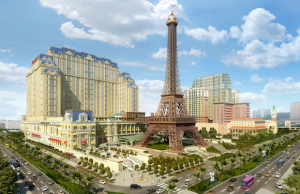 supply-driven (and hotel room supply constrained) market, Sands has developed a strong foothold in the mass market segment.” Also, 3Q19 cash flow out of Macao was almost $1.2 billion, dwarfing the company’s $93 million Las Vegas Strip EBITDA. Sands’ avoidance of VIP play was hailed, with 90% of Macanese profit being derived from mass-market play, more reliable than VIP action.
Sands’ expansion of Marina Bay Sands in Singapore is expected to only solidify its predominance over rival Resorts World Sentosa (that’s what happens when build a casino resort over a POW graveyard—karma). Meanwhile, Sands thinks it can derive 20% ROI from a Japan resort, even if the budget swells to $12 billion. (The Land of the Rising Sun is already home to most of the world’s gaming devices.) However, Sands has been relatively circumspect in its Japanese overtures, while MGM and Melco Resorts & Entertainment have been waving fistfuls of money at Nippon. We wonder if Sheldon Adelson knows something we don’t.
* New York‘s four newest casinos are pleading for a tax cut (to rates to which they previously agreed to pay), seeking parity with the Empire State’s Native American tribes. As an Oneida Nation spokesman put it, ‘rate equalization’ is “just a fancy term for bailout.”
