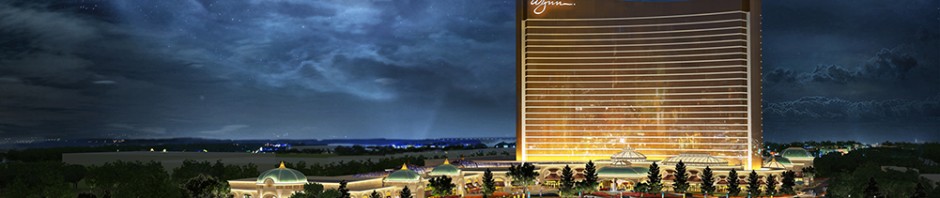

Massachusetts gaming-revenue numbers are out and Encore Boston Harbor is the story. It’s got 65% market share and $1.75 million casino win per day. MGM Springfield is far behind, with 19% market share and  600 dimes win per day, with Plainridge Park bringing up the rear with $330K daily win. Plainridge Park’s $10 million haul represented a devastating 27.5% falloff, as it is caught in a pincer between Twin River in Tiverton and Encore. Players were obviously staying away, as handle was down 22% despite an impressive win/slot/day of $274. Also slipping at the slots was MGM, down to $176/win/slot/day, for a gross of $14 million, a dip of 2.5%. MGM had a terrible month at the tables, toppling 30% to $5 million.
Encore, by contrast, grossed $54 million, with only $22.5% of that coming from slots ($231/win/day). Table revenues shot up from November to $31.5 million. Win/table/day was $7,085 compared to MGM’s anemic $1,355 table/day. Given these dynamics, developers like Neil Bluhm should think hard about investing $500 million into a fourth Massachusetts casino but we’ll let the free market be the final arbiter.
* Four heartless heartland states have been called on the carpet for not fully funding their responsible-gaming programs. The scofflaws are Oklahoma, Kansas, Missouri and Louisiana. The accusation has been leveled by the Responsible Gaming Collaborative. We don’t know who’s to blame but, whether you’re a politician who supports legalized gambling or one who opposes it, you nevertheless have a moral imperative to support programs that address its negative side effects.
* The mystery of the casino shutdown at Harrah’s Reno has been solved. Casino.org reports that Vici Properties is selling the hotel to Reno City Center, whose intent is to convert the property into commercial space. We sympathize, as Reno has all the casinos it can support. (But not more.)
* No surprise here: JP Morgan analyst Joseph Greff gives two thumbs up to the MGM Grand/Mandalay Bay sale. The $4.6 billion transaction represents a 15.75X cash flow that would be an insane markup anywhere  but in Macao or on the Las Vegas Strip. Adds Greff, “the proceeds here should serve as an accelerant to MGM achieving its low balance sheet leverage target (1.0x domestic net leverage by year-end 2020,” with the money going a long way toward retiring MGM’s huge debt burden and freeing up development money for Osaka. Buyer Blackstone “who has the potential to be a continued partner down the road for both gaming/non-gaming transactions and liquidity catalyst with respect to MGM’s soon to be ~55% ownership of MGP.”
Greff applauds Blackstone’s “stellar reputation and track record in all things” real estate, as well as its commitment of $150 million in equity to  MGM Growth Partners. “Lastly, we believe there were many high-quality real estate bidders for the MGM Grand/Mandalay Bay [real estate], which underscores the value (private higher than public) these types of RE firms place on LV Strip assets. In general, we think these transactions suggest a pretty favorable operating outlook for the LV Strip and an appreciation for LV Strip real estate values that are not present in public equities like MGM and MGP.”
* Congratulations to reader Greg Askins for being the first to answer yesterday’s trivia question. The mystery tower next to The Cosmopolitan of Las Vegas was the since-demolished Harmon Hotel. It holds a unique place in Las Vegas history as the only resort to be torn down without ever hosting a single guest. Through a Jedi mind trick, MGM Resorts International has almost made us forget the Harmon ever existed.
