

In a shocking upset, “a source close to the matter” reports that Hard Rock International has been turned down for the Hellenikon megaresort 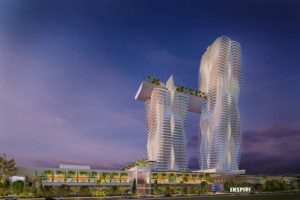 development in Greece. That means the winning bidder is Mohegan Sun. Hard Rock was apparently faulted both for its thinner construction track record and its financing. (Mohegan Sun’s current megaresort experience in South Korea could hardly have hurt its cause.) How huge is this news? Mohegan Sun stands to win a 30-year operating contract, plenty of time in which to recoup its investment. The casino must have at least 120 tables and 1,200 slots—but Mohegan Sun likes to think big, so we expect much more. Hard Rock has 10 days to appeal.
* The Reno Gazette-Journal confirms an earlier report that Harrah’s Reno is being sold to Reno City Center, hence the closure of its casino floor. (A thing of rags and patches, according to reader American Gaming Guru.) Harrah’s Reno began life 83 years ago as a mere bingo parlor, the seed from which Bill Harrah grew his gaming empire. The sale severs Caesars Entertainment from its roots, strong symbolism as the Eldorado Resorts purchase is about to take hold. The asking price for Harrah’s Reno was a mere $50 million, of which $12.5 million is rendered unto Caesars, with the rest going to Vici Properties. The property will still be operated by Caesars until 3Q20.
With Eldorado already owning and operating its eponymous, downtown casino, Silver Legacy and Circus Circus Reno, Harrah’s was expendable. Also, potential antitrust issues are made moot. (Vegas-based Silver State Realty & Investments is the company behind Reno City Center.) The sale, along with that of Eldorado’s Shreveport casino, puts Eldorado CEO Tom Reeg $280 million closer to his goal of $500 million in cost savings through the takeover. Lake Tahoe‘s MontBleu casino is next on the chopping block. Any takers?
* The last time we looked, Iowa had more casinos than it could handle. However, with a new Des Moines airport terminal having funding problems, developer Reggie Sinha has a magic potion: an airport-based casino, to be operated by Wild Rose Entertainment. (Good choice, Reg.) 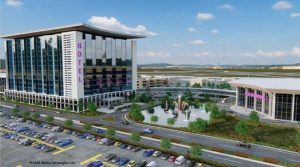 The casino would be budgeted at $225 million-$250 million and would include a 350-room hotel, which would be nice if you’re stranded overnight in Des Moines, not a very happening place. Sinha shopped the project around before settling on homeboys Wild Rose. He’s not stinting on the rhetoric, promising that the casino would be “for its size, an unparalleled architectural masterpiece reflecting the ‘highest and best use’ of airport facilities.”
We don’t know about the ‘masterpiece’ part, as the hotel is unlikely to be mistaken for the work of Louis Sullivan or Frank Lloyd Wright anytime soon. But it does present a striking image and, frankly, quite a lot better than what some of what Big Gaming has commissioned in other markets. The hotel would be connected to the airport—It’s cold up there!—via a skywalk. The casino would also be a bridge … to solvency. The airport is $194 million under budget and Sinha is promising to achieve $85 million a year in gaming revenue. This would be the second casino in the Des Moines market—a point in its favor—and a second bite of the apple for Wild Rose, which was rejected at the ballot box seven years ago. Problem-gambling counselor Tom Coates counseled against a casino as a budgetary fix-it: “Brick-and-mortar casinos are on their way out … The casino is not going to be the draw they think it is long term.” Maybe but it will have a captive audience.
* According to the IndyStar, the $436 million wagered by Indiana gamblers in the last four months, “was enough to match the net worth of LeBron James, buy 110 million Popeyes chicken sandwiches or snag the most expensive painting in the world, Leonardo Da Vinci‘s Salvator Mundi.” Already 68% of the betting is mobile-based and, as Ball State University economics professor Michael Hicks put it, “You can download an app and bet on a college football game after two beers. Who wouldn’t do that?” The $436 million breaks down to $65 per Hoosier, although the playing field is tilted toward the one-fifth of bettors who are placing 80% of the wagers. Revenue was $41.5 million, with $4 million going to Gov. Eric Holcomb‘s coffers. Gambling.com‘s Max Bichsel sees it as both found money and a win-win-win, saying “The state is making money. The operators are making money. Everyone is making money.”
Hicks was more skeptical. Calling sports betting a novelty, he said, “It’s probably just a big burst of activity and we will see it settle down.” Told what Hicks had said, Bichsel called it “preposterous” (we are inclined to agree) “That’s insane to think that it’s going to go down.” History is firmly in Bichsel’s corner. For every newbie punter who got burned on their first big wager, there will be many who—so long as the economy cooperates—see it as a viable, new alternative for their entertainment dollars. The one surprise that basketball, the signature sport of Indiana, is lagging football at the wickets, $82 million to $178.5 million bet on football. Fans of darts and cricket, don’t despair: You can bet on them too. And with Ohio and Kentucky still out of the sports-betting movement, Indiana will have plenty of non-Hoosier clients upon which to draw.
* Mixed signals from Macao again: Deutsche Bank analyst Carlo Santarelli reports that mass-market revenues were up 8% in 4Q19 but VIP ones were down 23%, although there was an upward trend from the third quarter. Slot inventory was flat while all-important table games grew 2%. This is good news for mass-market operators like Sheldon Adelson, bad news for VIP-centric ones like Pansy Ho.

Montbleu in lake Tahoe will be sold to Monach Gaming which owns the Atlantis in Reno. Sale will be announced within the next month.
Steve. Thanks for the info. Montbleu is a nice asset, but Eldorado will have its hands full in the market already w Harveys and Harrahs (Caesars also divested it following the take-over form Harrahs). Interesting how history kinda repeats itself. Anyway, good for Monarch. They should know the market well!