

Carl Icahn clings to dilapidated Trump Plaza like a child to a favorite toy. But he may be forced to face reality whether he likes it or not. It’s ‘Look out below’ for pedestrians passing the corpse of the casino, which is 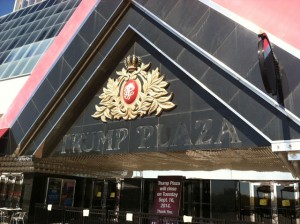 “shedding chunks of its tower,” reportedly making it a perilous venture to simply walk past the hulk. The place has been closed for six years and the underlying real estate would undoubtedly be more valuable without the Trump relic that sits upon it, but Icahn is curiously reluctant to part with his dinosaur. Now Mayor Marty Small (D) is taking Icahn to court to force him to demolish Trump Plaza. In time-honored political fashion, Small had planned to hold the announcement in front of the disintegrating resort but “we didn’t feel safe enough to stand near Trump Plaza.” So the press conference was held in Boardwalk Hall instead.
“An imminent hazard” was what City Licensing & Inspections Director Dale Finch called the tower. Elaborated the Philadelphia Inquirer, “Small said the city had video that showed chunks of the building’s stucco and concrete facade falling down onto Columbia Avenue minutes before thousands of people arrived for an event last Saturday at Boardwalk Hall.” (Insert metaphor here.) “We are negotiating in good faith. But it changes when we have to dispatch emergency police and personnel 24 hours a day around the building,” said Small, who added that the city had drone footage of five holes in the building, as well as of destabilization caused by cracked seams that are letting water into the building. Oh, and it’s no longer Trump Plaza but “MP PLA,” per the peeling marquee.
Since Atlantic City can’t afford to condemn the pile, it’s appealing to (and trying to compel) Icahn to do so of his own volition. It would cost 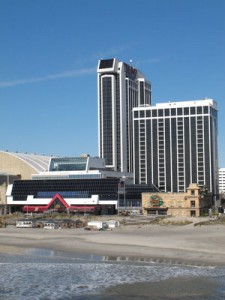 $14 million, he says, at least $5 million of which Icahn would like to finance using casino-redevelopment monies. Neither he nor Small can agree on what to do with the site (here’s an idea: sell it), although a parking garage has been mooted. Icahn, not Donald Trump, is to blame for the present state of affairs, which appears to be snowballing. “When it opened, it was a state-of-the-art high-rise,” Fire Chief Scott Evans remarked. “We were very proud of it at the time. That’s no longer the case now. The maintenance has pretty much disappeared.” Shame on you, Carl.
On a happier note, casino revenue in Atlantic City was 11% higher last month. Slot receipts rose 12.5% while table-game winnings were up 8%. Borgata gained 14% on 35% higher table win (despite flat wagering—the house played exceptionally lucky), while its slots won 6.5% on 2% more  coin-in. It grossed $57.5 million. Business at Ocean Casino Resort continues to grow by leaps and bounds—51% in February—as it grossed $21 million. The Caesars Entertainment trio were up 5%, with slots up 9% on 7% higher coin-in. Luck wasn’t really with the house at the tables: Wagering rose 12.5% but win only 4%. (Low hold at grind-joint Bally’s was blamed.) Tropicana Atlantic City finally had a good month, up 8% on 2.5% more slot win, on 2% greater coin-in, while tables vaulted 32.5% on 21.5% larger wagering. Maybe they’re finally getting the customers they say they want.
Ballys’ slid 6% to $12 million, Harrah’s Resort grossed $26.5 million (plus 9%) and Caesars Atlantic City was up 7% to $21 million. Despite a 14% gain, Hard Rock Atlantic City slipped into fourth place with $24 million. Golden Nugget was up a percentage point to $16 million while Resorts Atlantic City recorded one of the few slippages, down 1.5% to $14.5 million. (But Resorts Digital brought in another $13 million.) Sports betting was robust, with $495 million in handle, but an unknown amount of that was placed on future events that are now either postponed, suspended or kaput.
“New Jersey’s year-over-year gains remained impressive in February, but we are in uncharted territory now,” said analyst Dustin Gouker. $54 million was wagered on the Super Bowl, puny next to Nevada‘s $157 million. The Kansas City Chiefs‘ big win was a big loss for Garden State
 books, which ate over $4 million. Even so, revenue came out at $17 million. $219 million was bet on basketball (uh-oh), producing $6.5 million in win. Over 88% of the handle was generated online, which would be fine—can’t get coronavirus from your computer—were there anything left upon which to bet. Retail betting was dominated by FanDuel at the Meadowlands, generating $1.4 million in win. Not much but a lot more than anybody else. Covid-19 should be good for Internet casinos, already robust with $52 million in revenue. Said analyst Eric Ramsey, “The Golden Nugget’s online casino … generates more revenue than its retail casino, and others have been closing the gap. That online revenue stream could prove vitally important in the coming months.” True that.
* Casinos in Detroit had a warm February, up 6% to $122 million. MGM Grand Detroit gained 6.5% to $52.5 million, MotorCity hopped 5% to $40.5 million and Penn National Gaming may have cracked the Greektown Casino nut, gaining 8% to $28.5 million.
* MGM Resorts International temporarily closed all nightclubs and day clubs after a suspected Covid-19 positive at Wet Republic. Vegas pools are not for the squeamish.
* Encore Boston Harbor closed its nightclub and buffet after it turned out that infected Utah Jazz player Donovan Mitchell had visited the resort. The high roller is described as “low risk and showing no signs of symptoms when at the resort.” Peril to other guests is described as “minimal.” Even so, employees in the high-limit table game area have been put on leave.
* Softness of demand may be manifesting itself on the Las Vegas Strip. An S&G source reports $149/night rates for weekend rooms at The Venetian and Caesars Palace. “I’ve just never seen demand evaporate at the scale and speed that it has,” a veteran hotel executive told HotelsMag.com 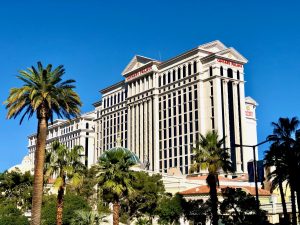 . “And not only have I not seen it, I don’t think I ever conceived of the depth and breadth of what we’re seeing … This is a true black swan.” In an in-depth interview, he outlines a series of cost-cutting measures that we’re seeing now or are soon to see (example: furloughed doormen, double shifts), as well as a concern that “the powers that be” soon send “a stabilization signal.” Capex spend is on hold, as the industry braces itself for a 20% downturn in revenue per available room and an even worse hit on cash flow.
“I had given a town hall to our above property level teams, not more than five months ago, saying that I felt that the economy wasn’t really as strong as the headlines would have you believe,” the exec continues, adding,  “we’ve been seeing the deceleration since the second quarter.” In his case, he’d started cost-cutting in 4Q19, which may turn out to have been prescient. “But certainly, with interest rates that are probably going to come down even lower, I think that’s good news in the recovery, right? Because less costly debt allows you to be better leveraged to the recovery.” And would-be hotel buyers may be more aggressive thanks to a lower cost of capital. As he says, “it won’t be business as usual, and it gets really hard before it gets better.”

AC: Wondered why Icahn’s group bought the building that Trump had to build around, giving them a full city block now rectangular parcel. They have a plan, just not for right now. Icahn could delay demo as long as they want, AC doesn’t have the money to do anything without the casino money and NJ state management.
AC update: Earlier today, 3/13/20, Ocean Casino offered me tonight, Sat, and Sun comp room, they never offered me a weekend comp before. MGM Borgata offered me a mid-week comp room, the first offer in 6-8 years. My friend stayed @ Borgata last night, the Water Club tower was completely closed. At their Amphora player’s club lounge, you no longer could serve yourself food from their buffet, an employee did it for you (AC players clubs serve real food, not snacks).
I was at Caesars in AC in November and observed the rats at Trump Plaza scattering around in the former pool area..