

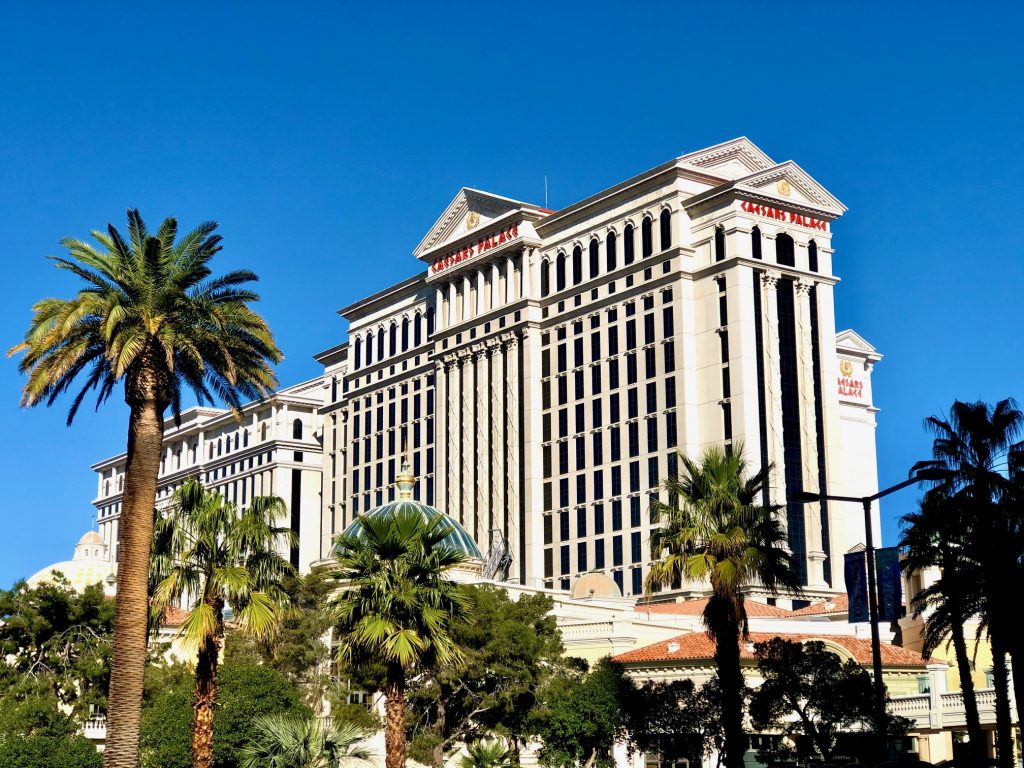
Although it tried to flash Wall Street some ankle yesterday, Caesars Entertainment’s 4Q20 numbers failed to surprise analysts. In a reverse image of the rest of the industry, better-than-expected cash flow on the Strip (cost-cutting?) was “more than offset” by weakness at regional properties. JP Morgan analyst Daniel Politzer blamed “negative impact of regional property closures, restrictions, and soft demand at destination properties.” Funny, but you don’t hear about the latter from MGM Resorts International or Penn National Gaming or Boyd Gaming or …
Like most of its fellows in the industry, Caesars sees meeting business returning to the Las Vegas Strip after June. As for Joe Average travelers, bookings are up 20% month/month, with half of those reserved over 30 days out. March is a mixed bag, with midweek occupancy only 50%-ish but weekends up to 95% or higher. That’s a trend line moving in the right direction. Despite weekend rates that have sometimes verged on terrible (or perhaps because of them), CZR properties packed them in on the Wilder/Fury fight weekend: 99% occupancy. Politzer foresees Baby Boomers coming back and gives the Strip a six-month-to-one-year recovery timeline. It will be no trick to surpass last year but if 2021 even just comes within shouting distance of 2019, that will indeed be something to celebrate.
Caesars “bookings have recently reached their highest level since its properties began reopening this past summer,” reports Politzer. “9 of CZR’s top 10 booking days since the reopening have occurred in February, and the booking window has been elongating as well.” Perhaps the greenest shoot of all is that room rates for summer and autumn are up 32% for group business over 2019 levels, reflecting the drawing power of The Forum (a very impressive meeting center). The one perplexity was “lower demand at destination properties” regionally, something about management should be very concerned, especially given CZR’s reliance on its hub-and-spoke system. Isle Grand Palais is officially defunct but a new, land-based casino is coming to Lake Charles, so there’s some good news. Baby Boomers are sparser but players 35 and under are being seen in greater numbers everywhere.
Before leaving Las Vegas for the moment, the importance of meetings was driven home by yesterday’s tourism numbers, which showed January occupancy citywide at 31.5%. The absence of Consumer Electronics Show and its 180,000 attendees had a lot to do with that. Bargain hunters had a field day on the Strip, with average room rates of $97, translating into a feeble $30/night of room revenue for operators. Drive-in traffic was also down, including 9% less at the California/Nevada border. Those looking for a silver lining can take consolation in declining Covid-19 numbers, positive vaccination trends and an increase in casino capacity (to 35%).

Stock analysts paid far less attention to Caesars (perhaps because so unsurprising) than to DraftKings. The sports-betting Goliath guided Wall Street to $900 million, perhaps $1 billion in 2021 revenue (up from $750 million-$800 million). Credit Suisse‘s Ben Chaiken reacted that this was “better than anticipated, highlights underlying acceleration,” adding that marketing expenditures were “clearly gaining traction.” That cost of gaining customers was $159 million, yielding an adjusted gross profit of $181.5 million, according to Carlo Santarelli of Deutsche Bank. Fourth-quarter revenue was $320 million, “which well exceeded both the company’s our/implied guidance (at midpoint) of $229m,” reported Politzer. “While we believe higher than forecast revenues were expected given publicly reported sports betting revenues … we are, nonetheless, surprised by the extent, 40%, to which DKNG exceeded its implied 4Q revenue guidance (issued November 13th).”
The number of unique players jumped 44% (to 1.5 million), as opposed to Wall Street’s expectation of 1.3 million. There’s additional reason for optimism: DraftKings is live in 12 states (with more to come) that represent 25% of the U.S. population. As revenue-hungry legislatures look to sports betting, expanded sports betting and even i-gaming, DraftKings ($58/share) is looking like an excellent wager.
Colorado rang up $327 million in handle last month, as sports betting surpassed the $300 million threshold for the first time. Sports books kept $23 million and reported $31 million in Super Bowl handle. The NBA dominated January wagering with $88.5 million, compared to $75 million for the NFL. Throw in another $40 million for college basketball and roundball rules the Rocky Mountain State. But don’t count out table tennis: $12 million in handle, a percentage comparable to hockey in other states. One believer in the state’s potential is PointsBet, which has set up corporate headquarters in Denver. “What’s really stuck out is just how relentless Colorado’s growth has been,” said Jessica Welman, analyst for PlayUSA. “Every month sportsbooks set a new state record. There has been no letup regardless of what has happened with sports schedules during this pandemic. Growth is the rule in just about every legal jurisdiction, but none have had such a long, consistent upward trajectory.”
Brick-and-mortar casinos are sucking wind in Illinois but i-gaming is achieving traction in the Lege. A bill before the House would allow casino operators to host three ‘skins’ apiece, at $500,000/license. Taxation would be set at 12%. We could list who’s prospectively “in” (DraftKings already owns a terrestrial casino, for one) but it would be easier to name who isn’t.
Despite a disappointing Chinese New Year, Melco Resorts & Entertainment maintained a “very optimistic tone” on this week’s earnings call, according to JP Morgan analyst Joseph Greff. This contrasted impressively with Melco’s “repeatedly past pessimistic, as well as early and accurate, tone over the past 12 months, since COVID-19 started to disrupt Macau visitation. Therefore, we find this change in tone to be credible.” Not that Melco is getting carried away. It foresees non-VIP play reaching 2019 levels no sooner than October. More mainland China cities are being taken off the Coronavirus quarantine list and Hong Kong citizens returning from visits to Macao no longer have to be sequestered. We’re still four to six weeks away from the inflection point at which Melco expects demand to start returning. But it’s seeing a significant number of newcomers and old friends alike. Chinese New Year may not have blown anyone away but it’s said to have been better than almost-as-important Golden Week, last October.
Jottings: Despite 2020 property closures, casino-owning REITs are sitting pretty, especially since their leases are structured so that most of the risk falls on the tenants. Reported Hoya Capital, “Owing to this lease structure, rent collection and occupancy rates have remained essentially spotless throughout the pandemic.” Even at the depths of the Great Shutdown, while rents had to be renegotiated, foreclosures were never on the table … 300 director Zack Snyder hasn’t had a hit since we can’t remember when and his mercs-rob-zombie-casino Army of the Dead seems unlikely to change that downward trajectory, going straight to Netflix. When your biggest ‘names’ are Dave Bautista and Tig Notaro you’ve got a problem … Speaking of zombie casinos, the Plaza Hotel is offering $75 bingo match play as part of a surprisingly “george” 50th anniversary promotion in July. There’s a minimum two-night stay involved but if you’re lucky you might snag one of the commemorative chips that are being struck for the occasion. Other celebratory events remain TBA.
