


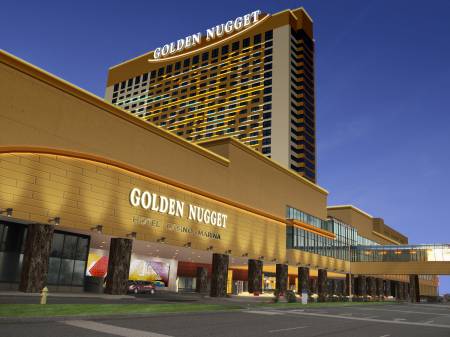
We’re going to have revise our prediction that Atlantic City would recover from Covid-19 faster than Las Vegas. Not at the rate things are going. March casino win was down 17% from 2019, coming in at $185 million. The Caesars Entertainment threesome slid 29%, with slot win down 29% and table win -26%. That’s far worse than citywide averages, which saw slot win -17% and tables -16%. Borgata‘s $46.5 million, while more than enough to lead the market, was 22% off from 2019’s halcyon days. We already knew Hard Rock Atlantic City had a good month, as President Joe Lupo took a press-release victory lap even before the revenue numbers were released. It grossed $31 million, a 25% leap over 2019. Ocean Casino Resort vaulted 33% to $20 million. The next closest thing to a ‘good’ number was Resorts Atlantic City‘s 19% dip to $12 million. Thanks to Hard Rock and Ocean, that -17% overall declivity looks a lot better than it was. Bally’s Atlantic City slid 33% to $10 million and Golden Nugget plunged 38.5% to $11 million. Caesars Atlantic City shed 23% to $18 million, Harrah’s Resort fell 33% to $18 million and Tropicana Atlantic City slid 30% to $19 million.
PlayUSA tried to put a happy-talk spin on the sports-betting numbers, pointing out that revenues were up to $56 million from February’s $42 million—yet well short of the $74 million that Credit Suisse analyst Ben Chaiken had modeled. FanDuel lost serious market share, down from 58% to 50%, almost all of it to DraftKings, up from 18% to 25%. BetMGM also gained a percentage point (to 11.5%). JP Morgan analyst Joseph Greff reported the revenue as $61 million but showed FanDuel losing even more market share, down to 45%. (Still double that of DraftKings, per his estimate.) The only other operator of consequence was William Hill, with 8% market share ($5 million revenue). FanDuel won $28 million to DraftKings’ $14 million and BetMGM’s $6 million. Driven by a fourfold increase in basketball wagering from last year, handle was $859.5 million. “It will probably be until football season before the state gets that first $1 billion month, but New Jersey’s online market has made a habit of outperforming expectations,” PlayUSA analyst Dustin Gouker argued.
He didn’t hesitate to point out the mistake made by New York State Gov. Andrew Cuomo (D). “New York’s decision to create a closed market was good news for operators who are heavily vested in New Jersey,” Gouker wrote. “By closing the market, the select few operators that will operate in New York will have to focus on profitability just to meet the state’s high revenue split. That will leave a window open for some [Garden State] operators to offer more competitive products and promote more aggressively than any operator in New York.”
If sports betting underwhelmed, online gambling broke records, notching $114 million in win. Are players shunning Atlantic City in favor of their keyboard and mouse? Either way, Borgata surged past Golden Nugget to gain first place with $36 million and a 32% market share. The Nugget won $32 million ($10.5 million of that for Golden Nugget Online), also a uptick from February but not enough to catch MGM. “Even when we get past this pandemic, I don’t think gamblers will log into online casinos any less. Instead, this year-long surge points to a long-lasting market shift,” wrote analyst Eric Ramsey. Strange bedfellows Caesars/WynnBet split $17 million and DraftKings won $14 million. As PlayUSA put it, i-gaming was the month’s big winner, no two ways about it.
Next door in Pennsylvania The Scranton Times-Tribune fired a salvo in the smoking-in-casinos war, arguing that the days of the smoke-filled gaming floor should be over. Or, as the editorial board put it, “crucial public health initiatives no longer should have to yield to narrow public interests.” Pegging American deaths caused by smoking at 480,000/year, the Times-Tribune all but accused the Keystone State Lege of prioritizing $1.3 billion in annual tax revenues over the health of its constituents. The paper lashed out at “nicotine-addicted gamblers” and called cigarette smoke “poison.” Well, I guess we know where they stand. But money talks louder, we suspect.
No sooner was the ink dry on Arizona sports-betting legislation than PlayUSA initiated coverage of the state, pegging it as a market that, once mature, will engender $3.3 billion/year in handle, boiling down to $225 million in revenue. (This assumes a 7% hold.) Eric Ramsey opined that Arizona has “a collection of attributes that will likely help the market mature quickly. In fact, few other of the recently launched U.S. markets have quite as many positive characteristics.” Surprisingly, Gov. Doug Ducey (R) and solons haven’t agreed on a tax rate yet. PlayUSA suggests 8% but that would be awfully lenient of the guvmint. Added Ramsey colleague Dustin Gouker, “There is no question that Arizona will be a fruitful market, but there are still a lot of moving parts that will need to be sorted before launch.” Going in the state’s favor are the presence of four major-league teams, four NCAA Division I college athletic programs, NASCAR races, and multiple PGA Tour events. Alluding to Cuomo again, Ramsey opined that “One of the smartest things that Arizona did was to create a relatively open market, like Indiana, which will spur competition and raise the market’s ceiling.” We hope so.
The Philippines are associated with Internet casinos (or POGOs) while could politely be called dodgy. “However, POGOs have also brought other aspects of governance into the mix, including human trafficking and other seedy behaviors,” adds Brendan Bussmann. The Philippine government took advantage of the Great Shutdown to shake up the POGO industry, which has shrunk from 51 entities to 38. Among the reforms is a stricter anti-money-laundering regime, after $287 million in suspicious transactions were flagged over the past two years. All of this should improve relations with currency-hoarding China, for whom POGOs have been a burr under the saddle. However, the mass importation of guest workers by POGOs continues to be a sore point with Filipinos. Service providers are even accused of “selling” workers to one another. Small wonder that U.S. companies give the Philippines a wide berth where gaming is concerned.
Jottings: Tune in for a highly emotional interview with Navajo Nation Gaming Enterprises CEO Brian Parrish, whose tribe has taken a distinctive approach to the Coronavirus pandemic. We need more CEOs like him … The Tropicana Las Vegas may be living on borrowed time. Bally’s Corp. Chairman Soo Kim said, “It only has 600 slots and in some instances it feels like it hasn’t been touched since 1960. We truly believe that Las Vegas is going to recover quickly, and this gives us a chance to be there, invest a little money, and decide later what would be the best fit as a real attraction” … Florida Gov. Ron DeSantis‘ latest compact proposal got backhanded by the Seminole Tribe. It looked ‘george’: Exclusive rights to sports betting (plus three new casinos) in exchange for a new, private-sector casino in Miami Beach. But sports-betting revenue is small peanuts compared to a casino megaresort in a tourist magnet. Also, the Miami Beach specification seems odd, as though the new casino were juiced into the Soffer Family already … Casino gambling, sports betting and a state lottery are showing signs of life (again) in Alabama. The state Senate voted decisively to approve all three, including six casinos. Keep your fingers crossed.

sounds like the timing is good for a Trump Doral Casino.
I think the only way a Trump Doral Casino could ever happen is a back room deal, otherwise they would have to come clean on the financial backing this property has, which I think would lead to The Kremlin. Russia is amassing tens of thousand of troops on its border with Ukraine, and it attempted to murder its now jailed opposition leader. Trump remains popular in some circles, DeSantis certainly loves him, but any Miami casino project should come with transparency, through the front door, open the books to forensic scrutiny, any casino anywhere in the United States needs to be free of any organized crime connections. Eric Trump said they were using Russian money when they bought Doral, the Seminole and others deserve to know the truth before a gift is given away to someone else…
The big deal for the Seminoles is the new Florida State Compact, includes a statewide monopoly on Craps & Roulette. In addition, online Sports Betting, for former dog tracks.
https://www.casinonewsdaily.com/2021/04/23/florida-governor-seminoles-polishing-details-of-new-gambling-deal/