

 Florida Gov. Ron DeSantis (R) succeeded where predecessor Rick Scott failed, inking a pact with the Seminole Tribe that would unlock the $35o million a year that the Seminoles have been holding in escrow. In return, the tribe gets a pretty ‘george’ gambling expansion: three new casinos, craps and roulette (Take that, blackjack-offering racinos!), Internet gambling, and both retail and online sports betting. For his part, DeSantis was able to get the Seminoles to up their annual ante to the state to as much as $600 million a year over a period of 30 years, with $2.5 billion guaranteed by 2026 and $6 billion by 2031. So everybody wins.
Or do they? The Seminoles could yet be hoist on their own petard, having teamed with Disney to pass a constitutional amendment that puts any expansion of gambling in the hands of the voters. Which means the new compact is certain to face a court challenge. Then there’s the butter-fingered Lege, which has managed to fumble every significant piece of gaming legislation within memory. When last seen, lawmakers were trying to sneak through a sports-betting bill on the excuse that it wasn’t ‘casino gambling.’ Excuse us while we fall down laughing. At worst, however, legislators could disapprove or try to f-up the DeSantis compact with add-ons of their own.
As Global Gaming Businesss reports, the Seminoles are pre-empting a Florida incursion by the Las Vegas heavy hitters by courting them to partner in the new casinos. In addition to MGM Resorts International and Wynn Resorts, the tribe has been flirting with former adversary Las Vegas Sands. They also get a substantial cut of sports-betting action booked at parimutuels although they have to pay some of it forward to Tallahassee, in a complex formula that GGB deserves a Nobel Prize for explaining. Sports teams and venues appear to have been left out of the Seminole/parimutuel/state deal, wholly unmentioned by the compact.
And, as we predicted, Fontainebleau owner Jeffrey Soffer is juiced into a Miami Beach casino (sorry, Donald Trump), which will be enabled by transferring the casino license from Soffer’s Mardi Gras Casino & Racetrack. However, Soffer’s somewhat at the mercy of Lege, which needs to pass a law declaring Miami Beach’s opposition—and zoning—null and void. And since a casino license has never been relocated in Florida, the courts are again sure to see litigation of this issue. As GGB reports, opposition across a wide spectrum is already girding itself for battle, while the Seminoles’ exclusivity may be too diluted (among other issues) by the DeSantis deal to pass Department of the Interior scrutiny. The governor and the tribe have made a significant deal—but the devil is very much in the details.
Helped by two new OSB-provider launches, Tennessee recorded $206 million in sports-betting handle last month. That translated to $16 million in revenue and $3 million for the taxman. “Even with the early knockout of Tennessee, the state’s lone representative in this year’s NCAA Tournament, March Madness was still a huge draw,” said PlayUSA analyst Nicole Russo. While favorite son Action 24/7 was sidelined for a week by regulatory issues, William Hill and Twin Spires both debuted in the Volunteer State, bringing the number of OSB providers to six. “William Hill and Twin Spires have the potential to shake up the market a bit, but it will be difficult for either of them to displace any of the top three operators in the market,” Russo said, alluding to probable leaders DraftKings, FanDuel and BetMGM.
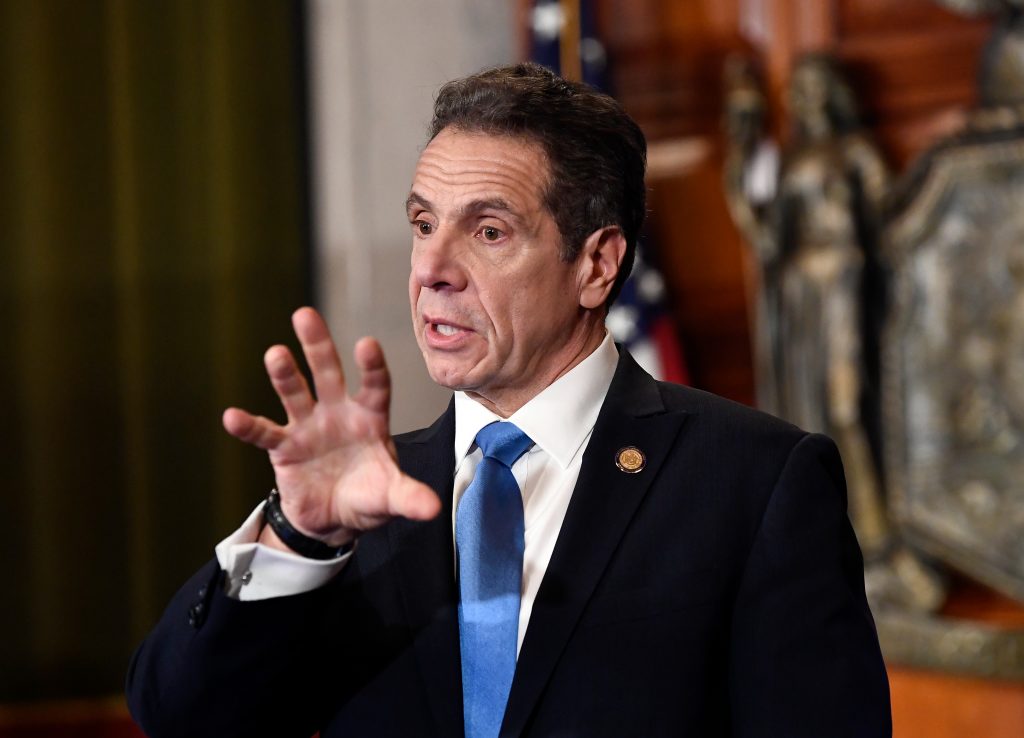
New York State‘s new OSB regime would be so confusing that the government has felt obliged to issue a 10-page FAQ. Credit Suisse analyst Ben Chaiken offered a few key takeaways and our first impression is that the Cuomo administration has Blown It yet again, fostering an anti-competitive atmosphere. Rather than competing for the Empire State’s two OSB platform-provider licenses ($25 million apiece), two ostensible competitors could pool $50 million for the exclusive rights. If a third provider is added to the bid (where did they come from?), the tab rises to $75 million. Thus, FanDuel and DraftKings, who have played monopolistic footsie in the past, could collude to keep the two provider licenses for themselves (and DraftKings already has Gov. Andrew Cuomo [D] in its pocket). The winning providers can then award themselves their own skins. Nah, nothing sleazy about that.
“All qualified platform providers and operators” can bid for the skins. This is better. Basically it means that regardless of who has a preexisting relationship or doesn’t—or who isn’t even in the state yet—there will be a level playing field. Chaiken: “This clarification is basically saying anyone without access … can apply and previous market access relationships will be a non-factor.” Of course, a FanDuel could apply for platform and skin alike, whereas it would be more equitable to make it an even/or proposition, given the limited opportunities to participate. Also, OSB providers can apply independently and together, further muddying the waters. As for taxation, the state says, “The tax rate will be determined by the highest rate bid by an Applicant based on the rate provided for the number of providers awarded.” In other words, providers get to dictate the taxes they will pay and can even collude by looking at what each other proposes. Cuomo has really set himself up to get rooked. You know how a camel is a horse designed by a committee? What we have here is a camel.
Parx Casino is under fire from animal-rights activists. Of 1,400 racehorse deaths in the past 11 years, more than 700 are alleged to have occurred at Parx alone (appalling if accurate). That would make Parx a mighty deadly place to race. Now that it has casino gambling—which grossed $50 million last month—Parx could certainly get by without racing. Rather casino winnings, as we have long maintained, are being used to prop up the horse racing industry on its wobbly fetlocks. Pennsylvania Gov. Tom Wolf (D) wants to defund the horsey set in favor of college scholarships. We agree. Let’s see how far he gets with it.

Jottings: There’s finally a reprieve for Main Street Station. According to Boyd Gaming, it will probably reopen sometime in the second half of the year, when the Hawaii trade is expected to return to Sin City …Despite having put in the high bid for a Richmond casino ($650 million) Bally’s Corp.—profiled here—has been turned down, in its first major setback. It now comes down to Urban One vs. Cordish Cos. in a race that’s too close to call. Cordish has the longer track record, Urban One the home-field advantage … There’s a second bidder for Crown Resorts. In a $2.3 billion tender, Oaktree Capital Management is making a play for James Packer‘s shares … It’s all over for the Eastern Band of Cherokee Indians. The lawsuit to thwart a Catawba Tribe casino at King’s Mountain has been rejected by a federal court … The Caesars Entertainment takeover of William Hill US has closed. When the music stopped playing William Hill President Joe Asher was left without a chair … Airline travel is forecast to reach 96% of pre-Covid levels by year’s end. A good thing, too, as airline debt has ballooned to $651 billion. The International Air Travel Association is predicting nearly $48 billion in global losses by airlines this year. Said IATA Executive Director Willie Walsh, “This crisis is longer and deeper than anyone could have expected.” Cargo flights are recovering faster than passenger ones. Adds IATA CEO Alexandre de Juniac, “Government aid is helping to keep the industry afloat. The next challenge will be preventing airlines from sinking under the burden of debt that the aid is creating” … In a promising development for newly LEED-certified MGM Springfield, the casino is staffing up for the summer. So is MGM Northfield Park in Ohio … Big-ticket shows are finally reopening in Las Vegas. Blue Man Group moves to Luxor June 24 and while O splashes down July 1.
