

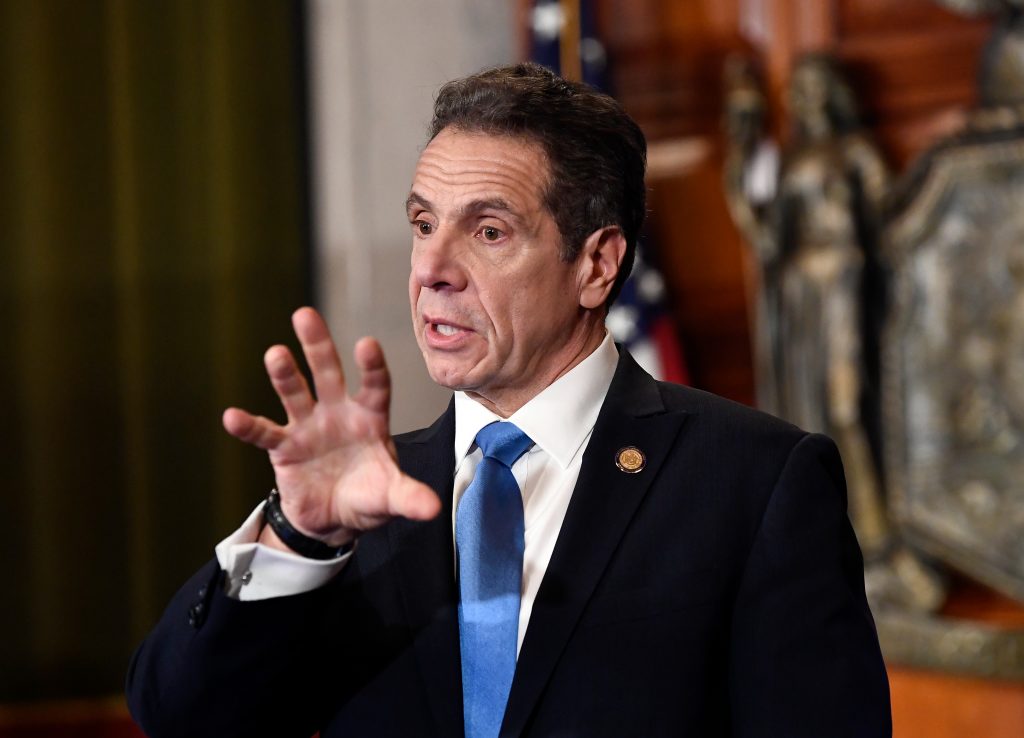
Rather than face (well-deserved) impeachment, New York State Gov. Andrew Cuomo (D) resigned in disgrace today. Which happened to coincide with the disclosure of the companies which have applied to be online sports betting provider(s) for the Empire State. Cuomo’s not-a-moment-t00-soon departure means that the contenders can hope not to be shaken down or chosen on the basis of how usuriously they are willing to be taxed (isn’t that tantamount to bribe solicitation, guv?). And Cuomo’s obvious favorite, DraftKings, now faces a level playing field. At least that is our hope. The finalists will be Bet365, Penn National Gaming/Kambi, FanDuel/BetMGM/DraftKings, TSG/FoxBet, TheScore and a jumbled combination of Kambi/Caesars Entertainment/Resorts World/PointsBet/WynnBet/Rush Street Interactive. DraftKings still has a very good chance of getting one of the plums, if for no other than reason than it’s riding the coattails of MGM and favorite son Empire City Yonkers. The second Kambi combination platter also has an edge since it contains two other New York brick-and-mortar operators, Rush Street and Resorts World.
“We expect to learn of the winning consortiums, and we believe two will be chosen, in the next 4-6 weeks. Based on the criteria put forth in the RFA, we believe there are obvious front runners from the list, and those for whom the prospects appear dim, based on their track records relative to the RFA selection criteria. That said, it’s New York and anything can happen,” wrote Carlo Santarelli of Deutsche Bank. Yes, anything can happen. Just ask Andrew Cuomo.
On a happier front, Ohio is bursting at the seams with gambling revenue. Casinos won $211 million, 30% higher than 2019 (!). Table play rose 16% and slot coin-in was 33% higher. Deutsche Bank, unfortunately, lumped the four Penn National properties together but they produced a combined gross of $74 million, vaulting 31%, while Belterra Park grossed $9 million for a 22% gain. MGM Northfield Park yielded $25 million, rising 17%, and Scioto Downs rendered unto Caesars $21 million, plus 34% over 2019.
Despite two extra weekend days in July, Missouri casino traffic wasn’t quite so feverish, even though fewer players (-13%) spent more (+33%). The statewide gross of $167.5 million was a 16% improvement on 2019. Alas, no two-year stacks of individual casinos were made available from Deutsche Bank and we’ve misplaced our green eyeshade, so we’ll just have to look at the big picture and say that it looks pretty darn good and hope to update you later this week.

Scientific Games reported better-than-expected numbers from 2Q21, while continuing the process of dumping its lottery and sports betting units. It also shaved $147 million off its leverage, leaving it a worrisome $9.1 billion in arrears. Nonetheless JP Morgan analyst Joseph Greff boosted his $50/share price target to $69. He wrote, “While SGMS’s Digital/SciPlay businesses have benefitted from COVID-19, and the Gaming segment should be levered to a recovery, with Lottery stable, we believe that at the current ~$68 level, this is already well reflected in the stock. Similarly, while we acknowledge there could be upside/optionality related to potential asset sales and the potential divestiture of Lottery and Sports Betting, we remain cautious given the fairly high leverage/debt load.” On the other hand, lottery revenue sales have been up due to cabin fever and record numbers of instant-game sales. Why on earth is Scientific unloading the segment of the business?
Ben Chaiken of Credit Suisse had the answer, leading with the observation that Scientific’s strength lay in lotteries. “However street estimates seem to capture this upside, and there is risk of some deceleration over time, in our view. There is no question results have outperformed expectations in this segment, but there also seems to be a correlation between Lottery results and COVID (i.e., strength in lottery as the world shut down), suggesting that as trends normalize some of the growth could contract to pre-COVID levels.” In other words, if you’re going to sell your lottery division, do it now while it’s at maximum value. OK. “In our view, secular trends are moving against SGMS sports betting tech in its current form, unless they are to find a singular buyer looking to vertically integrate. This is entirely possible, however it’s not obvious to us how many buyers there would be as CZR, MGM, Bally, DKNG, PENN all have in-house tech options. With that said, FanDuel is already using SGMS’ tech, and LVS has indicated interest in B2B aspect sports betting.” Hmmm … Las Vegas Sands buying Scientific’s sports-betting division? Plausible as well as intriguing. Is Rob Goldstein reading Chaiken’s reports?
On the good news/bad news front, Chaiken said that 90% of Scientific’s deployed slot machines are back in play—but they could lose floor space to expanded sports betting operations. We’re hearing that a lot and not just about SGMS. Still, according to Santarelli, slot sales beat forecasts, as strong casino comebacks in the U.S. compensated for “weakness” overseas. Even so, internal cost cuts are coming: $150 million over the next year. As for the lottery/sports betting spinoff, “Though no timeline has yet been provided, management did say they are very encouraged by the interest for both businesses, and the pace at which multiple discussions are happening.” Evidently Scientific execs think the digital business will be as big as retail in a very short time, hence their decision to repurpose the company, at least in part.
A quick resolution of the divestiture is expected by Truist Securities analyst Barry Jonas, who noted that Scientific “handily” outperformed and that its leverage was “reasonable.” His price target? A lofty $90/share. After all, adjusted cash flow ($383 million) was the highest in Scientific history. The only segment in which SGMS didn’t over perform was social gaming and even that was in line with expectations. “In addition, SGMS recently launched a Las Vegas iGaming studio that will focus on developing games from SGMS’s land-based franchises.” The sports betting segment will only get more lucrative as it is now in 12 states and several more coming. Unlike lottery, the sports betting division only looks to get increasingly valuable, which again raises the question of “Why?” as well as “Why now?”

Also meeting with approbation from The Street was Golden Entertainment. “The beat was very straightforward, with revenue and margins, in every segment, nicely ahead of forecasts,” wrote Santarelli. Net revenue was $292.5 million, $50 million ahead of analysts’ expectations and cash flow of $91 million beat The Street by $28 million. The Deutsche Bank analyst gave Golden’s Nevada slot routes and casinos most of the credit: “We continue to believe the Las Vegas locals market, driven by the child tax credits and enhanced unemployment benefits, population growth, and operator disciplines around promotions and marketing, in a tight market, has longer legs than most regional markets, as it pertains to the longevity of the outperformance currently being experienced.” The Strat, for instance, doubled first-quarter cash flow, despite being at only 70% occupancy. Why? Customers are spending 30% more than two years ago. “Management noted that weekend occupancy and ADR are now comparable to 2019 levels, while midweek business has been discounted.” Golden has also been able to raise direct bookings (as opposed to ones from costly online travel agencies) from 6% of the mix when they acquired the Stratosphere to 30% now.
Cash flow derived from locals play was up 124% (that’s not a typo) and Golden execs think it could get better still, as not all rated players have come back. Even so, 66 of Golden’s taverns outperformed and the company further benefited from a $60 million payment from Caesars, compensation for the loss of the William Hill brand. (More Caesars-derived scrip may be forthcoming.) The company’s debt-to-cash flow ratio is a reasonable 3X, so dividends are likely to be issued. Santarelli was inspired to raise his price target from $42/share to $56. Not a bad day’s work.
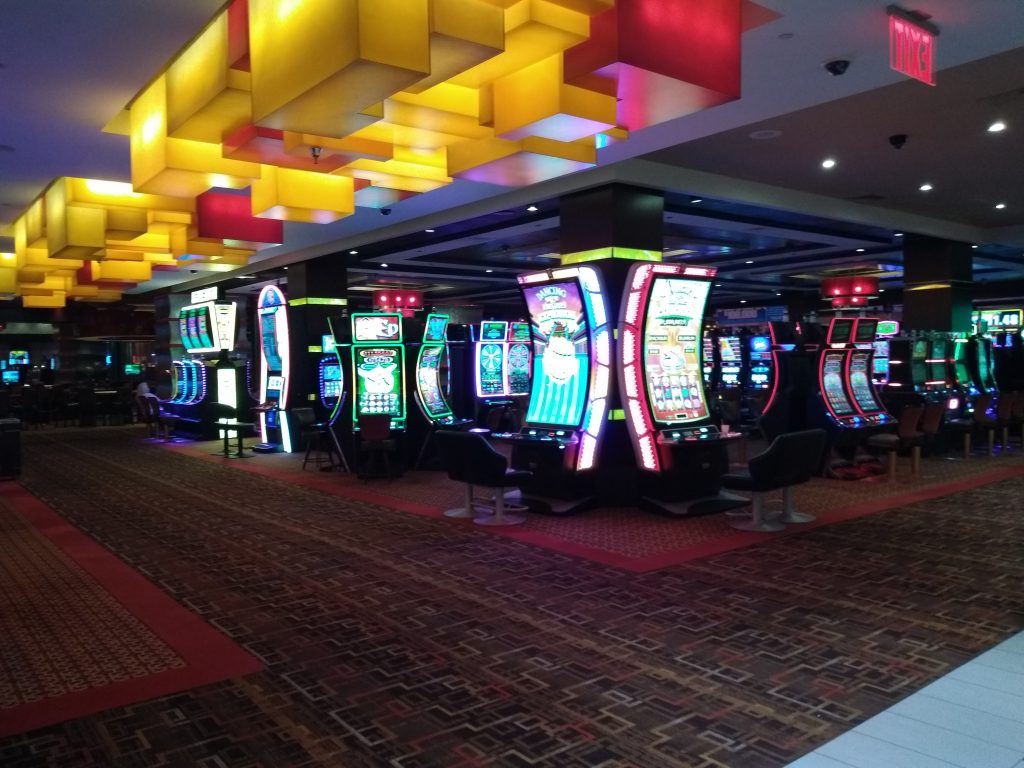
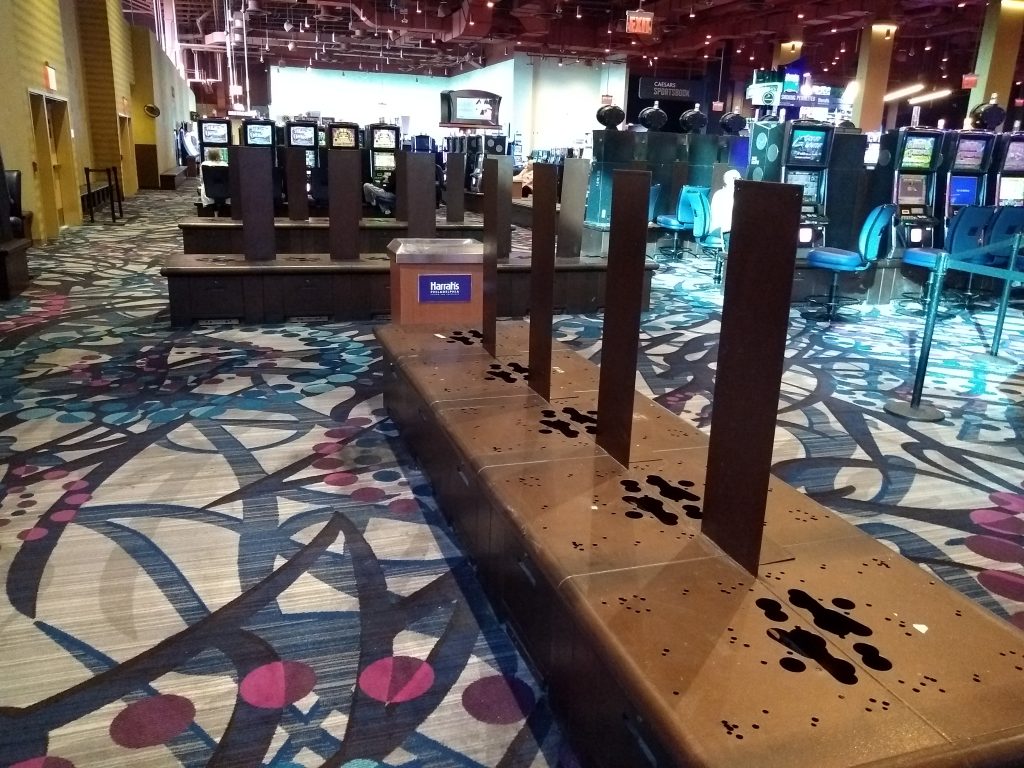
“Atlantic City is booming!” bellowed the cover story in an industry trade publication. If your name is Borgata or Hard Rock Atlantic City or Ocean Casino Resort, it sure is. The numbers prove it. Everybody else … not so much. For instance, above you see the scene on the Golden Nugget‘s slot floor yesterday. Nary a soul in sight. Tilman Fertitta sure could use that $1.6 billion in DraftKings buyout money if business continues like this. Where were the players? Definitely not at Harrah’s Philadelphia. Below you see the spectators for a race on Sunday:

“Maybe they were social distancing to another casino,” speculates our Atlantic City bureau. “Their signs say ‘pardon our dust.’ Shame they can’t afford a vacuum cleaner to clean up the mess. You were certainly right they removed a lot of old slot machines, including the only one-half cent machine that I ever saw. But the. good news, there are still plenty of old machines still there.”:
Quote of the Day: “But the state never had any intention of adhering to such constitutional niceties, which should come as no surprise. The last legislative session was an orgy of unconstitutional lawmaking, much of which has already been halted or overturned by the courts.”—the Orlando Sun Sentinel, in a withering denunciation of the Interior Department’s “cop out” on Florida‘s sports betting deal with the Seminole Tribe.
