

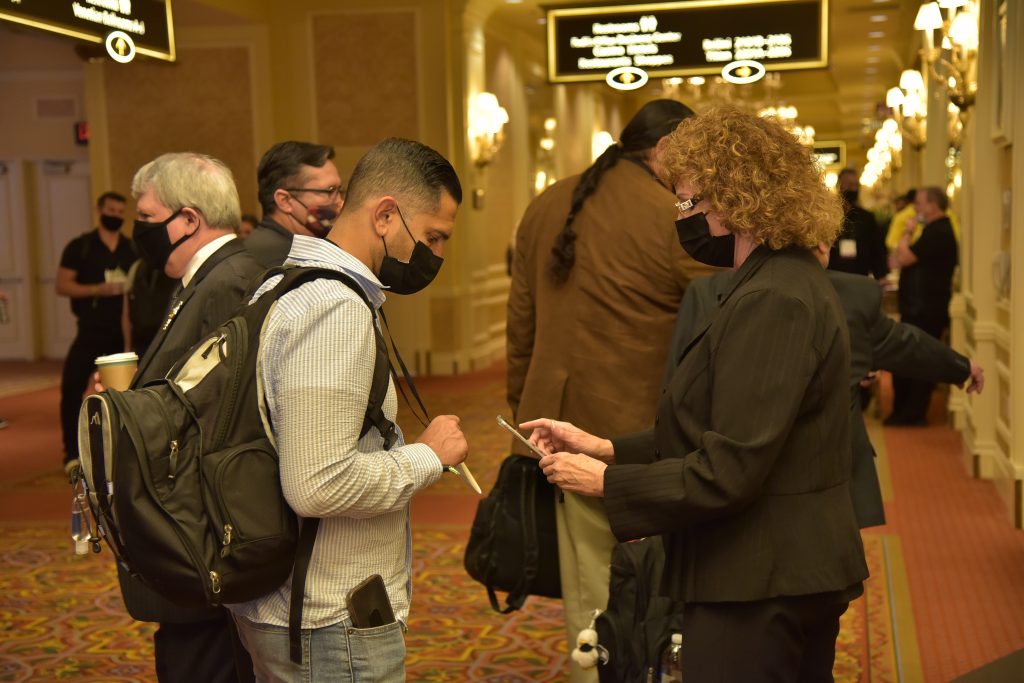
Exhibitors are folding their tents and weary journalists are packing it in as another Global Gaming Expo draws to a close, having kicked off inauspiciously with an anti-vaccine riot by “Covidiots” at The Cosmopolitan of Las Vegas. Looking back on the show, Truist Securities analyst Barry Jonas reported that attendance was less than 50% of previous expos (the absence of the international cohort didn’t help). Still, he saw enthusiasm, particularly from Las Vegas hoteliers, whose rooms and gambling floors were “packed.” Manufacturers had cause for optimism, too, as upward trends in gross gaming revenue gave them hope that casinos would loosen their purse strings and buy new machines next year. Interest in interactive gaming was described as a “feeding frenzy.” Revenue comparisons will get tougher next year, Jonas continued, and labor continues to be an issue (which we note is largely one of management’s own making). Also, promotional spending on sports betting is “unsustainable” and “leading to questions about a shakeout and more consolidation.”
In terms of gaming technology there were “no showstoppers” or great innovations but lots of “solid content,” with Everi, AGS, International Game Technology and Scientific Games given nods but, with the exception of Aristocrat‘s widely hailed Dune game, branded slots were notable by their absence “probably a good thing given the sizable expense and uncertain ROI.” Unlike Deutsche Bank‘s Carlo Santarelli, Jonas didn’t think Scientific’s pending spinoff of its lottery betokened similar action by IGT (for whom lotteries are bread and butter), despite IGT’s Italian lottery have taken a walloping recently. “Cashless” was the buzzword of the show, with many potential applications being hawked. (Fruition seems a ways off.) Out front was Everi, especially as it has a money-transmitting license, meaning that for IGT and Scientific all roads will probably run through Everi.
The slot floor of the future is likely to be a smaller one. Jonas sees slot managers using Covid-19 social distancing as an excuse to limit inventory. “Operators are eliminating and not replacing their worse performing games, while driving higher utilization on remaining machines.” Such demand as exists may be even further hampered by issues with the supply chain, another Coronavirus legacy. “Manufacturers have effectively had to reverse any lean manufacturing strategies and load up on what components they can get, often at significantly higher prices (not to mention materially higher shipping costs),” Jonas reported.
Like Jonas, our ears glazed over with the omnipresence of the world “omnichannel.” I-gaming was a hot topic, Jonas thinks, because it’s easier to integrate vertically with existing casino operations than is sports betting. (We would add that the potential revenue ceiling is significantly higher.) As for sports wagering itself, some are starting to suggest that profitability will remain out of reach until the market consolidates or some participants go belly-up, in part due to the aforementioned promotional wars. (How many billions can DraftKings burn through before we’re talking real money?) Speaking of DraftKings, its $22 billion Entain play could simply be a way of staving off the inevitable by acquiring Entain’s sizable offshore cash stream. MGM Resorts International CEO Bill Hornbuckle went so far as to threaten DraftKings with a poison pill (BetMGM being half-owned by Entain) that could enjoin DKNG from operating in the U.S.
Among the companies taking a go-slow approach to sports betting is Penn National Gaming, unwilling to lose large amounts of money to build its brand. Jonas: “Our meeting drove home their longer-term, measured approach which is underscored by the strength of the Barstool brand and database” Caesars Entertainment is spending big but says it is exceeding its initial targets and believes its Caesars Rewards can morph punters into brick-and-mortar casino players en masse. And if you want to talk “ominichannel,” there was Bally’s Gaming, which has diversified into an owner of sports leagues, among other things, and whose brand is inescapable across regional sports networks. “A more robust Bally Bet 2.0 sports betting product should be fully up and running by football season next year, while an iGaming offering in [New Jersey] should come out sooner (submitted to regulators by year-end) and we think could surprise investors to the upside,” Jonas forecast.
Caesars having already tipped its 3Q21 hand, other companies (Penn National, Monarch Casinos and Bally’s) are reporting continued strength, too. Penn “noted some softness in August meaningfully bouncing back into September and early October. For Vegas, despite international and midweek group still lagging, the Strip was crowded during our stay and [Caesars] noted 85% midweek occupancies (at their self-imposed ceiling for now).” Group business next year remains something of a question mark. The main concern, however, was labor shortages and consequent upward pressure on wages. Their concerns are allayed by Covid-induced cost savings and, with perhaps untoward glee, the news that “the Delta surge has reduced the competitive threats of alternative entertainment options, for now.”
Politicians, incidentally, found a way to fit G2E into their schedule. Rep. Dina Titus (D) did it the right way, focusing on nuts-and-bolts issues in a low-key discussion with American Gaming Association President Bill Miller. Then there was Gov. Steve Sisolak (D), whose self-serving oration sounded more like the kickoff of his reelection campaign, perhaps not the best choice when playing to an audience for whom you’re The Man Who Closed The Doors (albeit rightly so).

The Nevada Governor saved human lives, continues to save them, and he continues to follow the science… For this brave, ethical, and honest service, he gets daily death threats and gets treated like he is a interloper. Just imagine what it would look like if a Covid denier was Governor of Nevada, casino management has to ask itself that question, would they be currently swimming in high profits and low costs, I highly doubt it. Here in California we have the lowest Covid transmission rates in the entire country, yet our Governor had to fight a recall. Imagine if Greg Abbott, Governor of Texas, was the Nevada Governor. Be thankful Nevada has a man in charge who cares if you and your family survive a disease that slowly suffocates you, unfortunately that is where we find ourselves…