

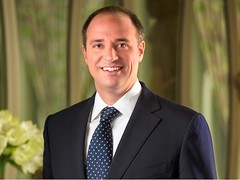
Headlines are still being made by Wynn Resorts this week. Shockwaves continue to reverberate from CEO Matt Maddox‘s surprise retirement, nearly one year ahead of schedule. His departure comes at a delicate point in negotiations with Macao (or should we say ‘dictations’?), where Maddox has been a key player. Also, it has been revealed that he was thoroughly investigated in 2020 by the board over an anonymously filed allegation of misconduct, phoned in over an employee hotline. Had Maddox failed to divorce himself from the boys-will-be-boys culture of Steve Wynn? We’ll never know and he seems to have been cleared of the charge. But still “It’s all very curious,” as Jefferies analyst David Katz said.
In other news, Wynn Resorts’ retrenchment on the i-gaming and online sports betting front began taking concrete shape. In a curt SEC filing, Wynn let it be known that a merger of Wynn Interactive with special acquisition company Austerlitz I is kaput. “While somewhat surprising, the tea leaves were present in the days leading up to the announcement … and WYNN announced that it was pivoting its strategy in sports betting and iCasino, given the irrational customer acquisition behavior they see taking place in the market,” wrote Deutsche Bank analyst Carlo Santarelli. “WYNN noted that it expected 4Q21 losses from the iGaming segment to be considerable ($103 mm 3Q21 loss), and we imagine, 4Q21 losses will exceed those experienced in the 3Q21, given programming of marketing and the busier NFL season.” Santarelli concluded that termination of the JV “could be construed favorably.” Especially for Craig Billings, CEO of Wynn Interactive, who wouldn’t have much to do were he not moving up to the top job at Wynn.
Such approbation was not the case with JP Morgan analyst Joseph Greff, whose price target for WYNN was shorn to $93/share (from $101) on the news. That being said, Greff remarked that the termination “isn’t entirely surprising” given Maddox and CFO Billings’ negative views on the current state of the digital sphere. He seemed more concerned with “the challenges associated with Macau uncertainty and lack of visibility related to travel mobility and regulatory considerations.” As well Wall Street should be.

In other news from The Street, under pressure from what he called “character assassination” for his negative views on Penn National Gaming, Santarelli backed off his “Sell” rating. However, he did so while firing off a fusillade of criticisms of what he views as an overrated company. “It is what we thought it was,” was his defiant headline, He reflected that his earlier downgrade was motivated by the belief that Penn “we felt would ultimately prove to be a victim of its prior success,” in part by wildly optimistic management beliefs in efficacy of OSB and i-gaming. “Since this time, PENN has massively underperformed the regional peers,” including Boyd Gaming, Caesars Entertainment, Golden Entertainment and Station Casinos. The growth in Penn’s stock price since the infamous “sell” recommendation has badly lagged that of those other four companies (61%, for instance, to Golden’s 262%).
“Since our downgrade, and after numerous character assassinations, we stuck with our Sell rating, because it was based on fundamentals, and ultimately we felt we were right and over time, the fundamentals would prevail,” Santarelli continued. “In our view, PENN did exactly what it should have done, as it took advantage of the euphoria and illogical optimism and issued ~68 mm shares, increasing the share count by roughly 60% since prior to the pandemic … However, to steal a recent quote from New York Mets President, Sandy Alderson, the stock promotion proved short lived, as the ‘blowhard in a house of cards was unable to keep it together long enough.”
Santarelli assesses Penn as “a strong regional gaming operator, with a solid C-level and operational management team, that was set up poorly from a margin perspective, relative to peers coming out of the pandemic, who overhyped a sports betting story to drive the stock, and made some questionable, at the time, and more highly questionable these days, iGaming related acquisitions, in our view.” He then backhands the company as “just a sideshow, a sideshow to a wildly volatile, incredibly libelous, and misleading social media front man,” undoubtedly a reference to Barstool Sports founder Dave Portnoy, who seems to have been an albatross around Penn’s neck in New York State. Concludes Santarelli, “Net-net, we think this era has been an unfortunate black eye for the gaming industry, and one that we believe most could have seen coming.”

Want some good news? How about Indiana’s October gaming revenues, which soared 20% over 2019’s. Give credit to Hard Rock Gary, driving new business. Without it, casino revs would have been only 8% higher. Sports betting grosses were unexpectedly poorer, down 19% from September to $27 million, depressed by low hold. FanDuel came out best with $9.5 million, then DraftKings ($8 million), BetMGM ($3.5 million), Caesars Sportsbook ($2 million), PointsBet ($1.5 million) and Barstool ($1 million). Getting back to terrestrial play, Hard Rock sped by Horseshoe Hammond (-10%), $32.5 million to $31.5 million—hardly reason for Caesars to abandon ship. Ameristar East Chicago actually managed a 19.5% gain to $21 million, while Blue Chip slipped 2% to $12.5 million.
Heading south, it was mainly Caesars’ show. Indiana Grand jumped 24% to $24 million and Harrah’s Hoosier Downs hopped 21.5% to $19 million. Even tribally owned Caesars Southern Indiana continued to be a player favorite, hitting $22 million for a 25% vault. Best of the rest was Hollywood Lawrenceburg, up 1.5% to $15 million. The lone loser was French Lick Resort, down 8% to $7 million. Belterra Resort was flat at $8 million, whilst Bally’s Evansville grew 13% to $13 million and Rising Star edged up 8% to $4 million, bringing up the rear.
Mickey Mouse is now a racetrack tout: Walt Disney Co. CEO Bob Chapek says the Mouse House must “seriously consider getting into gambling in a bigger way, and ESPN is a perfect platform for this.” He told investors that sports betting is “driven by the consumer, particularly the younger consumer that will replenish the sports fans over time and their desire to have gambling as part of their sports experience.” Chapek was clear on the ‘why’ but not on the ‘how,’ saying that “Gambling does not have the cachet now that it had, say 10 or 20 years ago, and we have some concerns as a company about our ability to get in it without having a brand withdrawal. But I can tell you that given all the research that we’ve done recently, that that is not the case.”
Jottings: Almost Selena, a tribute show to the late Tejana singer is debuting at Philadelphia Live with a bottom ticket price of $25 (not bad). Or you could gamble $2,000 for a ‘free’ turkey. As our East Coast correspondent puts it, “The customer would be the real turkey in that deal” … Jeffrey Soffer is going to have to put the pedal to metal, as he promises a “late 2023” opening of the long-delayed (14 years and counting) debut of Fontainebleau. At least the backing of Koch Investments gives this latest iteration of F-blue some street credibility as far as actually getting done … Poker trumps meetings at Pittsburgh Live. The suburban casino is cannibalizing a banquet facility to create a poker room. It will have seven tables … Just in case American investors were intrigued by Cambodia‘s volatile casino industry, three departments of the U.S. government have issued a joint communiqué warning them off. “The advisory highlights Illicit finance activities and interactions with Cambodian entities involved in the trafficking of people, wildlife and narcotics as the two primary areas of risk exposure for US companies, with casinos … closely linked to both,” reports Inside Asian Gaming. Macanese mobster “Broken Tooth” Koi is among the disreputable characters surfacing within an industry that is growing far faster than the Cambodian government can regulate it.

Hopefully the Fountainebleu will finally open. Mr. Soffer sounds motivated.
I doubt I am the only person who thinks the Koch operation that is finishing the Fontainebleau will never get a gambling license in Nevada, the Gaming Control Board if they value their autonomy will look harshly at the hundreds of millions of dollars Koch has thrown around and attempted to hide. They tried to literally take healthcare away from poor people, using blatant lies designed to gin up fear and division. Gambling licenses are golden, they should be reserved for non-political actors, nobody actively trying to deceive and divide should hold that license in my opinion. Sheldon Adelson did his political sugar daddy act with his own money, Las Vegas Sands correctly stayed on the sidelines… Young people are not going to go stay at a hotel owned by a company that makes bank on dirty fossil fuels, and finances quack sell out scientists who deny climate change…