

Update: The Seminole Tribe has finally, grudgingly stopped taking sports bets, effective yesterday.
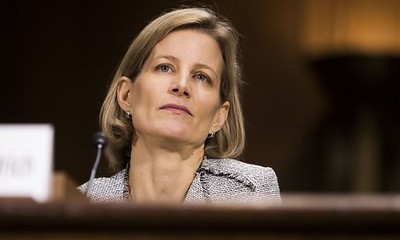
At the risk of using the Seminole Tribe as a punching bag, we have to observe that it clearly doesn’t understanding the meaning of the word “no,” especially when it comes to online sports betting. Judge Dabney Friedrich (pictured) ruled that the Seminoles couldn’t have OSB. But they kept taking bets. Then Judge Friedrich nixed their request for a stay. And they kept taking wagers. Now a three-judge panel of the D.C. Circuit Court of Appeals said no, you have to shut it down. And, as far as we know, the Seminoles are still accepting bets. The only commitment Seminole mealy-mouthpiece Gary Bitner would make is “The Seminole Tribe is aware of today’s Appeals Court decision and is carefully considering the steps it will take as a result,” which probably include continued defiance. Which raises the question, if the Seminoles won’t abide by the Indian Gaming Regulatory Act (at least when it’s not to their convenience) why in the bloody blue blazes should anyone else?
Pundits at the SBC Summit North America, taking place at the Meadowlands (a hub of sports betting) do not seem to have been amused by the Seminoles’ antics. Attorney Daniel Wallach asked, “Why would you place your license on the line when a federal judge has unambiguously concluded that these activities are in violation of federal law?” Indeed, the Seminoles admitted that some vendors were backing away from their renegade sports book, causing “an immediate chilling effect.” As indeed there should be.
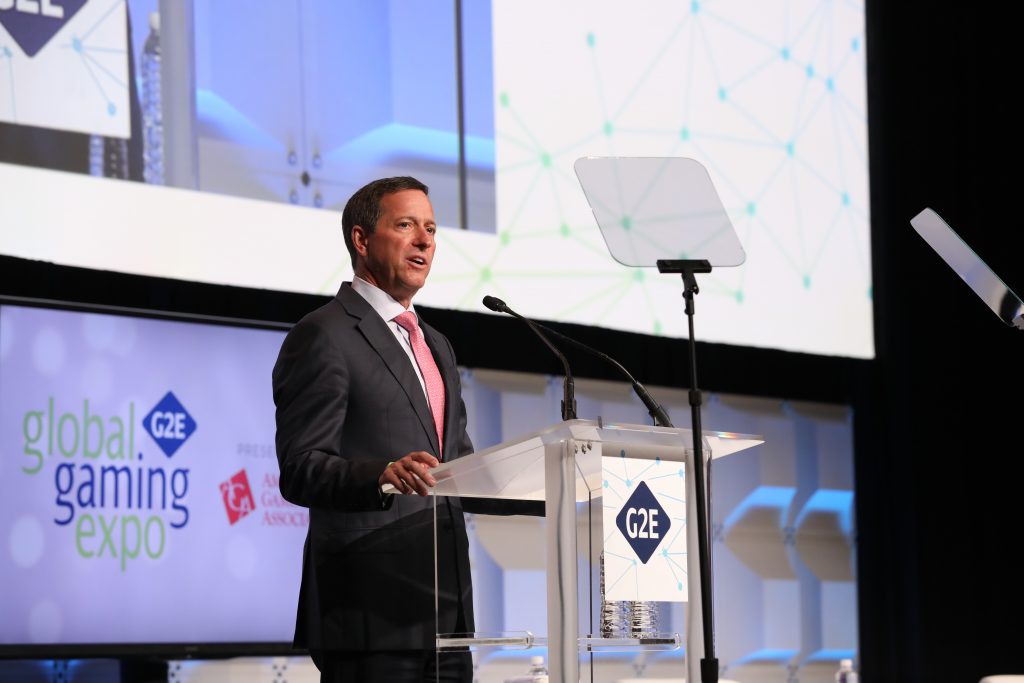
Whilst on the topic of sports betting, the SBC Summit got into the topic of sports-betting advertisements, a real hot-button issue. Compared to the heyday of daily fantasy sports, what you see during an average NFL game isn’t that hard to stomach. But the overall extent of wagering ads is causing concern for some in the gaming industry. American Gaming Association President Bill Miller (pictured) went so far as to call the current marketing wars “an unsustainable arms race.” And, to paraphrase LBJ, when you’ve lost Miller, you’ve lost Middle America. “Is it annoying?” he asked. “Is it too much? It is an unsustainable thing.” Big Gaming certainly wants to avoid regulatory intervention, this much is clear, lest something like the United Kingdom‘s “whistle-to-whistle” ban on advertising be imposed or worse.
When someone as long-versed in sports betting as International Game Technology‘s Joe Asher feels there is “a backlash on the advertising going on today, and the excessive amount of it going on,” you know the industry is starting to feel fatigued. “It’s not something that lends itself to self-regulation,” he added. “I do worry about when we get to that [intervention] phase.” Even a company as high profile as Caesars Entertainment conceded, “It’s not about shouting at people: ‘Free money! Free money! Free money!’ That’s what wears people down.” DraftKings‘ Johnny Avello was predictably unrepentant, however: “I was at the terminal in Hoboken yesterday and I saw DraftKings on every kiosk and every wall. And I think it’s effective. It works.” (For all the money DraftKings spends on marketing, why do its TV spots have such poor production values?) At least Avello took a stand. FanDuel and BetMGM were apparently invited to make their views known but chose to hide under the blankets.
Now that gambling is as American as apple pie, Mom and Old Glory, why not have casinos anchoring shopping malls in place of where, say, Macy’s used to be? Some are making the case that this is “perfect,” citing the success of Pittsburgh Live at Westmoreland Mall in Pennsylvania. “We’re an anchor tenant. We’re like Nordstrom. We’re like Macy’s. We’re like JCPenney. We bring people to the campus,” said General Manager Sean Sullivan and we’re hard put to disagree with him. Indeed, such decentralized, convenience-oriented gambling may be the future of the industry as opposed to the multi-billion-dollar megaresort.
“That has really been a catalyst for new leasing activities and increased traffic at the mall,” said CBL Properties spokeswoman Stacey Keating regarding Pittsburgh Live. “It’s been such a wonderful addition for us and it’s spurred considerable new leasing. We have seen traffic increases of double digits since the casino opened.” That ought to allay the fears of those who argue that casinos will leech business from their surroundings. (Limiting amenities would help.) CBL loves the idea so much it’s hosting Hollywood York, too, another pocket casino. The Keystone State has allotted three of its five satellite casinos already but this seems like an idea that could gain traction elsewhere.

Back when J. Terrence Lanni was steering the course for then-MGM Mirage, a map of the Las Vegas Strip showed sub-MGM Grand land earmarked for “Project Z,” an ambition that never took shape. Now, even though MGM Resorts International CEO Bill Hornbuckle says “We have enough Las Vegas,” CFO Jonathan Halkyard (pictured) effectively responds, “No, we don’t.” In an address to Morgan Stanley’s Virtual Global Consumer & Retail Conference he mooted the possibility of yet another south-Strip megaresort, saying that’s where the critical mass is. “That’s our neighborhood down toward New York-New York, Excalibur, Mandalay Bay and Luxor, MGM Grand, and Park MGM. The reality is—and not many people appreciate this—that there’s a substantial opportunity for our company to do additional development in that area,” the CFO explained.
He added, “There’s seven acres in front of the Excalibur. That’s equal to the entire footprint of The Cosmopolitan. I’m not suggesting we’re going to build a 3,000-room tower there, but that’s a significant development opportunity potentially.” (Anything that obscures Excalibur is fine by us.) Or pedestrian access to the Green Monster could be improved. Or maybe both. Or maybe not. Halkyard said the Cosmo buy was “the most allocation of capital we’ll be making in this market.” As for Omicron (which the National Review‘s Jim Geraghty likens to the name of a Transformers villain), Halkyard was at pains to ease fears. “It’s not reflected in the current business we’re seeing or in our bookings right now,” he said.
Regarding the sustainability of the present gambling boom, “We’re seeing an elevated level of spend from both rated and unrated players. Much of this is due to our marketing communications and the strength of our brand,” even if Baby Boomers are still slow to return. “I think a counteracting mechanism over the next several months will be the continued return of that demographic, which would more than offset any normalization and spend levels we’re getting from some of those rated and unrated guests,” Halkyard said, adding that he had more confidence in the return of convention business to Las Vegas than he had in the future of Macao. Wow. He also had the nerve to complain about being 4,000 souls short-staffed and never mind that Big Gaming is doing this on purpose, to inflate margins. If you’re running plus-2019 levels of business (by a wide measure) with 30% fewer employees, what makes you think you can offer your guests a quality experience? We’ll wait for an answer … but don’t expect to get one.
Enjoy the Tropicana Las Vegas while yet you can: The Oakland A’s reportedly covet its 30-plus acres for a stadium site. It would be strategic as all get-out, we’ll say that. Also, Scientific Games is over the moon about recent business trends. Having shed sports betting and lotteries, it’s putting its eggs in the i-gaming basket.
Quote of the Day: “Life is wide, limitless. There is no border, no frontier.”—Bruce Lee

I find it very hard to believe that a baseball stadium would replace a casino/resort, at a time casino/resorts are printing money… This could be a ruse, a game, a way to goose Oakland to step in and up it’s outreach. A stadium on the strip would gridlock Las Vegas Blvd, and impact the parking structures at the nearby casinos. Here in Los Angeles/Inglewood the new football stadium complicates parking at Hollywood Park Casino, casino patrons have to show players cards, and pay $20 to park, which the casino will refund you if you play three hours. A time constraint attached to casino gambling is crazy town, people need to be free to exercise personal restraint when gambling, not be hindered by a parking fee. Beware MGM, you own the South Strip (not the land anymore), a baseball stadium will hassle your patrons, who wants traffic jams complicating a simple casino visit. Exactly none of my avid poker playing friends dare go to Hollywood Park Casino on a football Sunday…
Mike, I agree with you about all three stadium sites mooted for the A’s along the Strip. Whether it’s the Trop, behind Bally’s/Paris-LV or on the old Plaza/Alon acreage across from Wynncore, the traffic nightmares would be horrendous. Station has a ginormous amount of land on and around Wild Wild West, although my gut feeling is the Athletics will ultimately go for the donated land in Summerlin. Can’t beat free, right?