


$75 million or else. That’s extortionate Chicago Mayor Lori Lightfoot‘s latest demand of casino applicants. If you win the bid, fork over the cash. Her Dishonor might settle for ‘only’ $40 million on the barrelhead, followed up by a $2 million ransom the subsequent year. So far only Bally’s Corp. has offered upfront money—$25 million—while its rivals want Lightfoot to settle for the city’s cut on the back end. With the Chicago Tribune (Bally’s), waterfront (Rush Street Gaming), and Soldier Field area (Hard Rock International) sites all being blown raspberries by aldermen and public alike, some are even advocating putting McCormick Place back into play.
They won’t have much time. Chicago Casino Committee Chairman Tom Tunney wants a final selection by May, with the goal of having the Illinois Gaming Board sign off on the choice by autumn. In the meantime, Lightfoot has been caught playing footsie with Bally’s, charging it only one application fee for two sites. (Rush Street had to pay twice over.) Lightfoot’s office cited technicalities to justify the favorable treatment while Bally’s Chairman Soo Kim, citing his deep pockets, said, “We paid the fees that were asked. Don’t you think we would have sent another $300,000 if they asked us to?” Certainly—but Kim wasn’t asked, another indication of which way Lightfoot is leaning.

Nevada casino revenue leapt 27% last March, reaching $1.3 billion, a huge improvement on none-too-shabby 2021. The Las Vegas Strip led all jurisdictions with $746 million, a 49% vault, while Downtown improved 22.5% to $86.5 million. The Boulder Strip was flat with $97 million, North Las Vegas nudged +3% to $27 million and Laughlin was up 4% to $50 million. Miscellaneous Clark County chipped in $154 million, a 13% upgrade. A few days back, the Deseret News engaged in some ill-timed gloating about the supposed moral superiority of Utah residents to their sinful Nevada counterparts. So who dropped $23 million in Wendover (+2%) and $18 million in Mesquite (+11%)? We’ve got a pretty good idea and it rhymes with “morons.”
Further north, Reno was up 1% to $60 million while Lake Tahoe hopped 6% to $25.5 million. While we don’t want to pour cold water on the Silver State’s recovery, we note that March was significantly better for tourist markets than locals-driven ones, strong evidence that Nevadans’ play is ‘normalizing,’ albeit at a level most states would consider enviable. On the Strip, slot win jumped 35% to $396 million, on 28% higher coin-in. The house cleaned up at baccarat, winning 147% more than last year, some $126.5 million. All other table games edged up 8% to $224 million in win on 11% higher wagering. Locals lost 36% more ($233 million) at slots but coin-in was just 10% greater than last year, while table game win of $44.5 million was 21.5% on 12.5% more wagering. Strip and Downtown numbers were aided by Reid International Airport numbers that far exceeded last year’s, by some 60%. International travelers—154,104 in number—weren’t a stampede but yet a 799% upsurge from the previous March. Keep ’em coming.
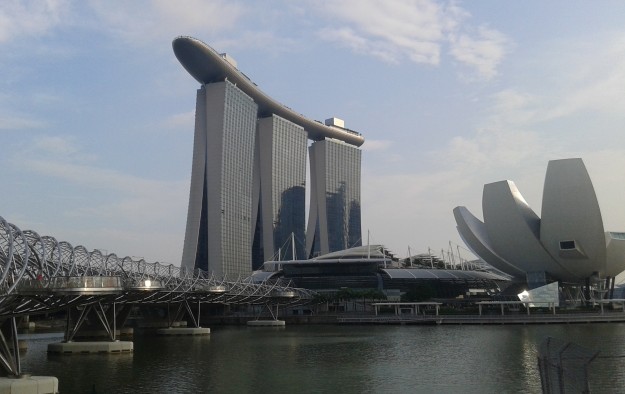
We haven’t heard so much about Marina Bay Sands as today. You’d think Las Vegas Sands executives had nothing else to talk about. Well, they didn’t … not much. Fortunately, the news out of Singapore was nothing but good. The megaresort should offer the best ROI in the Sands portfolio as it’s projected to do $1 billion in cash flow this year. That will require some dramatic acceleration but the property has been tracking sharply upwards in 1Q22, from $17 million in January to $46 million in February and $58 million in March. “Singapore is back and will experience the same post-Covid numbers as the U.S. in my opinion. The question is how fast does it get there? The demand is there and will continue assuming no more surprises from the pandemic,” forecast CEO Rob Goldstein. “Obviously Macao is in a difficult place right now so people will look for other opportunities,” he added, while trying to maintain that “It is all coming back.”
While a billion-dollar capex project in Marina Bay’s three hotel towers continues, the rest of a refurbishment/expansion is on hold as Singapore continues to recover from the pandemic. Goldstein cited to shortages of materiel and labor. At least the city-state has ended such restrictions as requiring outgoing tourists to test negative for Covid-19. (That’s somebody else’s headache now.) Overall, Sands reported a net loss of $478 million, not surprising when one’s Macanese assets are yielding bupkes. “Our results continue to reflect the pandemic’s impact,” Goldstein allowed. “Travel restrictions suppressed visitation in our financial results in both Macao and Singapore.”
Aside from some very good prospects in New York City, Sands executives continue to beat their heads against the walls that are Florida and Texas. In the former the public needs to want more casinos. In the latter, vox populi favors casinos but the conservative lawmakers Sands inexplicably coddles definitely don’t want gambling. Which leaves New York, about which Goldstein offered unhelpful generalities. He did say that it’s go big or go home for Sands, which “limits the opportunities to Texas and New York. We failed in Florida recently but we’re not done with Florida. There are few places we can go to invest the kind of money we want to invest and the kind of returns we want. We’re not going to buy small businesses.” Besides, as COO Patrick Dumont said, “We’re focused very much on building rather than buying. We want to make sure we create a lot of long-term value.”
Stock analysts likewise focused on Singapore. Calling the China/Hong Kong tourist a “drag for the time being,” Credit Suisse analyst Ben Chaiken opined that “Singapore could pick up some play as VIP Chinese players begin to travel and Singapore is viewed as a more attractive market.” Certainly more attractive than Macao, “which seems increasingly difficult to predict (lockdowns etc.), as a result we don’t think there are near-term expectations of a gaming recovery.” Similarly, Deutsche Bank‘s Carlo Santarelli headlined his report that Marina Bay Sands “shows progress as Macau remains stuck in neutral.” Sands, he elaborated, “remains a when, not if, story, for which our rating is more of a risk-reward call … When Macau reopens remains elusive, though bright spots have emerged in Singapore, and we believe the recovery at Marina Bay Sands is likely to serve as a roadmap for the Macau reopening, when it takes hold.”
The latter market was dismissed as “stale,” having missed cash-flow expectations by $98 million. By contrast, Sands closed out strong at Venelazzo, bringing in $75 million of cash flow and net revenue of $228 million in the last 53 days. The company collected $6.25 billion from the sale of Venelazzo but $600 million of that will go to the tax man. (Not every billionaire can be a freeloader like Jeff Bezos.) The company’s nascent digital strategy remains vague, and both leadership and Wall Street are comfortable with that state of affairs. Santarelli, for one, is no longer pretending that Sands isn’t the Mr. Big negotiating with the government of Thailand, although execs offered “little color” on that front. Finally, both Santarelli and Chaiken shaved down their price targets on LVS, with Chaiken removing a dollar per share and Santarelli subtracting seven bucks.

Finally, the Palms Casino Resort reopened—or perhaps was reborn—last night under the new auspices of the San Juan Band of Mission Indians, the first Native American tribe to penetrate the Las Vegas market. Reaction to the renascent property was generally enthusiastic. It should go over particularly well with locals, who had been made to feel unwelcome by previous ownerships. After repeatedly ratcheting down their hiring projections, Palms leadership says they have 1,400 employees … 200 more than their highest aspiration. In many respects, the new-feel Palms is a return to the original vision of creator George Maloof, who came up with the midweek-locals/weekend-Californians hybrid at which most foolishly scoffed and which San Manuel hopes to successfully emulate.
One of those who thinks history can repeat itself is Truist Securities analyst Barry Jonas, who threw some shade on past owner Station Casinos. “San Manuel bought an iconic property at a significant discount to replacement cost,” he noted, adding that Station’s missteps “can likely be improved upon by the Palms’ new and well-respected management team.” Even Boyd Gaming CEO Keith Smith welcomed the new(ish) competition for the adjacent Gold Coast, which has had 782 Palms-free days to run wild. The timing for the reopening could hardly be better, coinciding perfectly with the NFL draft. We’d wish San Manuel luck but have a feeling they won’t be needing it. As casino consultant James Klas put it, “It is certainly better timing than anytime in the past three years and I think the potential is there to catch the wave.”

Was a local Palms player since the place originally opened.. Stations completely ruined the Palms by taking away great free play and lots of inventive promotions..
Looking forward to see what these new owners do.